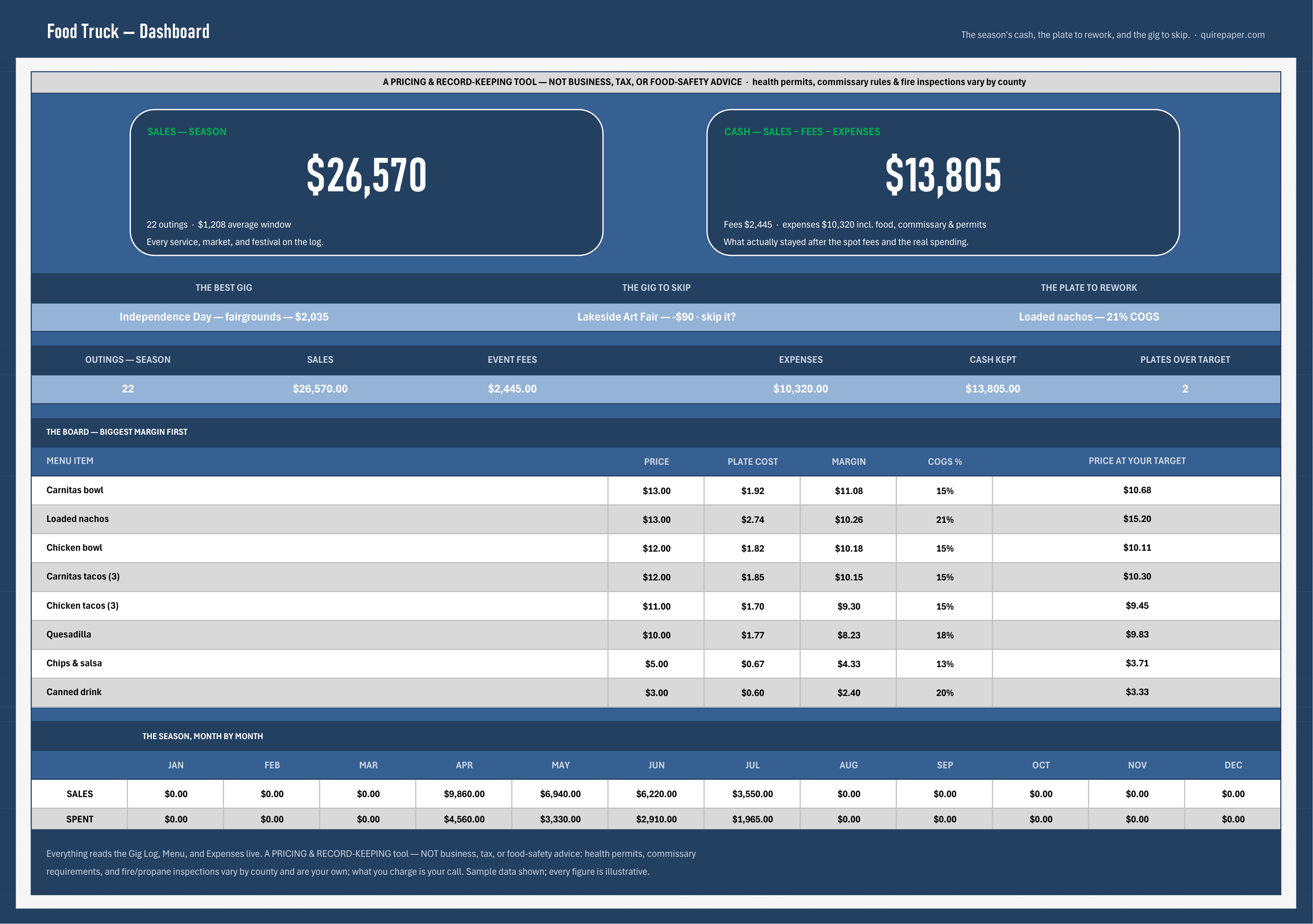
A food truck loses money in two places that never show up in the cash drawer: plates that cost more than their price admits, and gigs whose fees eat the whole day's take. This kit puts both on paper. The COSTING CHAIN prices ingredients the way you buy them (the case, the batch) and costs them the way you serve them (the portion, the tortilla, the scoop). The boat, the bowl, and the fork go on every recipe, because packaging is where truck margins hide. Each menu item shows PLATE COST, MARGIN, and COGS % against your target, red where it needs a rework. The GIG LOG is the truck-specific piece. Every outing records its sales and the fee it cost to be there, and NET OF FEE computes. The sample's art fair cost $400 and sold $310, so it reads −$90 in red, and it won't get booked again by accident. Real spending (food purchases, commissary rent, propane, permits, insurance) lives on its own log, so the season's CASH is sales minus fees minus real purchases, and estimates never double-count. Every formula independently verified. A pricing and record-keeping tool, not business, tax, or food-safety advice. Health permits, commissary requirements, and fire inspections vary by county and are your own.
The festival sold $310.
The pitch fee was $400.
As it opens in Excel or Google Sheets: season sales and real-cash heroes, the verdict strip (the best gig, the gig to skip, the plate to rework), six KPIs, the board ranked by margin, and the season month by month.

Plates, gigs, and cash, chained live.
The case, the batch, the sleeve become cost per portion, tortilla, scoop, or boat. Reprice a protein and the whole board re-reads.
One line per ingredient: protein, tortillas, salsa, the boat, the fork. Plate cost totals itself.
PLATE COST, MARGIN, and COGS % per item against your target. OVER shows in red, with the price that fixes it.
Sales and the fee it cost to be there. NET OF FEE computes, and a money-losing outing reads red.
THE BEST GIG and THE GIG TO SKIP, named. The log remembers so you don't re-book the dud.
CASH = sales − fees − real purchases (commissary, propane, permits). Plate costs are pricing estimates and never double-count.
One-time $16. Every plate costed to the fork, every gig netted against its fee, and the season's real cash, in one workbook for Excel and Google Sheets.
Buy & download instantly
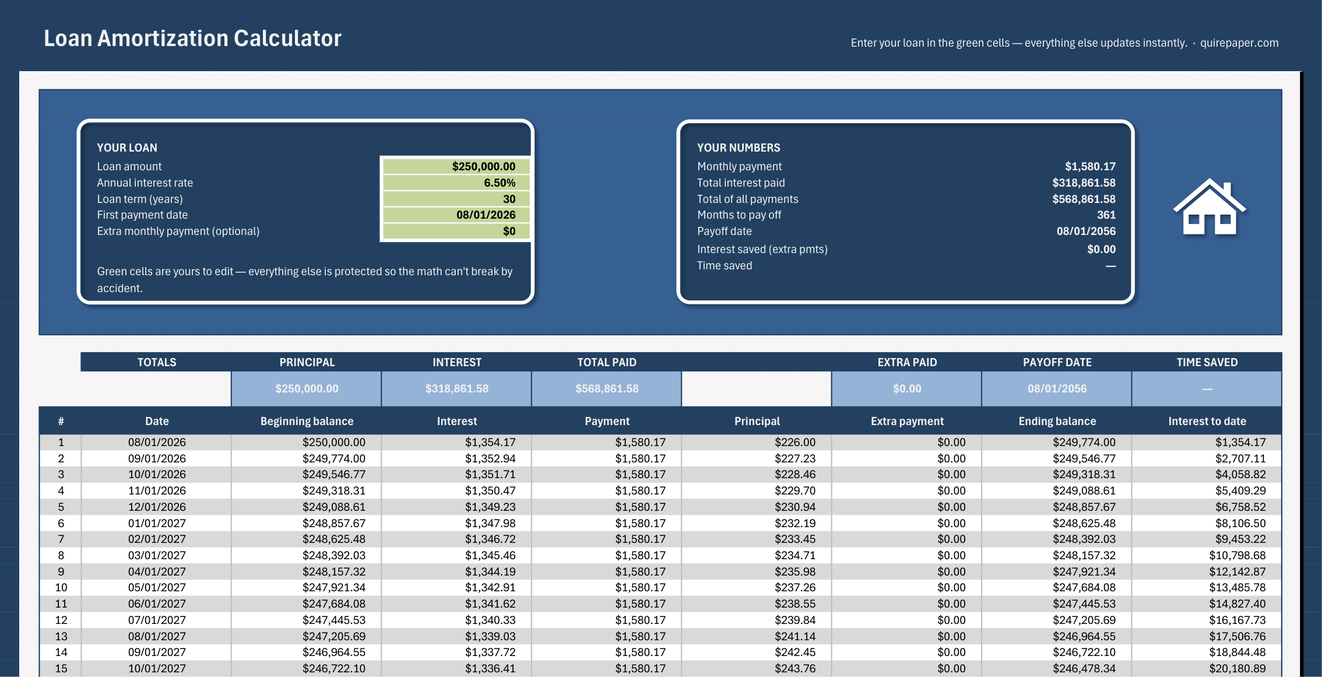
Your payment, your payoff date, and every month in between. It also shows what an extra payment saves you. Works for any fixed-rate loan.

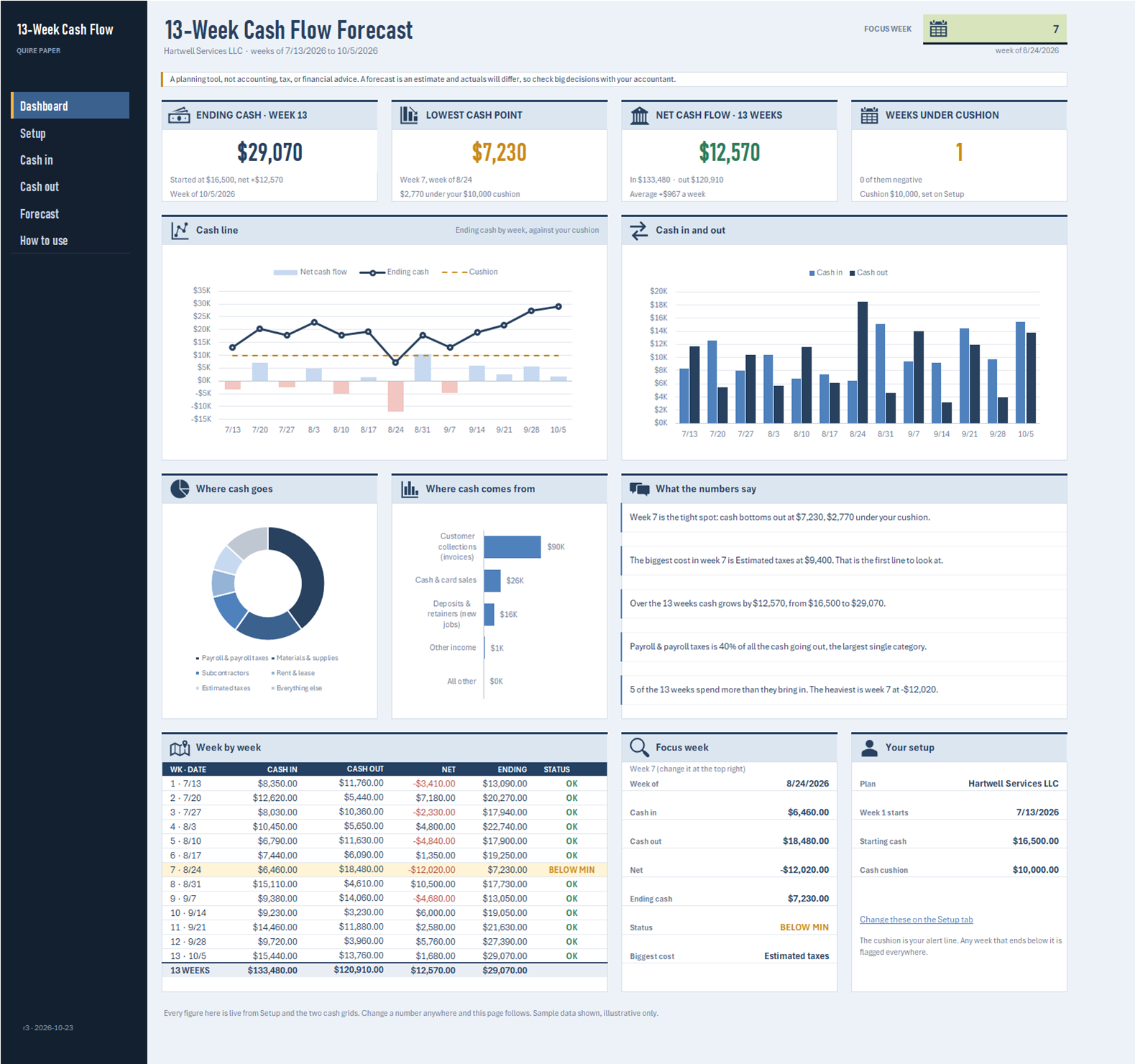
Thirteen weeks of cash in and cash out, rolled into a live ending-cash line, and the week it gets tight flags itself. It opens on a real dashboard: charts, KPI cards, a focus-week dropdown, and plain-English notes the formulas write for you. A menu on every tab gets you around.

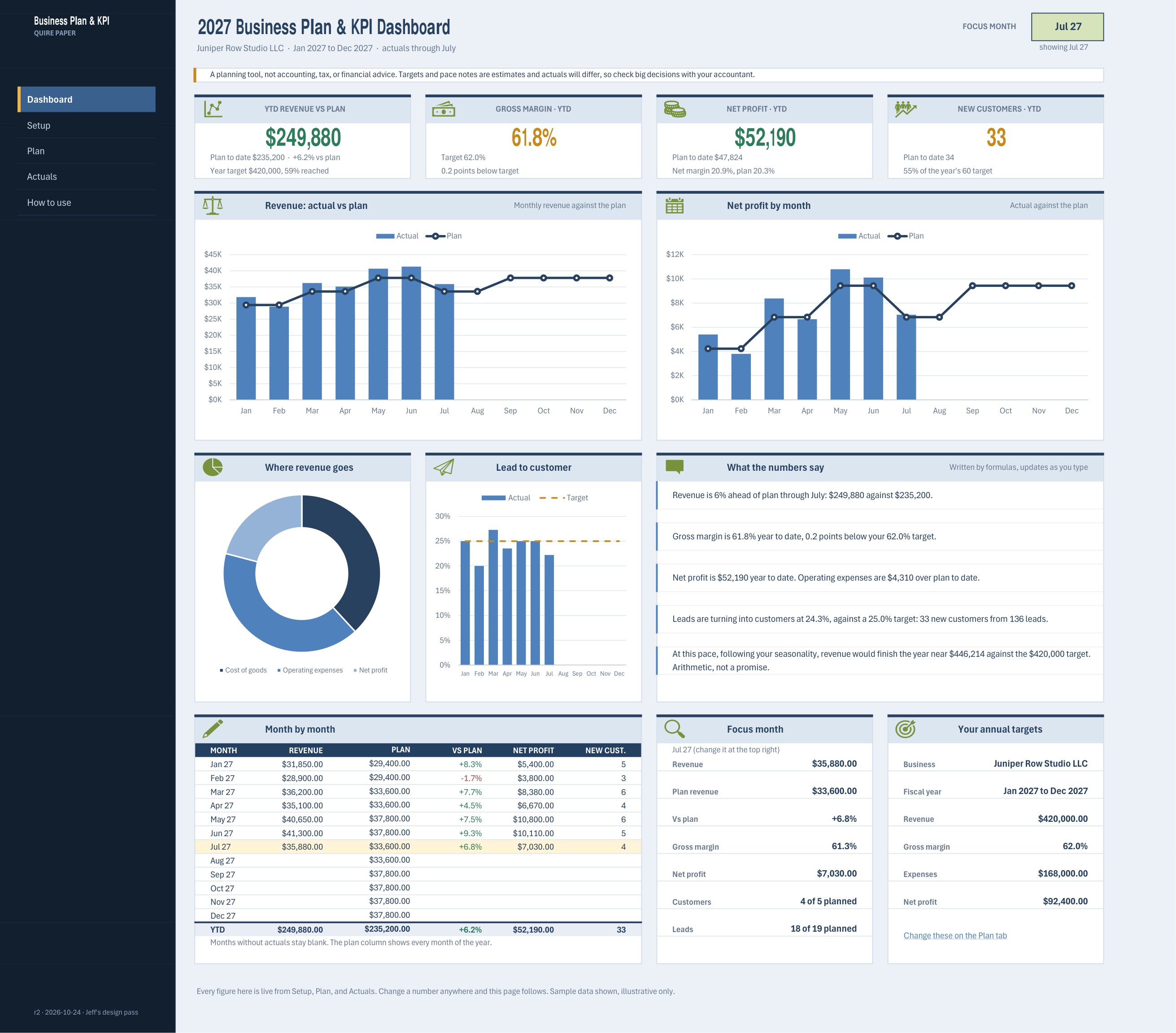
Set the year's targets once, enter each month's numbers, and see revenue, margin, profit, and customers against plan. It opens on a real dashboard with charts, KPI cards, a focus-month dropdown, and plain-English notes the formulas write for you.

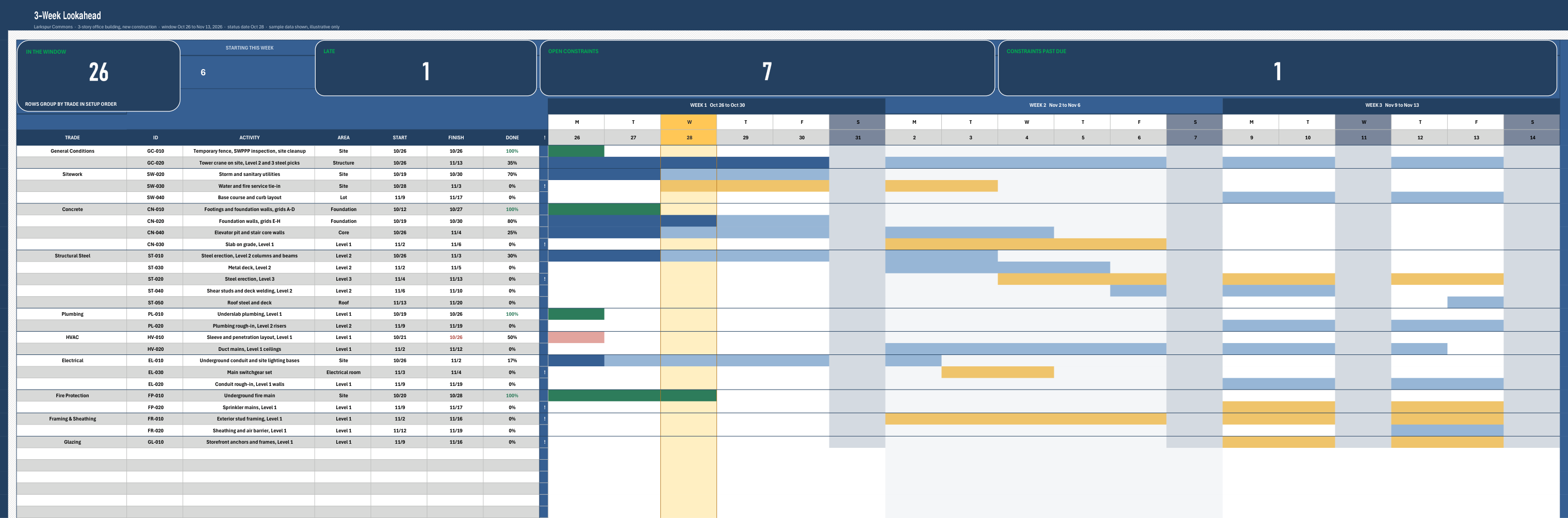
List your activities once and the next three weeks draw themselves: bars by trade, weekends and holidays skipped, a marker on today, and an amber flag on anything waiting on a permit, submittal, or delivery. A constraints log keeps the open items with an owner and a date.

A full year of designed two-minute safety talks: 52 one-page talks, each with a matching sign-in + quiz record sheet, an annual topic calendar, and the delivery method. Every talk now comes as an editable PowerPoint deck and Word sheet, so you can put your company on it.

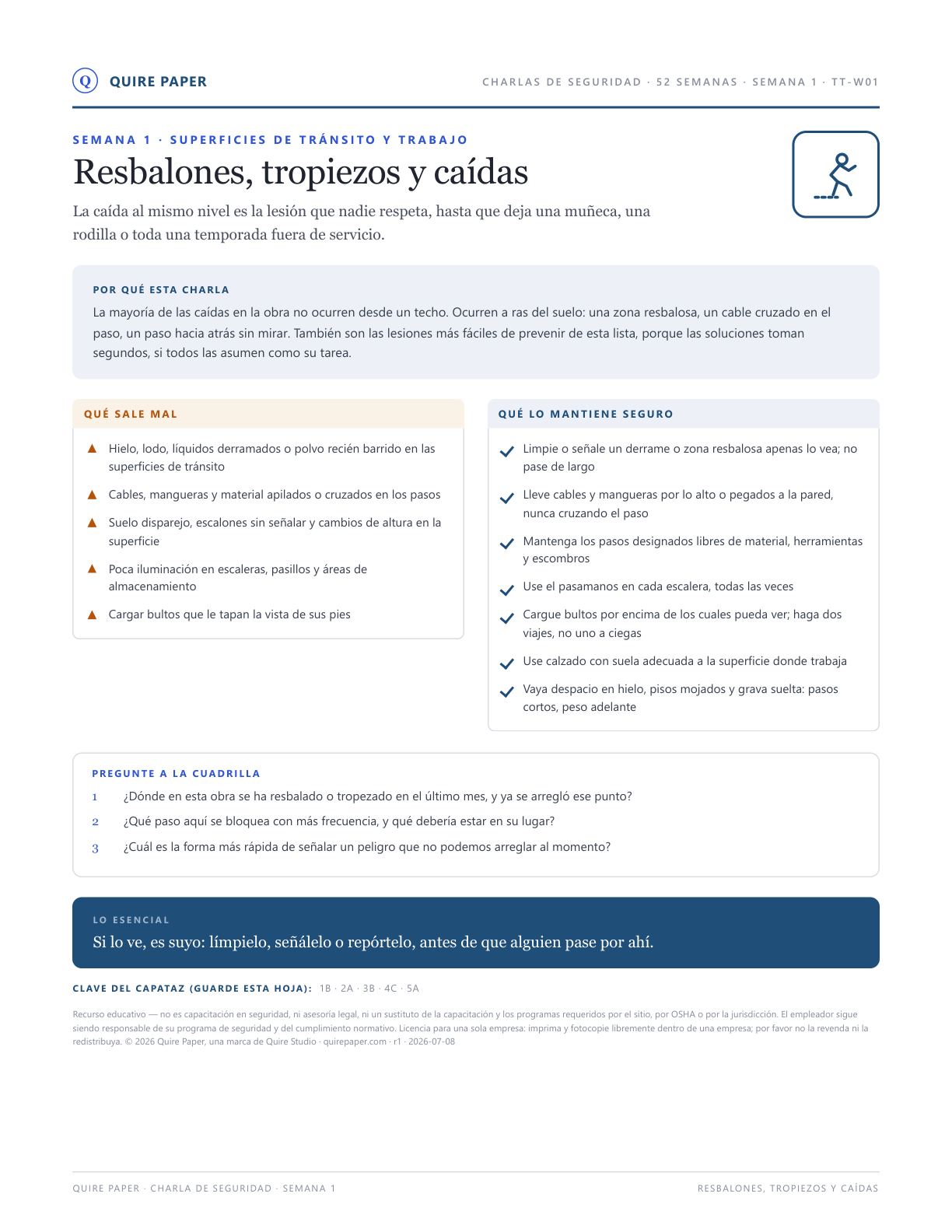
La edición en español de nuestro Sistema de Charlas de Seguridad de 52 Semanas: un año completo de charlas de seguridad de dos minutos para la obra, diseñadas y en español, cada una con su hoja de registro de asistencia y cuestionario, un calendario anual de temas y una guía de aplicación. Para cuadrillas que hacen sus charlas en español. Charlas de seguridad, listas para leer.

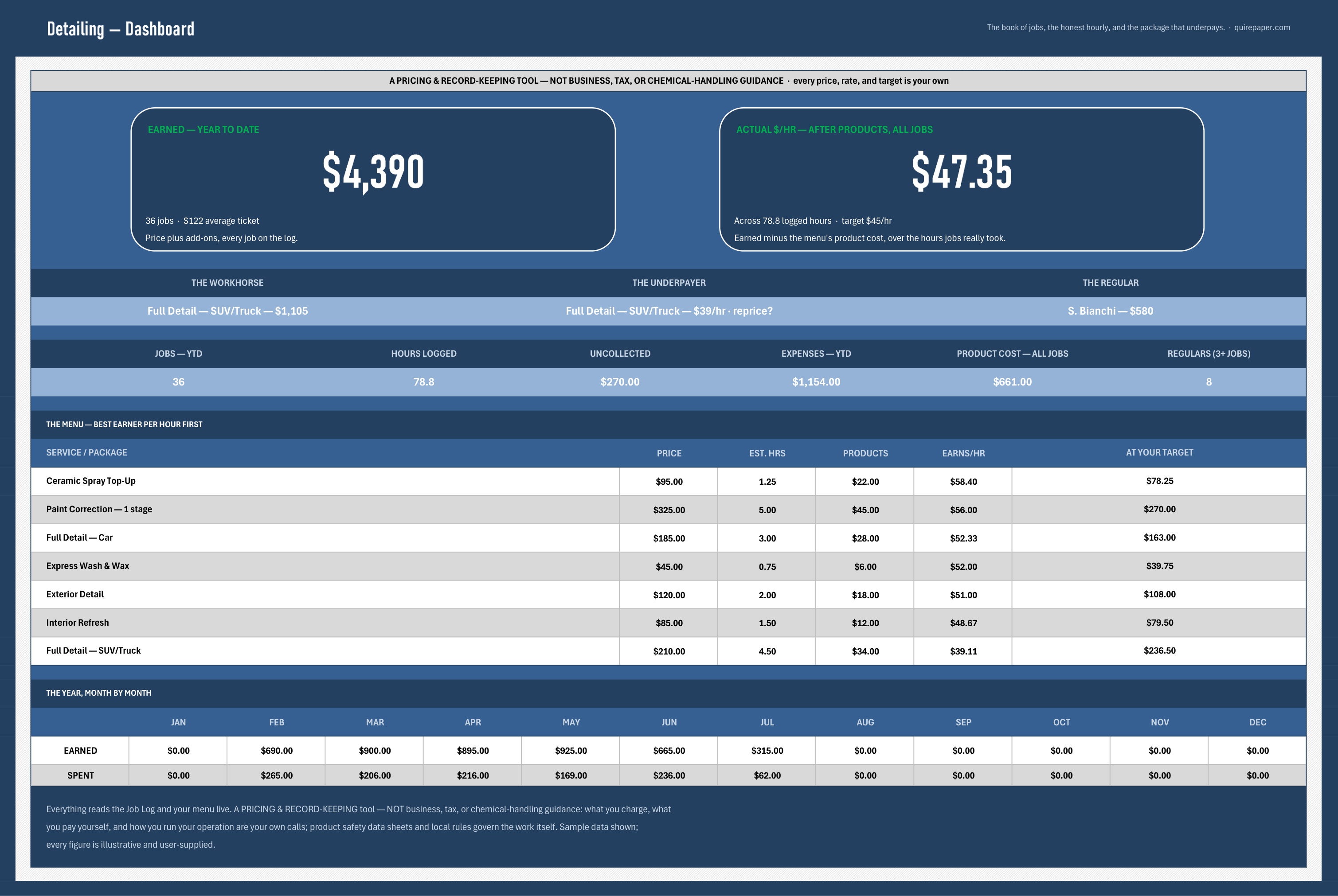
The detailer's menu and book. Every package on the menu shows EARNS PER HOUR (price minus products, divided by the hours it honestly takes) against your target rate, with the price that would fix it next to it. The job log records actual hours, so each job's real $/hr comes from what happened, not an estimate. Customers fill themselves: jobs, revenue, last visit, who owes, who's a Regular. The sample has the industry's usual twist: the SUV full detail earns the most money and the worst hourly. A pricing & record-keeping tool, not business advice.

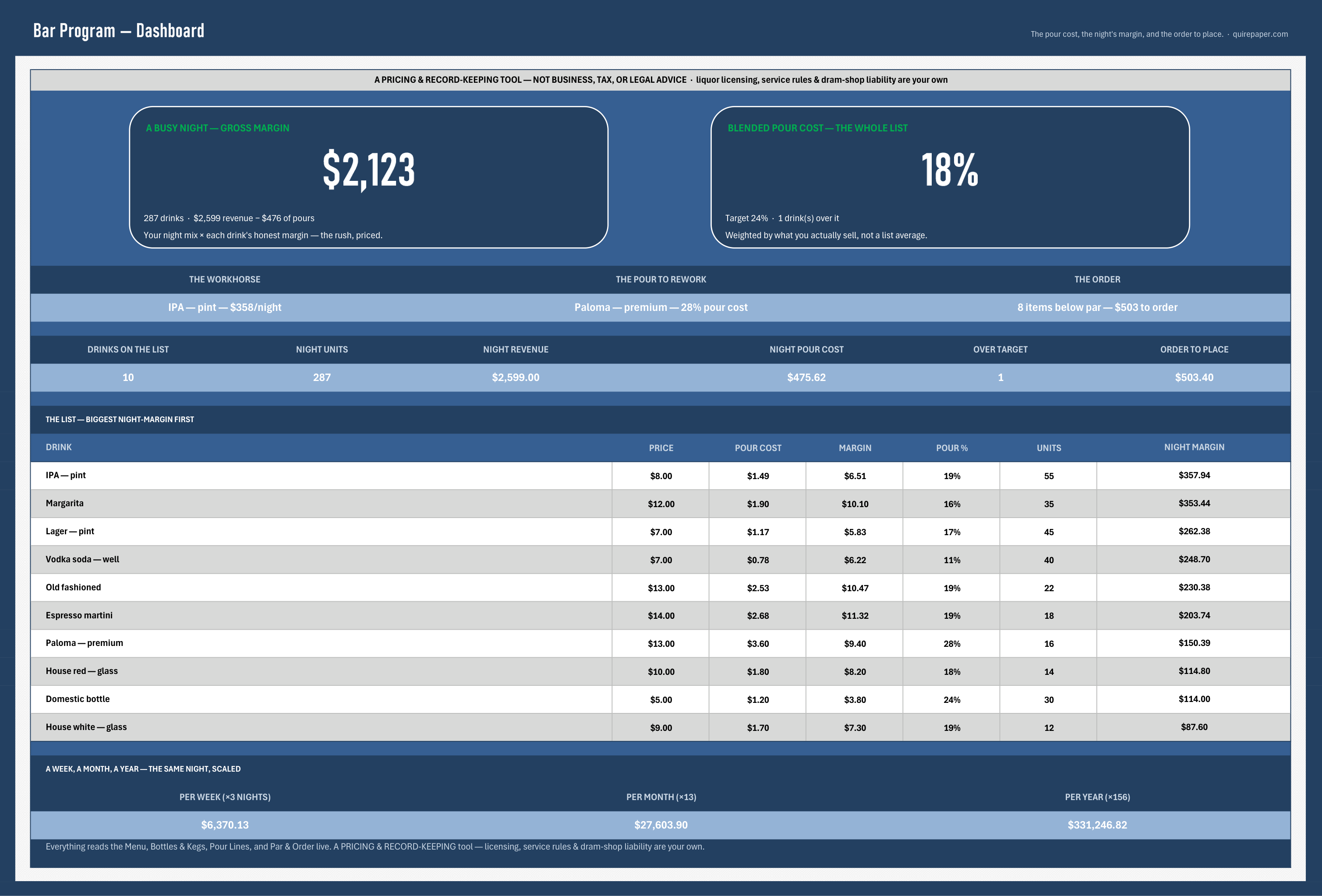
Every drink costed by the ounce from its actual pour lines (the spirit, the mixer, the fresh juice, the garnish) and read against your target pour cost. The sample's premium paloma runs 28% against a 24% target and reads red, which is the kind of pour this sheet is built to catch. Your busy night is priced from the real mix, units times each drink's margin, and the IPA out-earns the $14 martini. The walk-in count turns into a priced order: set the par once, count what's on hand, and the order fills in. Reprice a bottle and the whole list updates. A pricing & record-keeping tool. Liquor licensing, service rules, and dram-shop liability are your own.
Every bid on one dashboard: pipeline value, hit rate, and what's due in the next two weeks. There's also a line-item estimate worksheet that builds the bid price itself, from divisions through overhead, profit, and contingency.

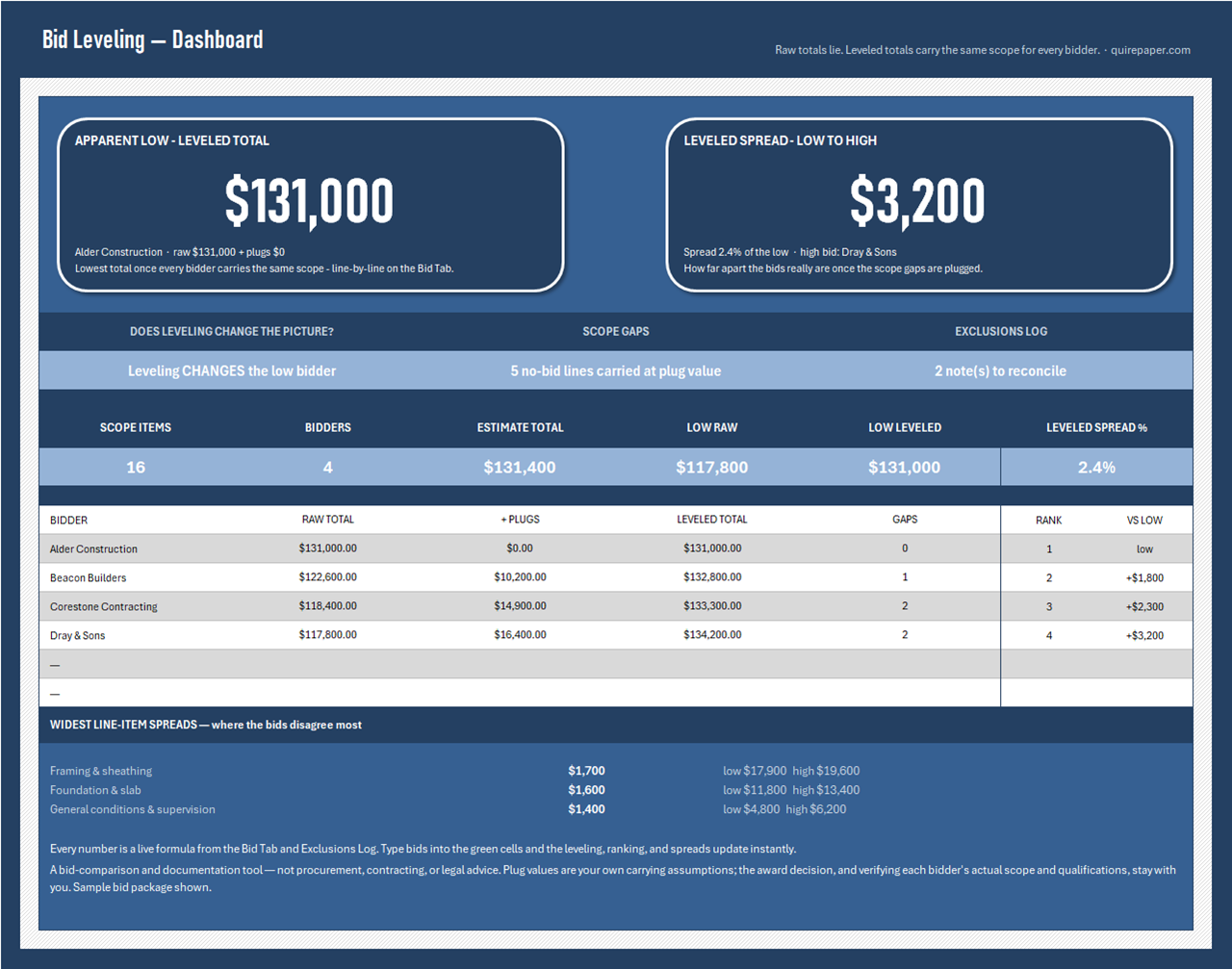
Raw totals lie, and the cheapest-looking bid is often just the emptiest one. Compare 4–6 sub or vendor bids line by line across your scope items. Plug the gaps where a bidder excluded or no-bid a line, and read leveled totals that carry the same scope for every bidder. You also get auto low/high/spread per line, red scope-gap flags, a leveled ranking, and an exclusions log. Four tabs, pure formulas, no macros.
List every bill and subscription once. See what each costs a month and a year, what is due next, and what you would save by dropping the ones you mark Cancel. It opens on a dashboard with charts, a 30-day due list, a focus dropdown, and plain-English notes the formulas write.

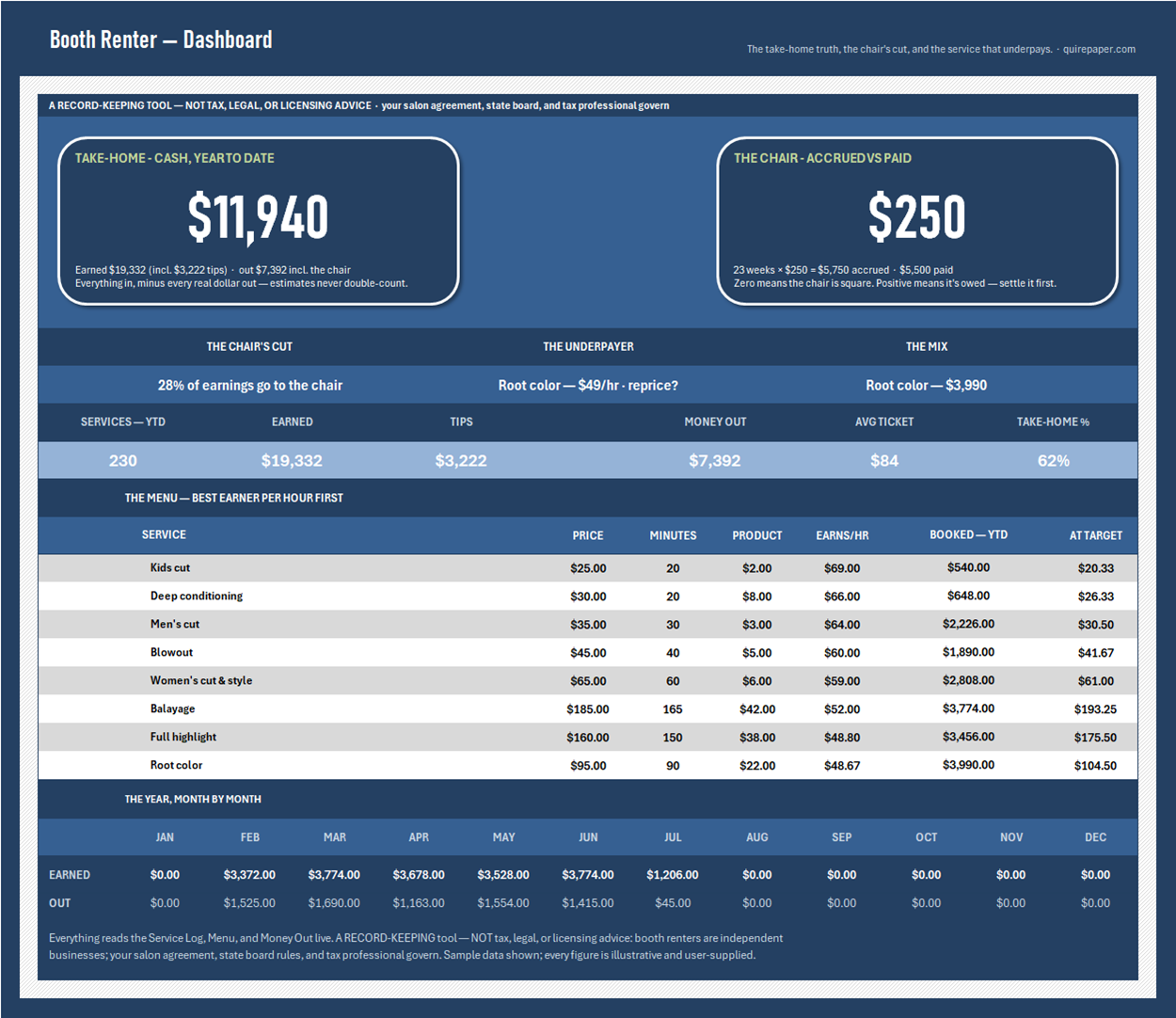
The chair renter's books. Log every service and tip once. Weekly booth rent accrues on its own from your start date, so "am I behind on the chair?" and "what share of my take does the chair eat?" always have an answer. The menu shows what each service earns per hour after product (in the sample, root color is both the most-booked service and the worst hourly). The number that matters is take-home: cash in minus cash out, with pricing estimates never double-counting against real purchases. A record-keeping tool. Your salon agreement, state board, and tax professional govern.

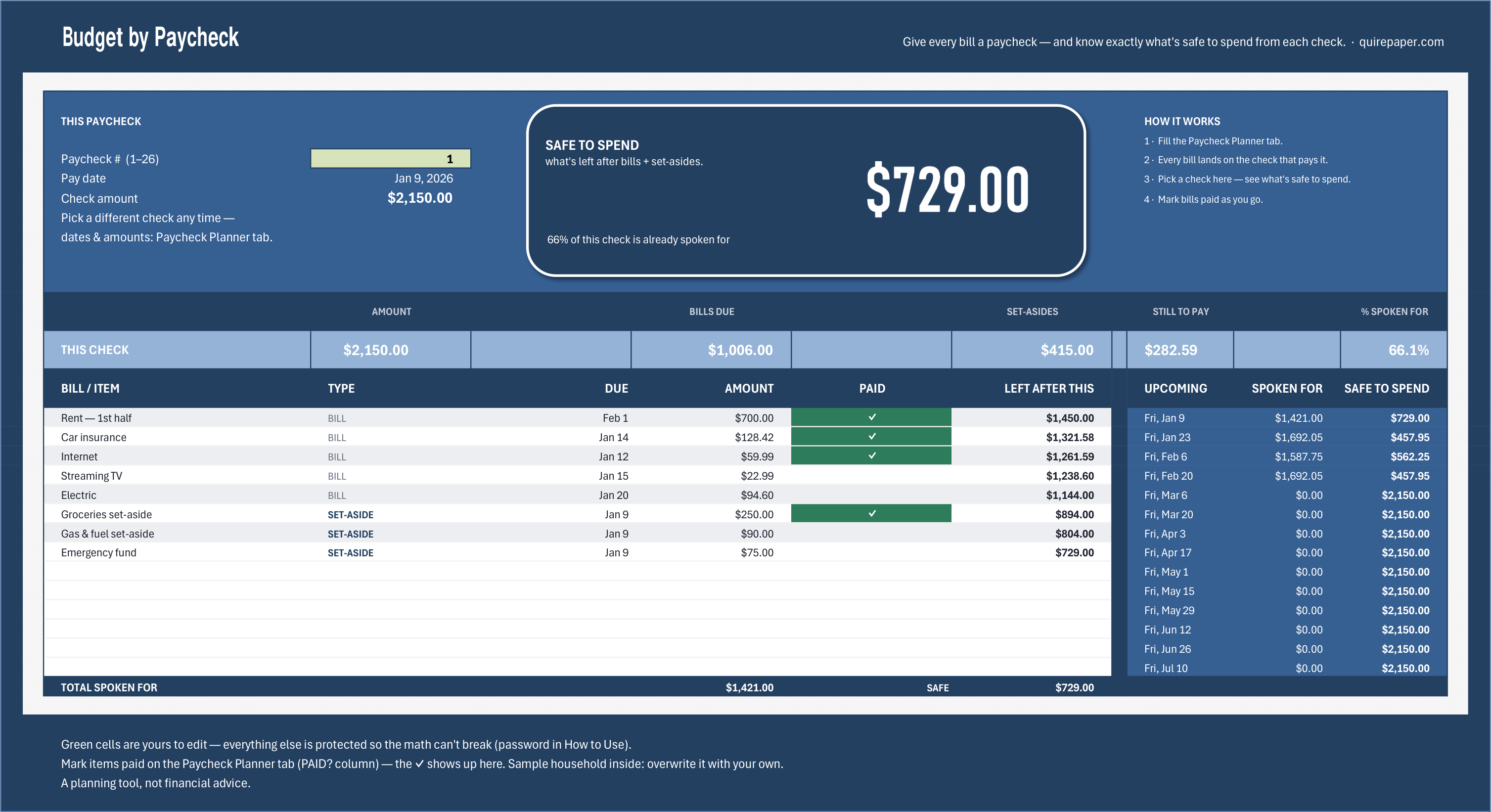
Give every bill a paycheck and see what's safe to spend from each check. 26 paychecks mapped, a 60-bill register, and one dark dashboard that does the math.
The flipper's honest book. Every car carries its ALL-IN: buy price plus every recon receipt, logged as it happens (the $40 parts runs are what the costs log is for). NET on the sale is real, and red when a flip lost money. DAYS HELD runs live on unsold cars, amber past your sitter dial, and the dashboard shows CASH IN THE DRIVEWAY. The sample includes a diesel sedan that needed a transmission and finished $1,085 down, because the losers should stay visible. A record-keeping tool; state DMV flip caps and dealer-license rules govern.

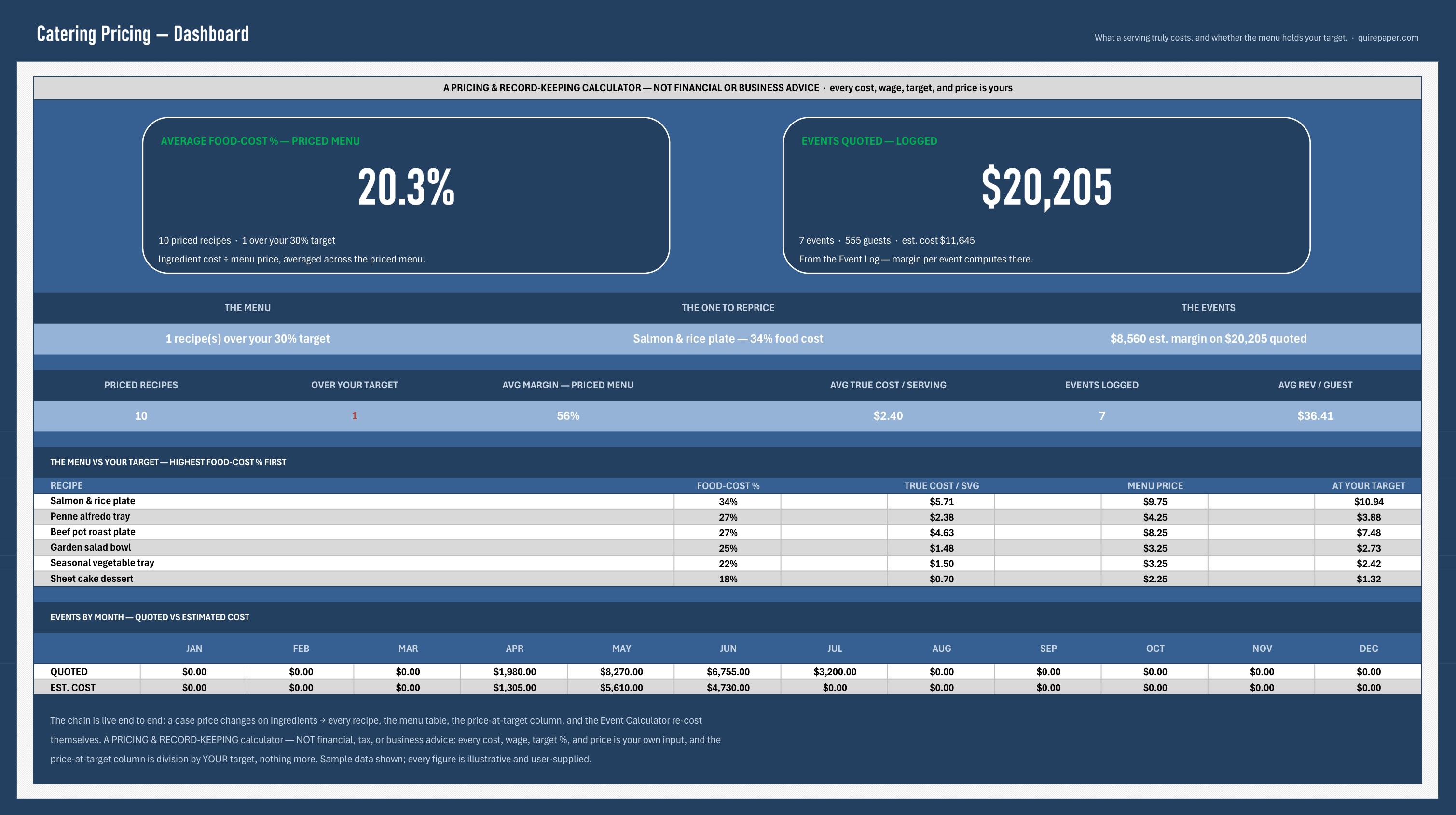
The whole food-cost chain in one workbook. Ingredient costs (buy by the case, cost by the pound) become recipe cost per serving, then true cost with labor and packaging, then food-cost % that flags red when a recipe runs over your target, then the price that target implies. An event calculator costs a whole job (menu × guests + staff + extras) against your quote before you sign it, and an event log tracks margin per event. Change one case price and everything re-costs itself.

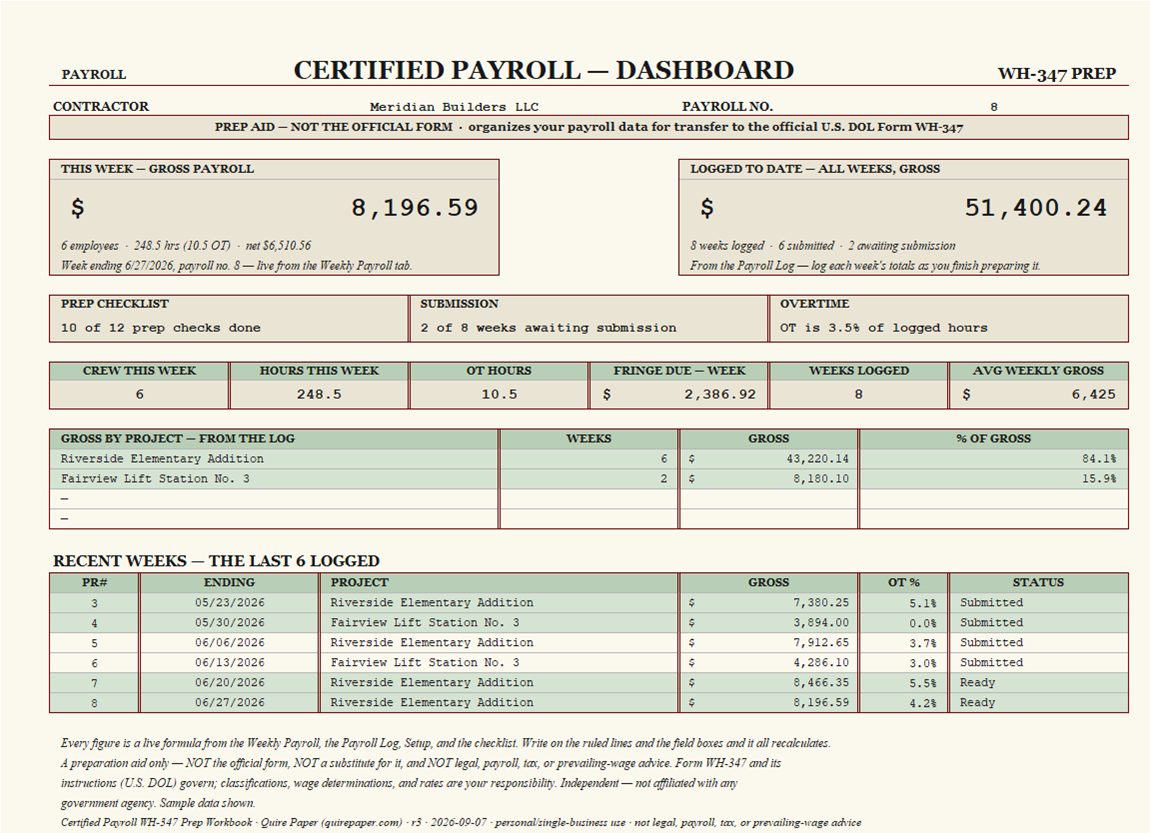
Every Davis-Bacon job means certified payroll every week, and the WH-347 is a slow form to fill from scratch. This workbook lays out the week the way the form reads: classification rates you set once, O/S daily hours per worker, auto gross (ST × base + OT × 1.5 × base), fringe obligation, and deductions to net. It also has a Statement-of-Compliance prep checklist, a multi-week log, and a dashboard. Transfer line by line to the official DOL form. A prep aid, not the form itself.

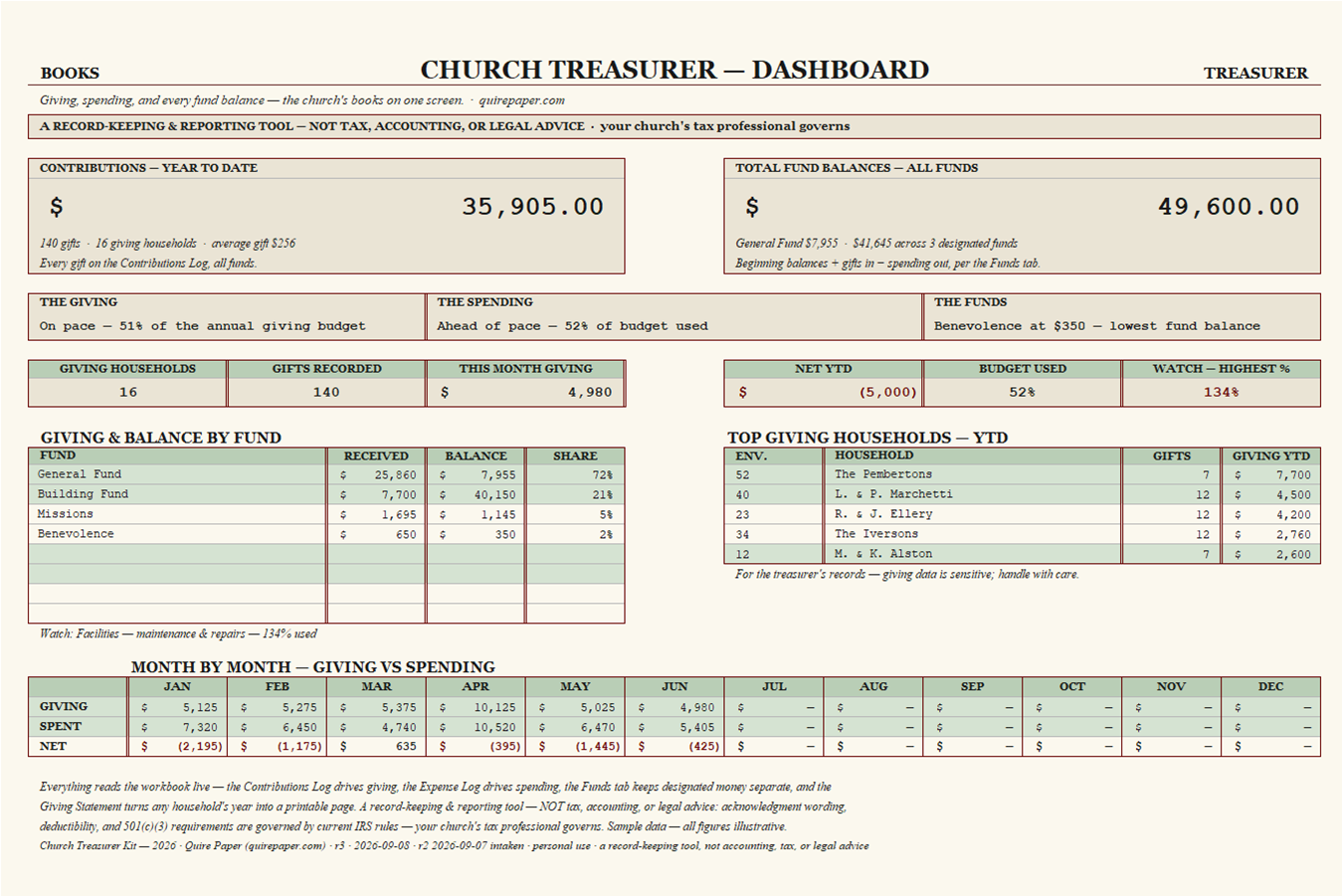
A workbook for the volunteer treasurer of a small church or ministry. A contributions log with per-household and per-fund rollups, a member directory, designated-fund tracking (beginning balance + gifts in − spending out), and a budget whose monthly columns fill from the expense log. January's job is covered too: a print-ready year-end giving statement generates for any household you pick. A record-keeping tool, not tax or accounting advice.

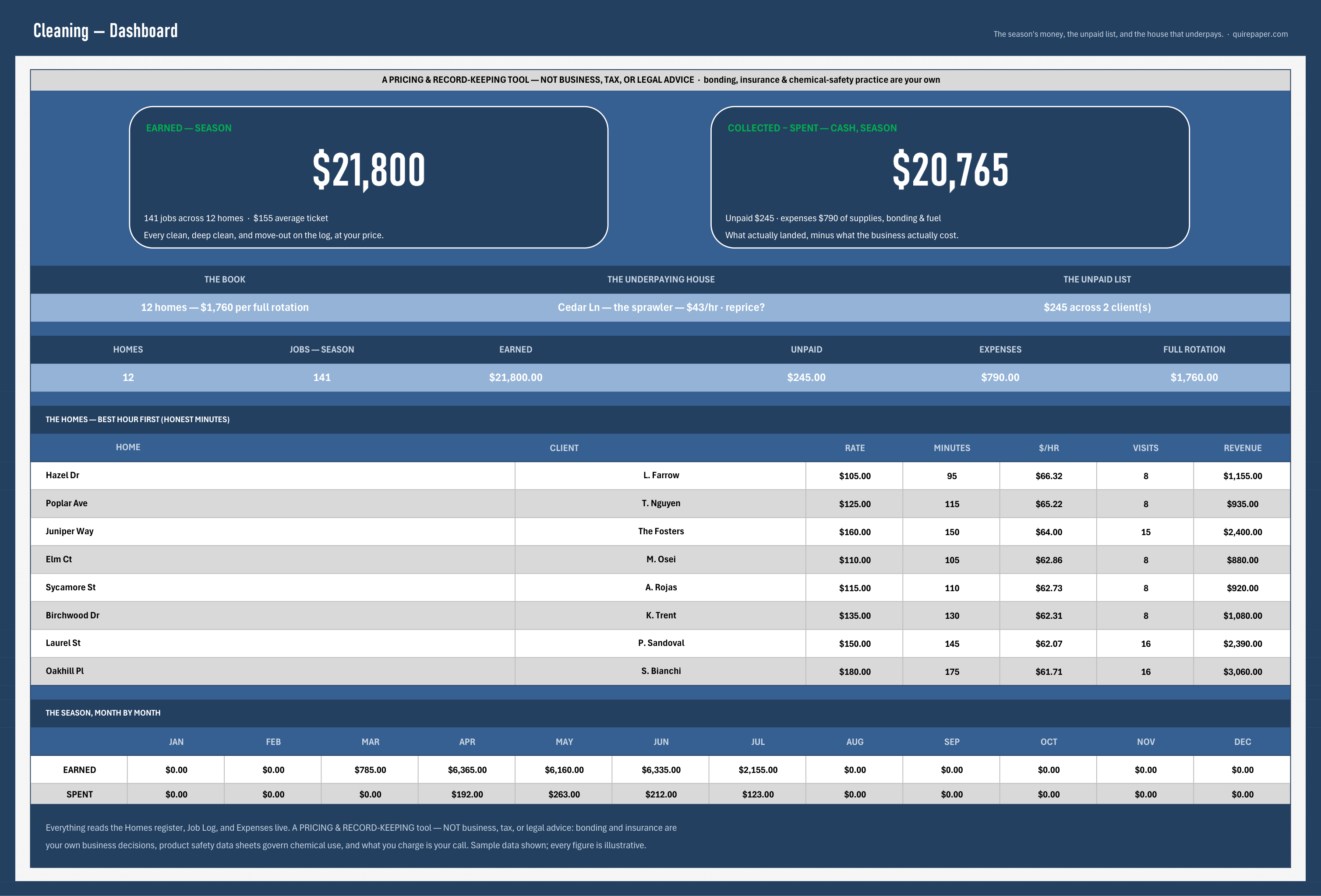
The paper trail for a cleaning business. Every home carries its clean rate and its real minutes, door to door with setup and load-out included, so you can finally see $/HR per house. The sprawler that grew a sunroom since you quoted it gets flagged in red ('$43/hr · reprice?'). A ten-second job log keeps every clean, deep clean, and move-out with its paid or unpaid status. The quote builder prices deep cleans and move-outs as supplies plus hours at your target rate, and checks the client's budget against it. Airbnb turnovers log the same way. A pricing & record-keeping tool; bonding, insurance, and what you charge are your own.

Every lead from first hello to signed or lost, on one dashboard: open pipeline, weighted forecast, win rate, and the follow-ups that are overdue or due this week. Pick a lead source or a service from the dropdown to see it on its own. A menu on every tab gets you around.

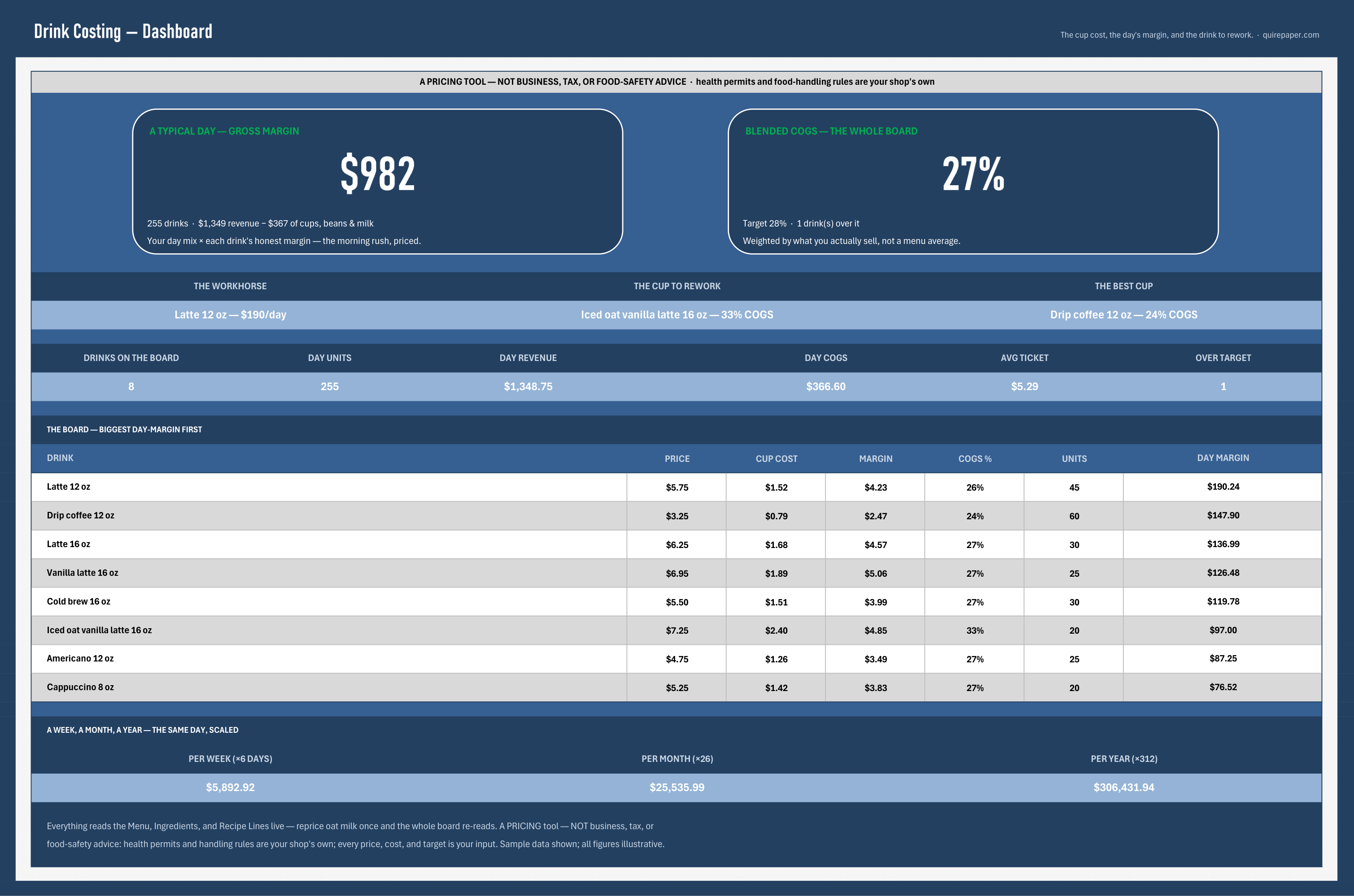
The espresso bar's costing engine. Every drink is built from its real ingredient lines: beans by the shot, milk by the ounce, syrup by the pump, plus the cup, lid, sleeve, straw, and ice, because packaging is where cup costs hide. Each drink is then read against YOUR target COGS %. The DAY MIX prices your typical morning: enter units per drink and get the day's revenue, cost, and gross margin, scaled to the week, month, and year. The sample's lesson: the $7.25 iced oat vanilla latte carries the worst COGS on the board. Reprice oat milk once and the whole board re-reads. A pricing tool, not business or food-safety advice.

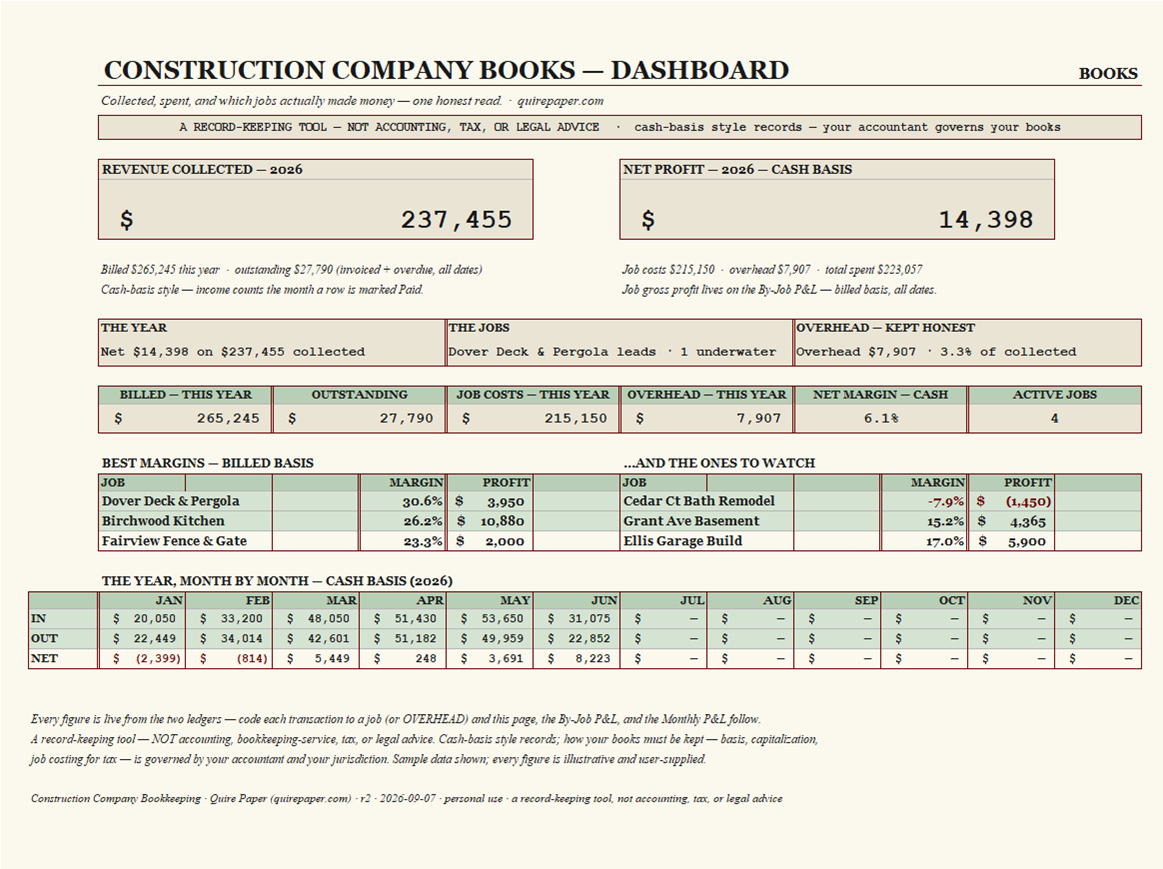
Bookkeeping built around how construction money moves. Every transaction carries a JOB code, so the same two ledgers produce a By-Job P&L (billed, direct costs by category, gross profit, and margin per job), a cash-basis Monthly P&L with overhead on its own line, and a dashboard that names your best and worst jobs. One sample job loses money on purpose, and that red row is the point. A record-keeping tool, not accounting advice.
A construction loan doesn't fund all at once. It funds draw by draw, and it charges interest on every dollar from the day it lands. This workbook runs the whole loan: an earned-value draw schedule by construction phase (budget × % complete − previously drawn = this draw request), a draw log with a running actual/365 interest-carry chain, and a dashboard showing utilization, remaining availability, interest vs reserve, and pending draws. Five tabs, pure formulas, no macros.

Bill a progress payment in minutes. An original AIA-style application for payment with a schedule of values, retainage on work and stored materials, and change-order math that ties out to the cent. The application foots every time.

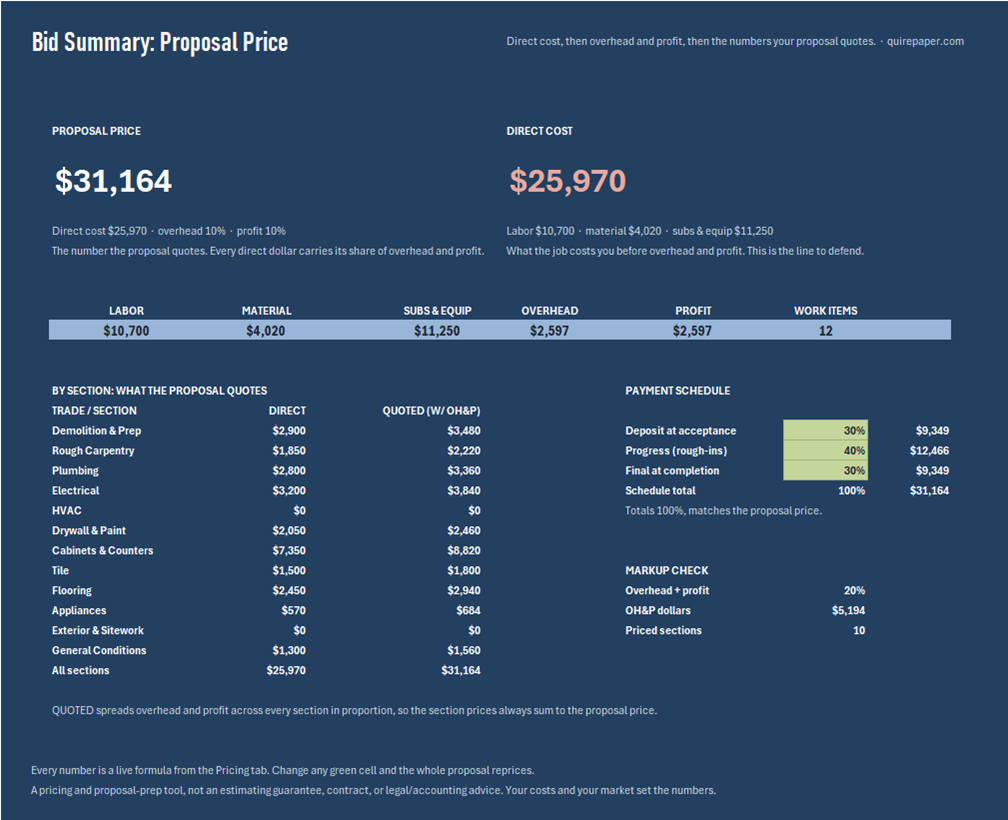
A proposal with scope-of-work language written trade by trade, an exclusions page that heads off the "I assumed that was included" conversation, and an Excel pricing worksheet that produces every number the proposal quotes.

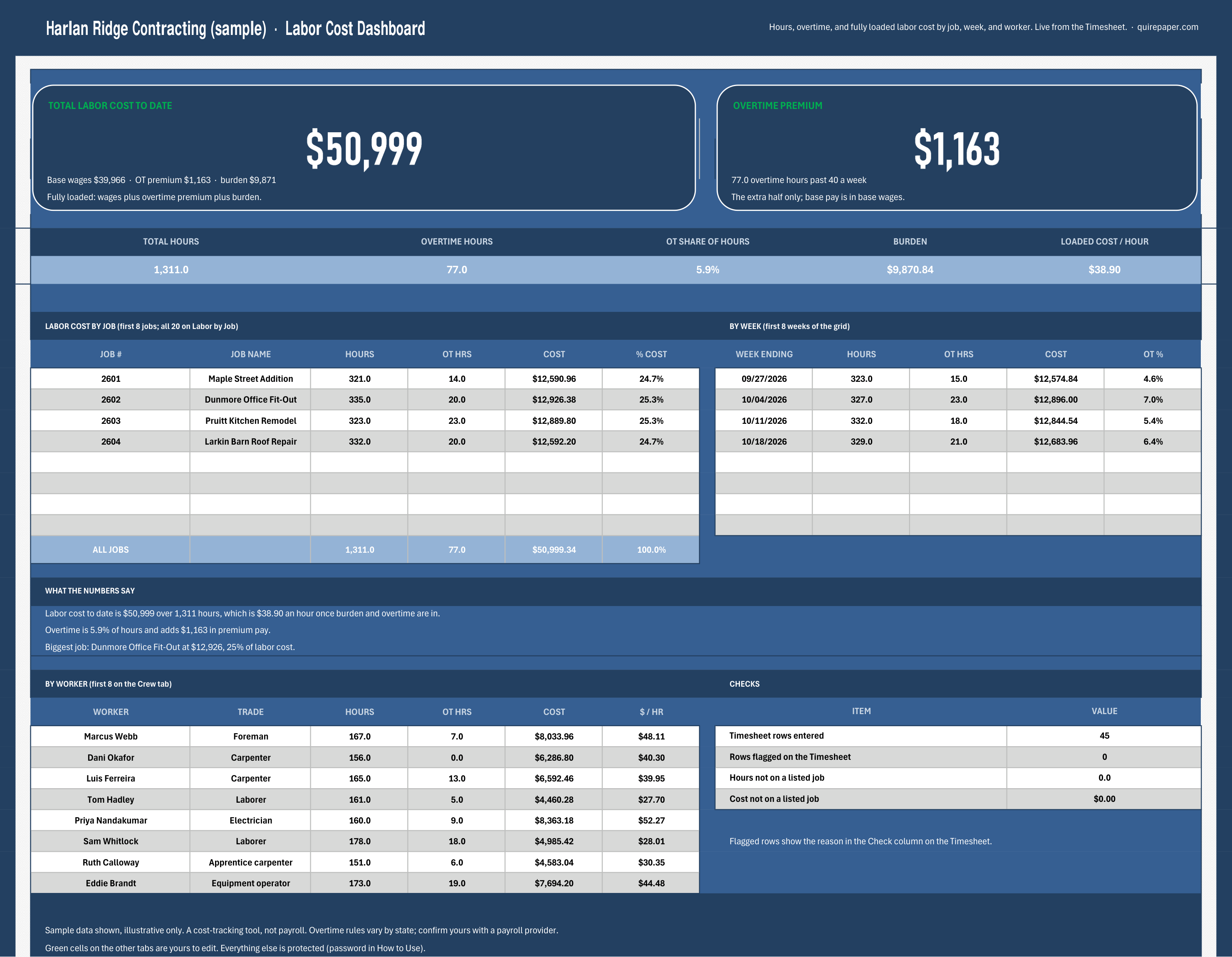
Weekly hours by worker and job, with overtime split for you and labor cost by job, burden included. Built for a crew of 5 to 25. A cost-tracking tool, not payroll.

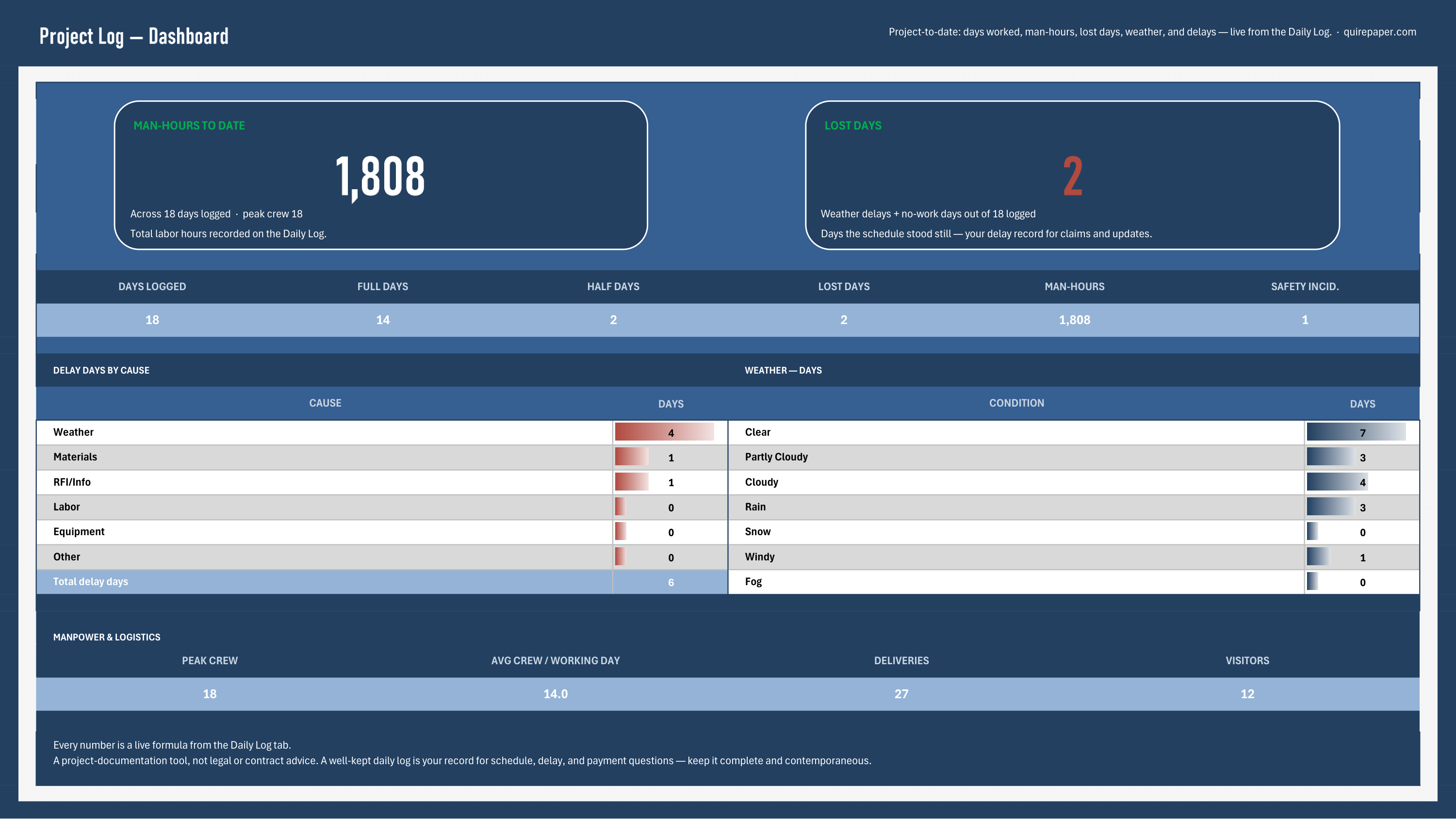
A superintendent's daily field log with one row per day: weather, crew, man-hours, deliveries, delays, safety. A live dashboard rolls it up to man-hours, lost days, and delay causes. A print-ready daily report form for the trailer comes with it.

The childcare provider's money book. A per-child tuition ledger where billed, paid, balance and Current/Behind/Delinquent status compute inside each child's enrollment window: a March start bills from March, a May withdrawal stops in May. It also has monthly subsidy/discount tracking, late fees and a delinquency threshold you set, a program expense log, and a dashboard with the roll, spots filled against your capacity, and the month. A record-keeping tool, not tax or licensing advice.

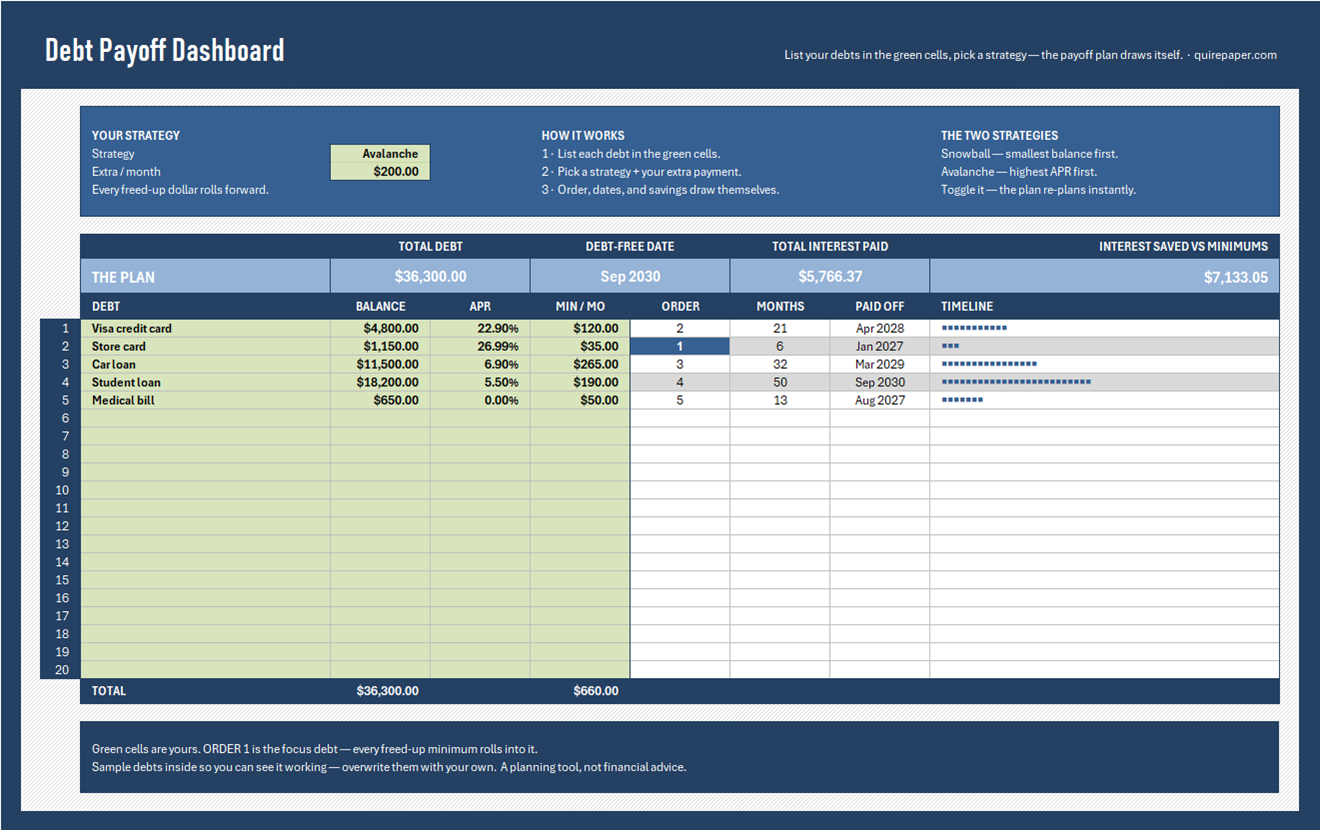
List up to 20 debts, pick snowball or avalanche, and see your debt-free date and how much interest you skip.

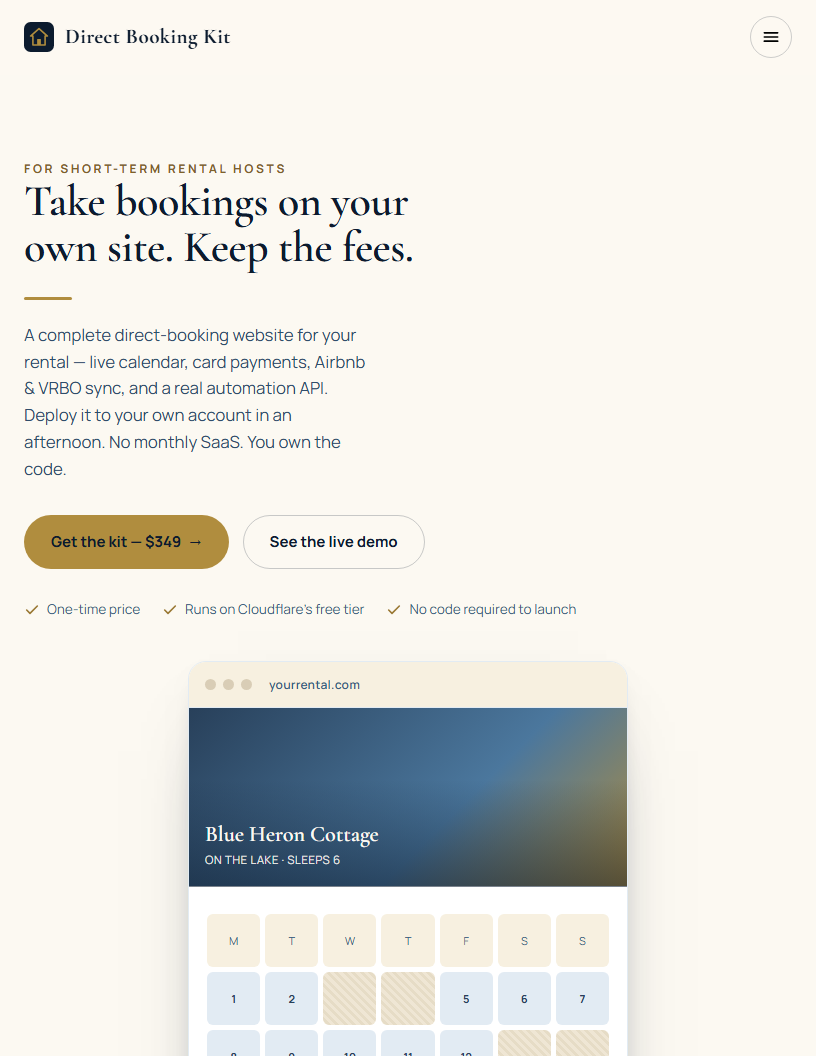
Take bookings on your own site and keep the fees: a complete direct-booking website for short-term rentals with a live calendar, card payments, Airbnb & VRBO sync, demand pricing, and a real automation API. You own the code, with no monthly SaaS. One repeat guest a year pays for it.

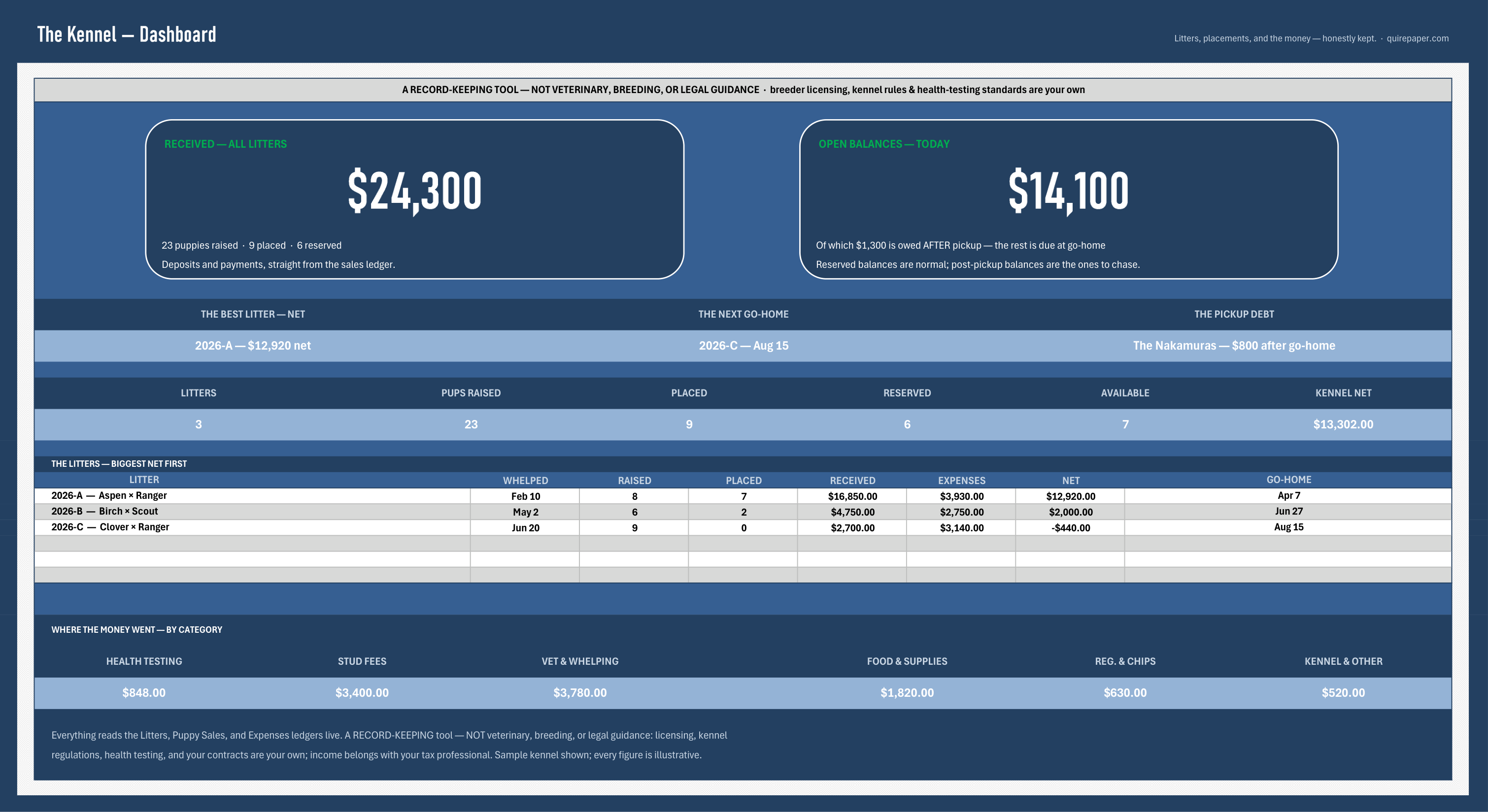
The kennel's book, kept honestly. Each litter from whelp to go-home, with the go-home date computed from your contract's dial and THE NEXT GO-HOME named on the dashboard. Each puppy's placement and balance: a Reserved balance is due at go-home (normal, amber), and a SOLD balance means the puppy went home before the money did. The sample's teal boy left in June with $800 open, and it reads red until it's settled. Expenses are tagged per litter, with health testing as its own category alongside stud fees, vet and whelping, so each litter nets on its own line. A young litter reads negative before pickup week because that's the truth. A record-keeping tool. Breeder licensing, kennel regulations, and animal care are your own.
Earned, used, and available paid time off for up to 30 employees. It opens on a real dashboard with KPI cards, charts, a list of who needs a look, and a focus-employee dropdown. Accrues per pay period or per hour worked, with an annual cap, a carryover limit, and optional service tiers.

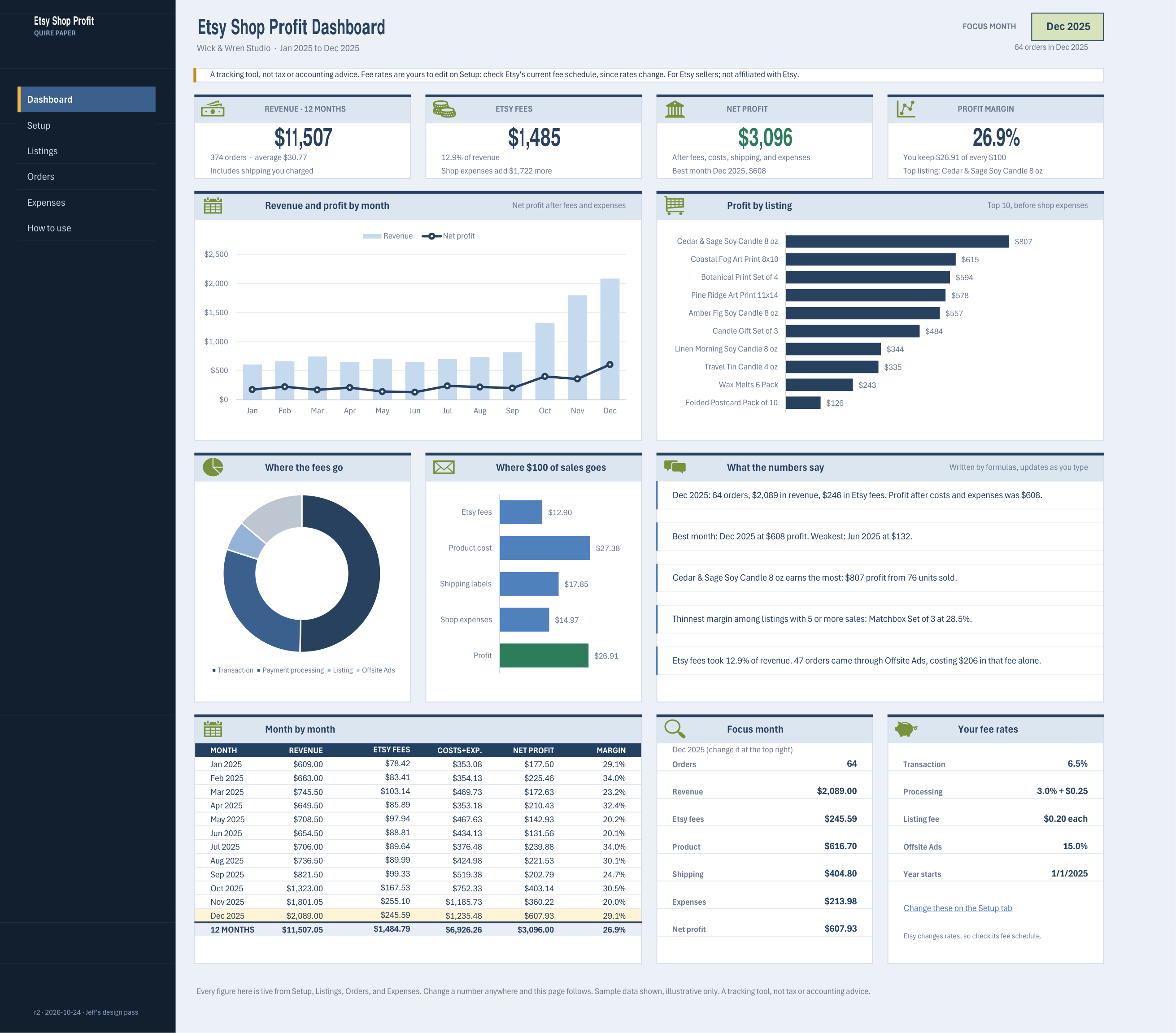
Enter your Etsy orders and shop expenses and see what the shop really kept: fees worked out on every order, profit by month and by listing, charts, KPI cards, and a focus-month dropdown. A menu on every tab gets you around.

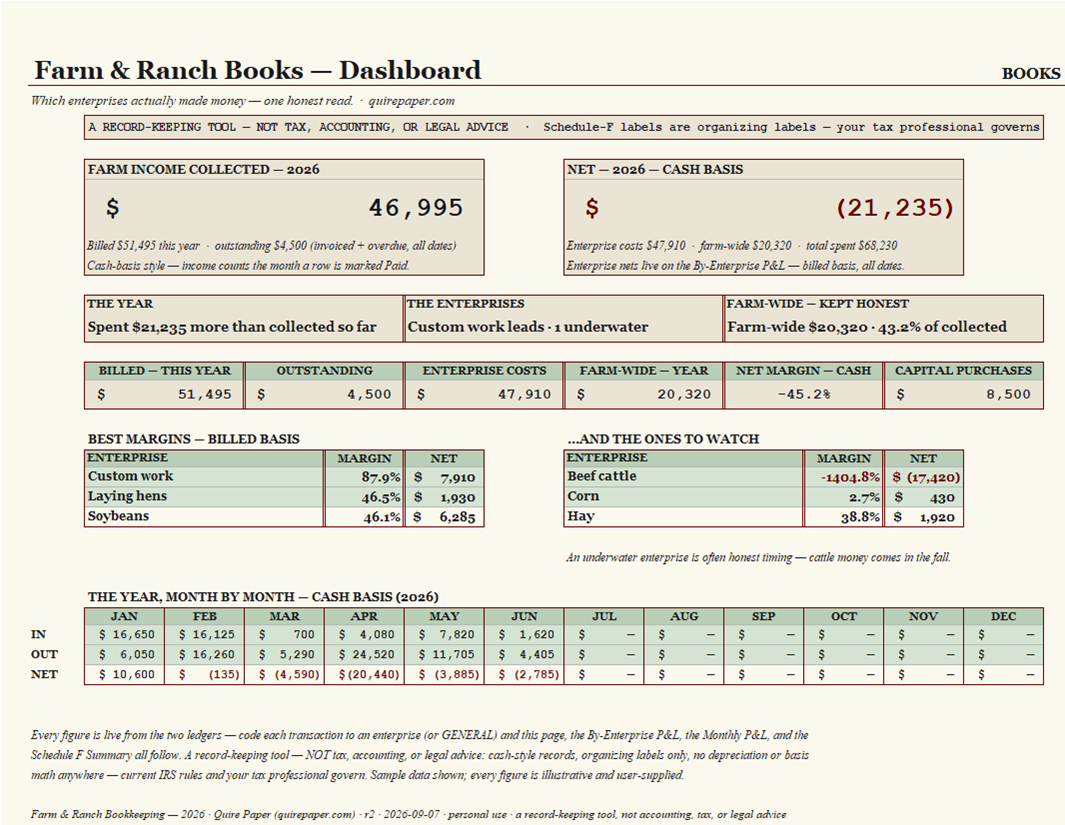
Enterprise-aware books for a farm or ranch. Two ledgers where every dollar carries an enterprise code (corn, beef cattle, custom work, or farm-wide GENERAL), so the same entries give you a by-enterprise P&L that shows which crop or herd made money, a cash-basis monthly P&L that shows the spring squeeze as it is, and a Schedule-F-shaped year summary your tax preparer can work from. Equipment purchases are tracked and broken out, not quietly expensed. A record-keeping tool, not tax advice.

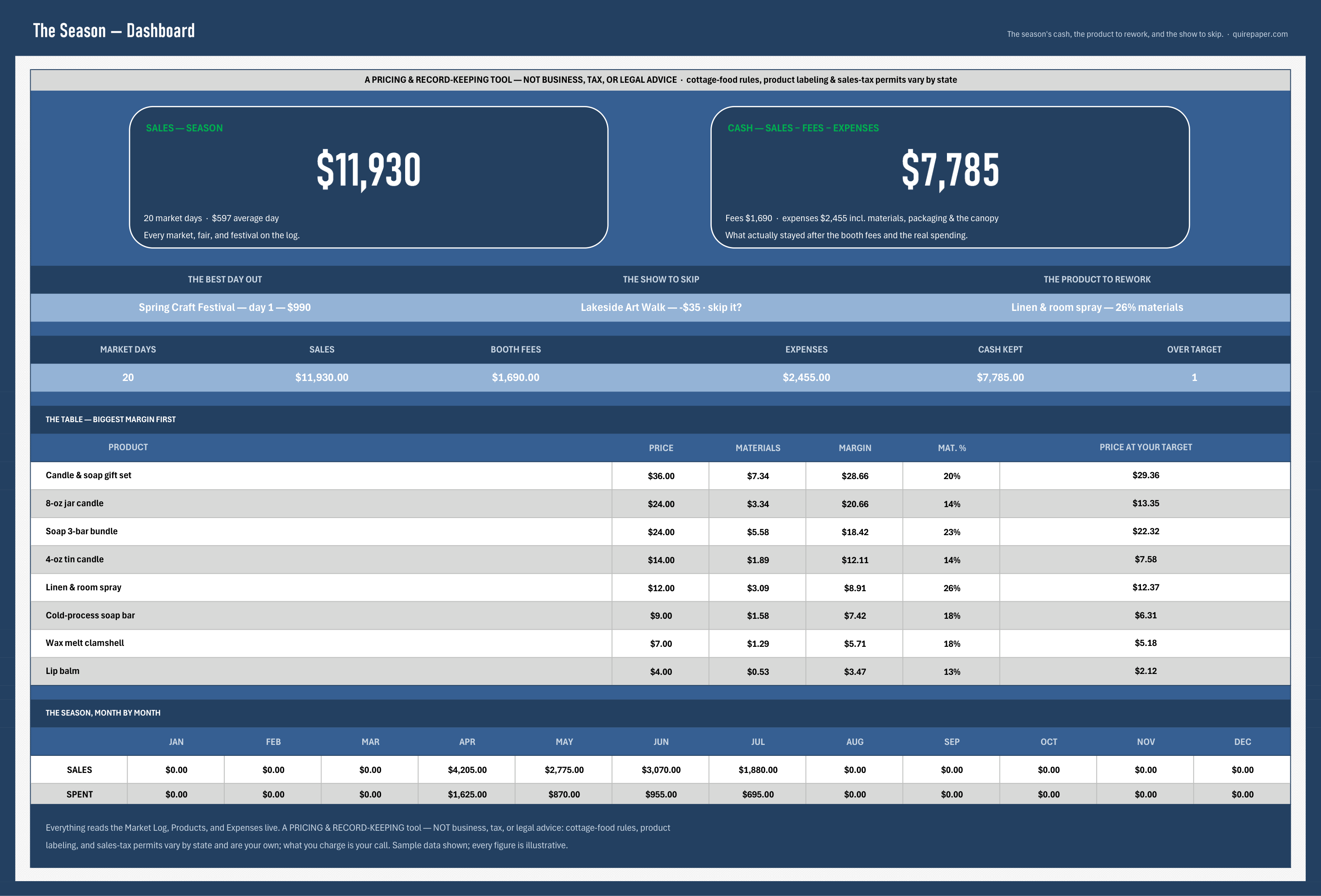
The maker's season, netted out. Every product is costed from its actual materials (the wax, the jar, the wick, the label) and read against your target materials share. The sample's room spray runs 26% against a 25% target and reads red, which is the kind of product this sheet is there to catch. Every market day is netted against its booth fee, so the art walk that cost $175 to attend and sold $140 reads as what it was, and doesn't get booked again next year. It also tracks the real cash: materials purchases, packaging, the canopy, memberships. Reprice one supplier pack and the whole table re-reads. A pricing & record-keeping tool. Cottage-food rules, product labeling, and sales-tax permits vary by state and are your own.
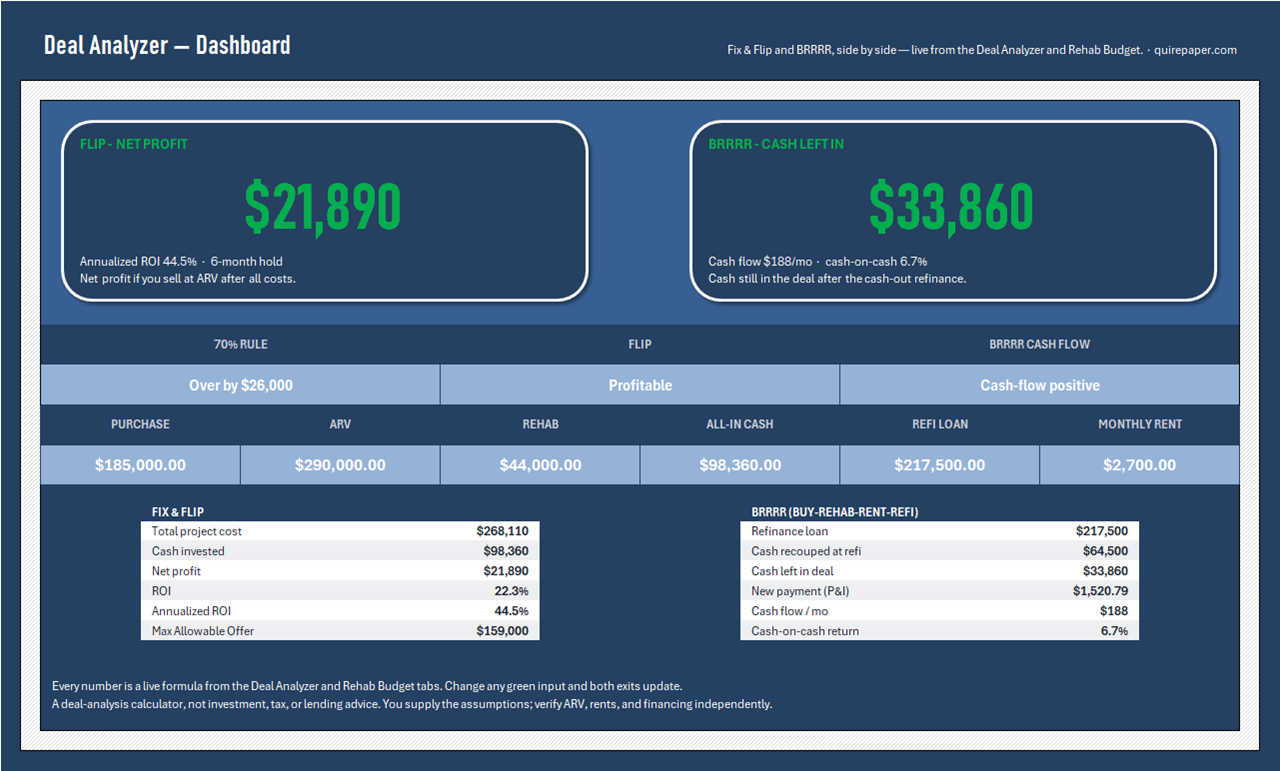
One model, two exits. Run a Fix & Flip and a BRRRR off the same numbers: net profit, ROI, the 70% rule, cash-out refinance, cash flow, and cash-on-cash. The rehab budget feeding it is estimated the way a contractor does it, by construction division. Four tabs, pure formulas, no macros.
A live maintenance schedule for a small fleet. Miles-, hours-, and months-based intervals are checked against each unit's real odometer, hour meter, or the calendar. Every task reads OK, DUE SOON (amber), or OVERDUE (red) at warning windows you set. A service log feeds per-unit costs and the spend trend. Free maintenance spreadsheets exist, but they're forms. This one does the math. A scheduling aid, not a DOT/FMCSA/OSHA compliance record. Manufacturer intervals and your regulator govern.

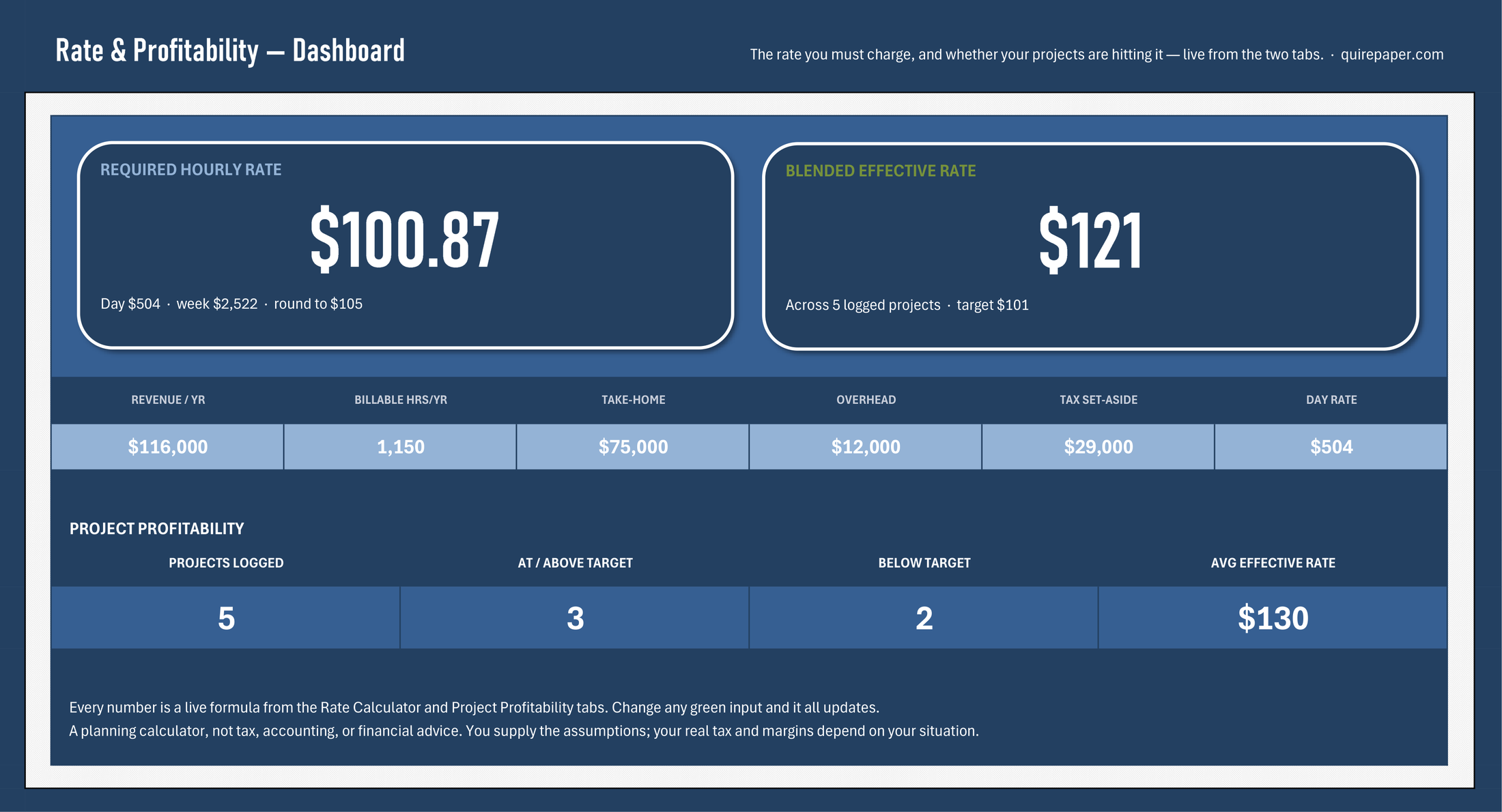
Work out the hourly, day, and week rate you need to charge from what you want to take home, your overhead, your tax set-aside, and your REAL billable hours. Then log each project and see whether it hit that rate. Three tabs, pure formulas, no macros.

A 12-week goal workbook held lightly: tiny-rung ladders, light weekly check-ins, and a mid-season permission slip. From our Daily Reset line.
The small gym's ledger. Enter name, plan, rate, and join date, and dues accrue on their own: months on the roster × the rate, so every member's balance stays current without writing an invoice. It goes red when someone's quietly behind and negative when they've paid ahead. The dashboard carries MRR and the annual run rate, names THE QUIET LAPSE by member and amount, and the by-plan table shows what carries the recurring revenue. Fits gyms, studios, dojos, clubs, and co-ops the same. A record-keeping tool. Membership agreements, waivers, and state auto-renewal laws are your own.
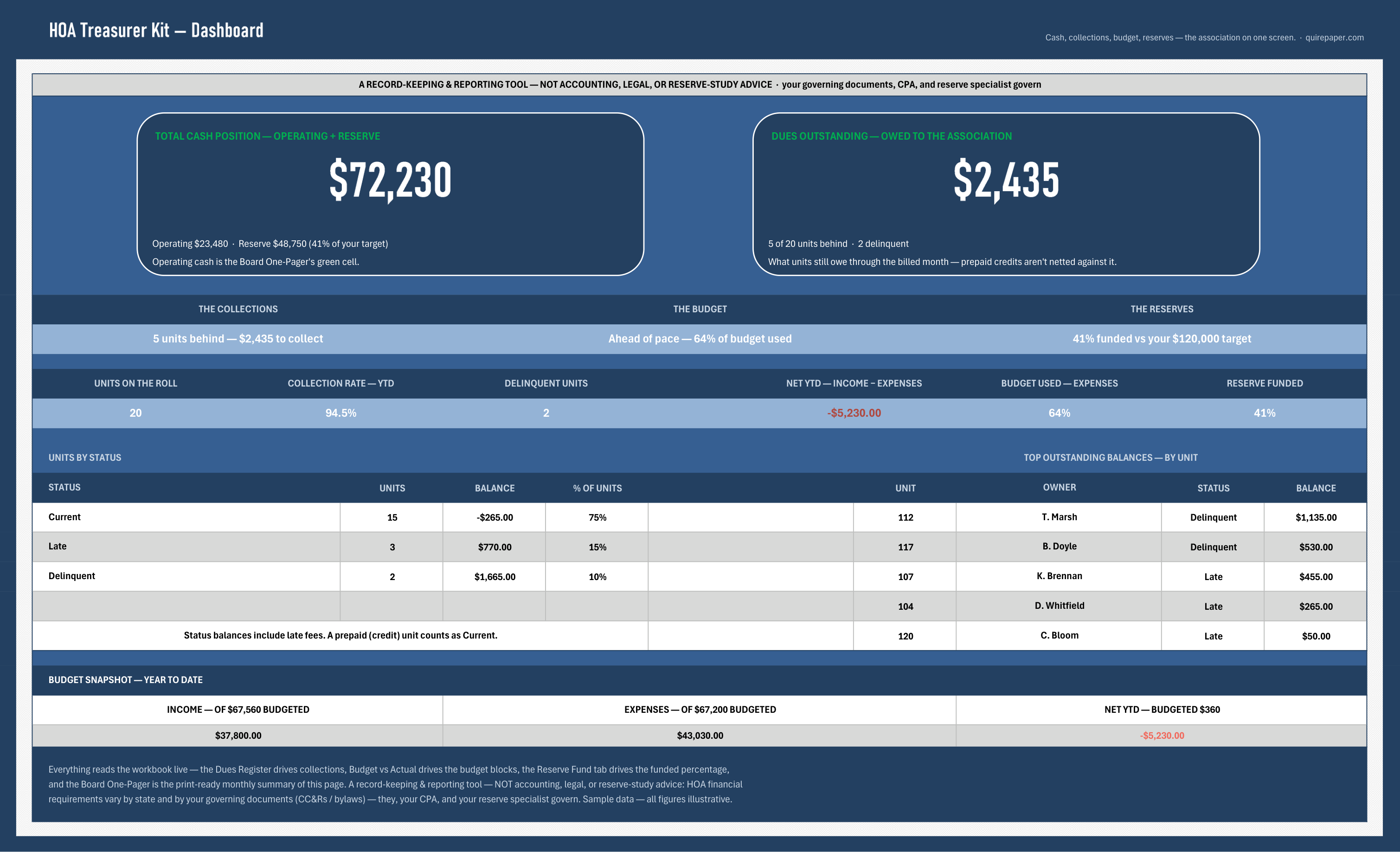
The volunteer treasurer's workbook for a small self-managed HOA or condo association. A per-unit dues register (monthly or quarterly assessments, a Jan to Dec payment grid, auto billed/paid/balance and Current/Late/Delinquent status at YOUR threshold), budget vs actual with over-pace flags, a reserve-fund tracker measured against your own reserve-study target, and a print-ready Board One-Pager, the sheet you hand the board every month. A record-keeping tool, not accounting or legal advice.

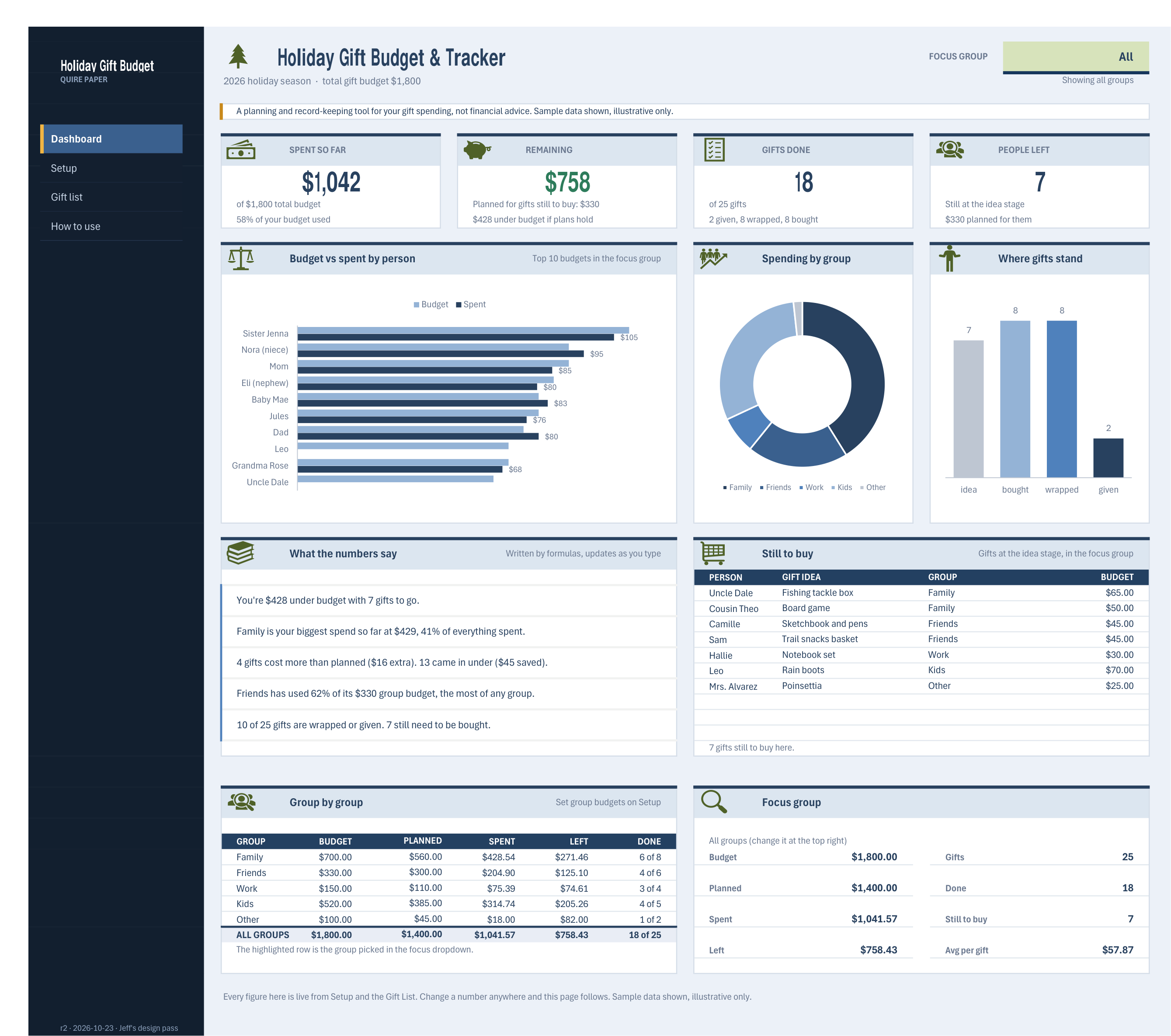
List who you are buying for, set a total budget, and mark each gift as an idea, bought, wrapped, or given. The dashboard shows spent against budget, what is left, and who still needs a gift, with a group dropdown to focus on family, friends, work, or kids.

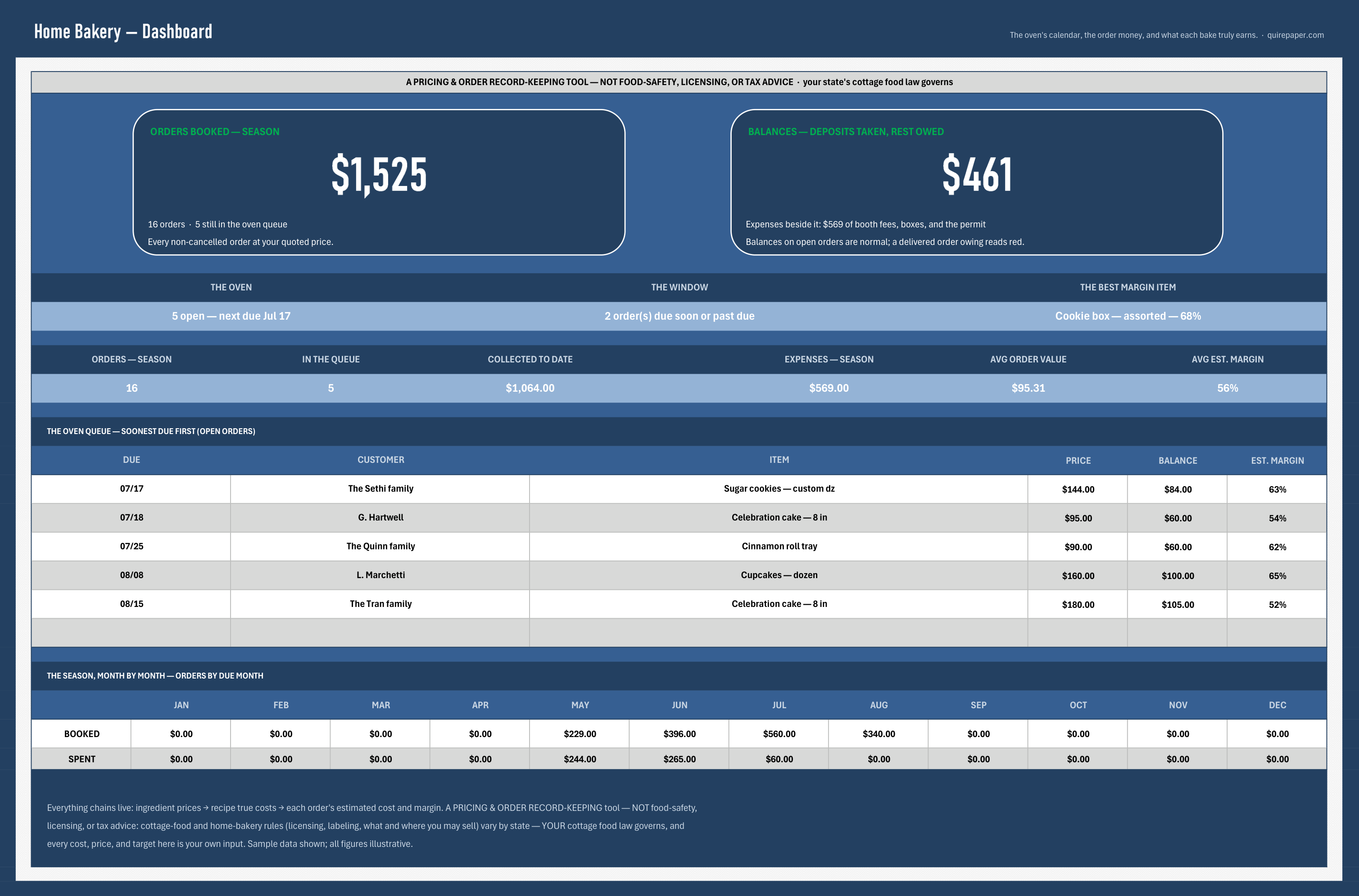
The home baker's order book and pricing engine, chained live: ingredients cost the recipes, and recipes cost the orders. Every custom order carries its due date (amber inside your window, red past due), deposit, balance (a delivered order still owing reads red, so you collect at pickup), and an estimated margin. Think the $85 cake that cost $43 to make. The sample even includes a $5.50 sourdough loaf that loses money once your hands are counted. A pricing & record-keeping tool. Your state's cottage food law governs.

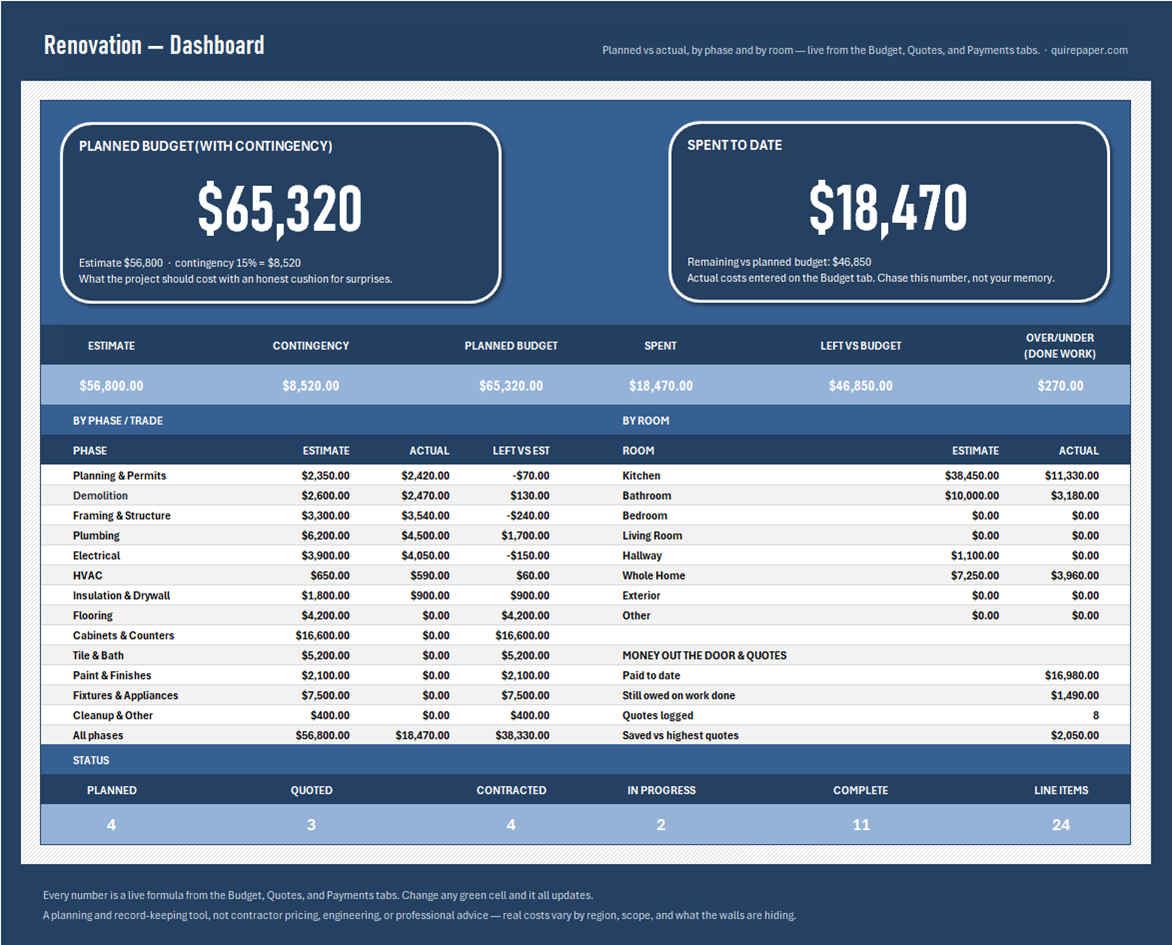
A renovation budget organized by trade, in build order, with room tags. Contingency sits on top, with planned-vs-actual variance, contractor-quote comparison, and a payments log that shows what you still owe. Five tabs, pure formulas, no macros.

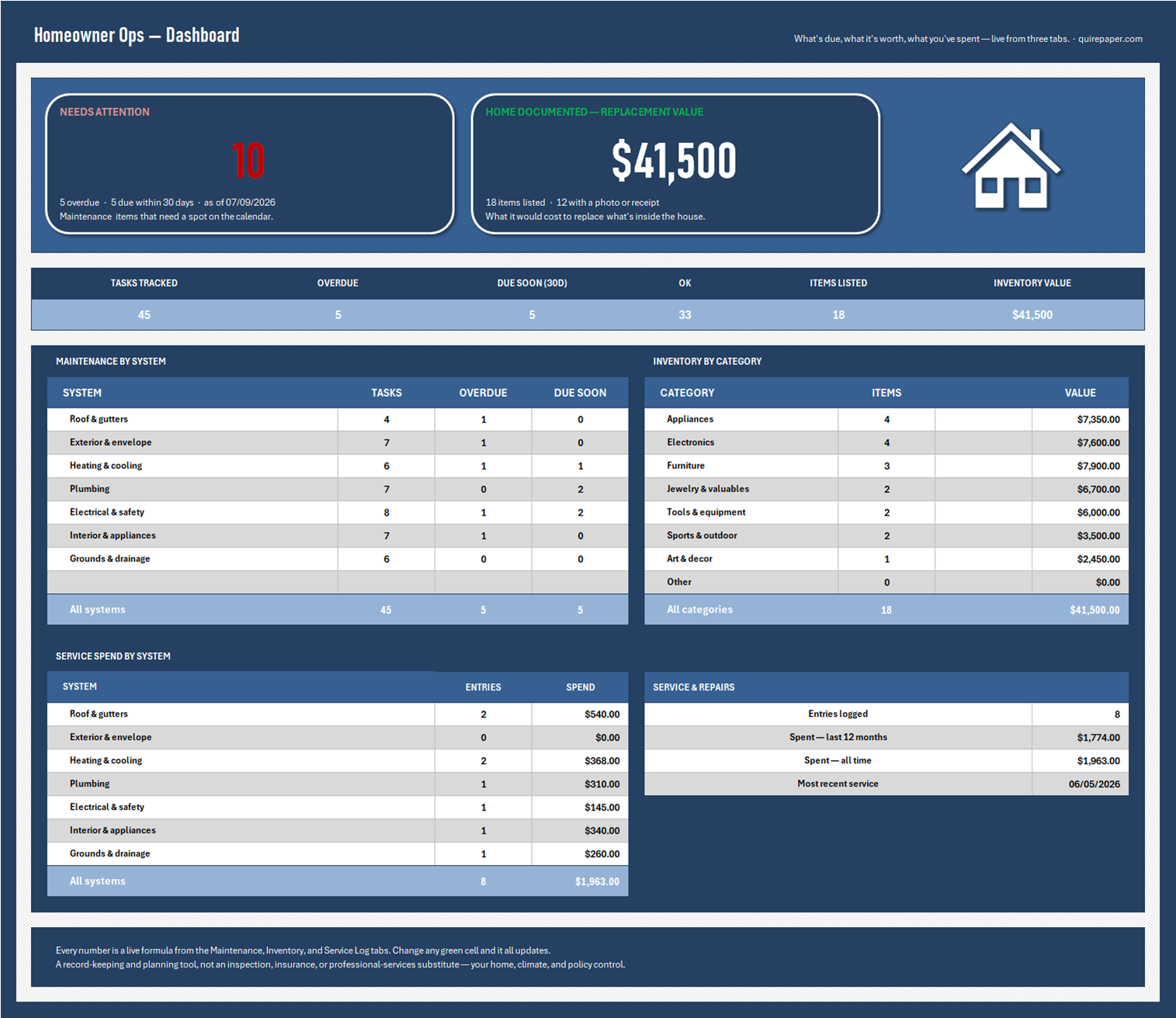
The three records every house should have: a maintenance schedule with a live due engine (45 curated tasks covering roof, envelope, and mechanicals), an insurance-ready home inventory with replacement value by category, and a service log that shows the house has been cared for. Four working tabs, pure formulas, no macros.

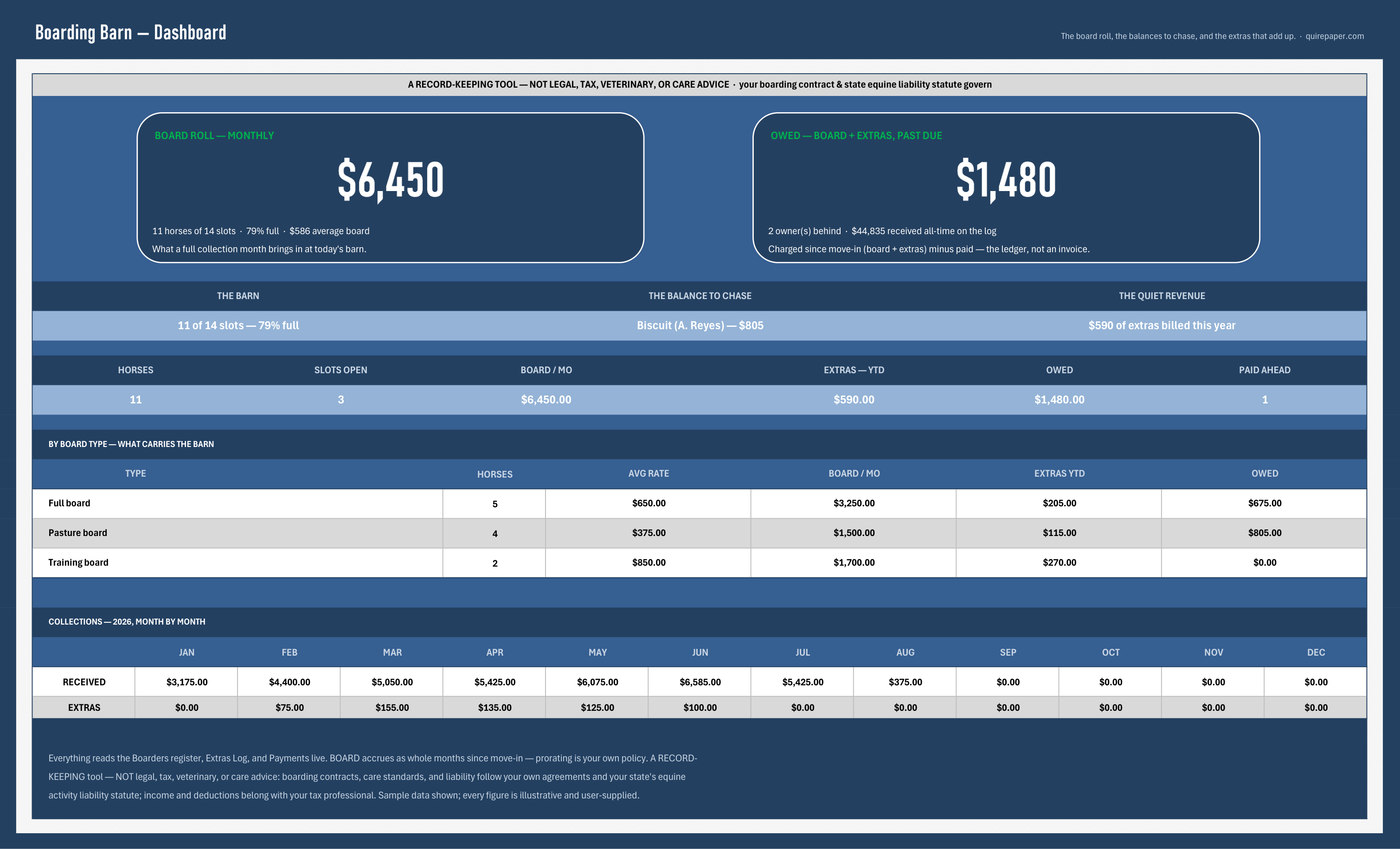
The boarding barn's ledger. BOARD accrues itself (months on the books × each horse's rate), and the EXTRAS LOG catches the revenue barns forget to bill: the $25 farrier holds, the training rides, the blanket service. Each owner's balance is board + extras − payments, red when a family owes. The dashboard names the balance to chase by horse and owner, and the by-type table shows what full board, pasture and training each carry. A record-keeping tool. Your boarding contract and state equine liability statute govern. Not veterinary or care advice.

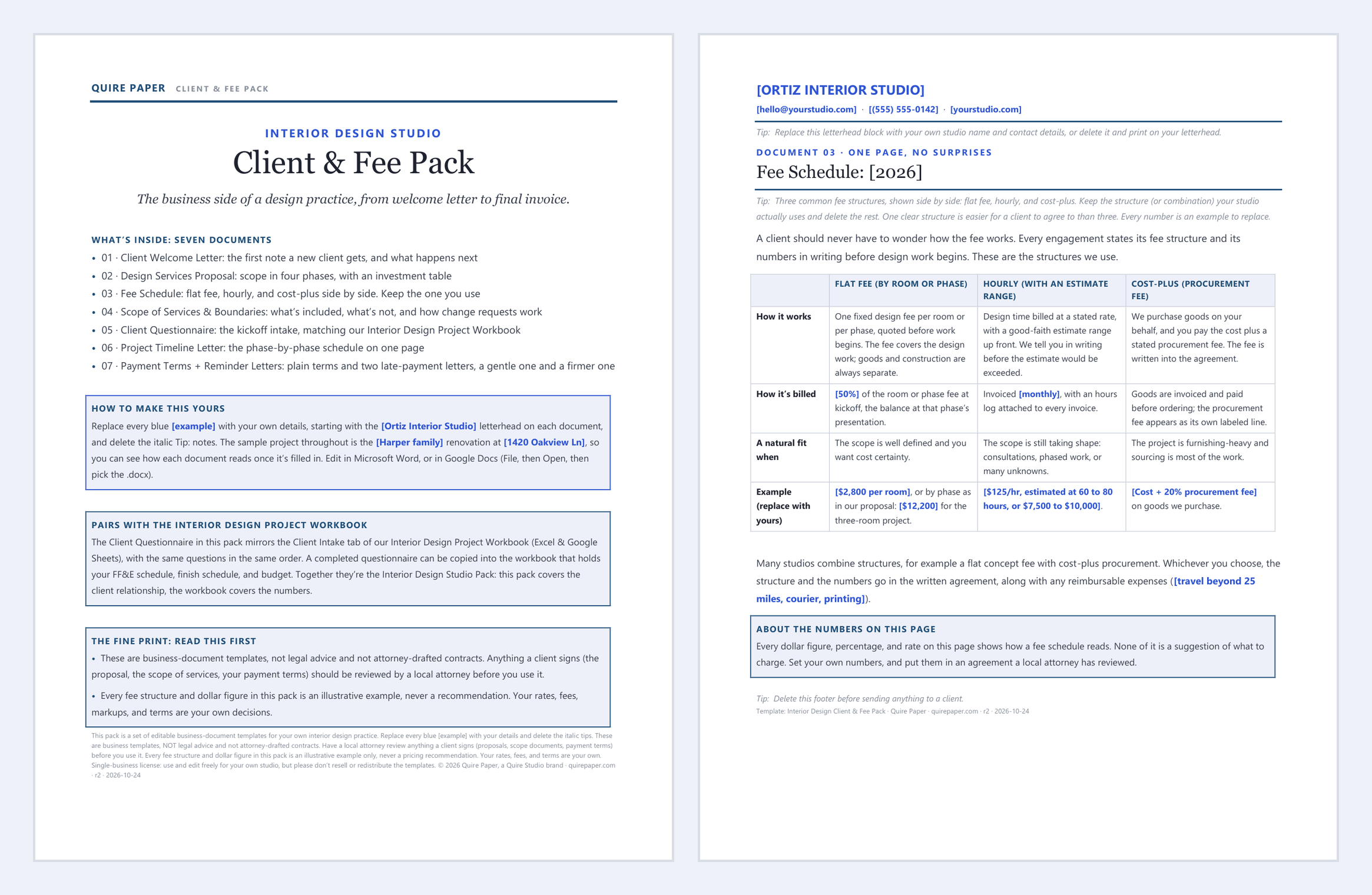
The paperwork side of a design practice, already written: a client welcome letter, a design services proposal with a phase-by-phase scope and investment table, a fee schedule (flat, hourly, and cost-plus side by side), a scope of services, a client questionnaire that matches our Interior Design Project Workbook, a project timeline letter, and payment terms with two late-payment reminder letters. Replace the blue example text with your studio's details.

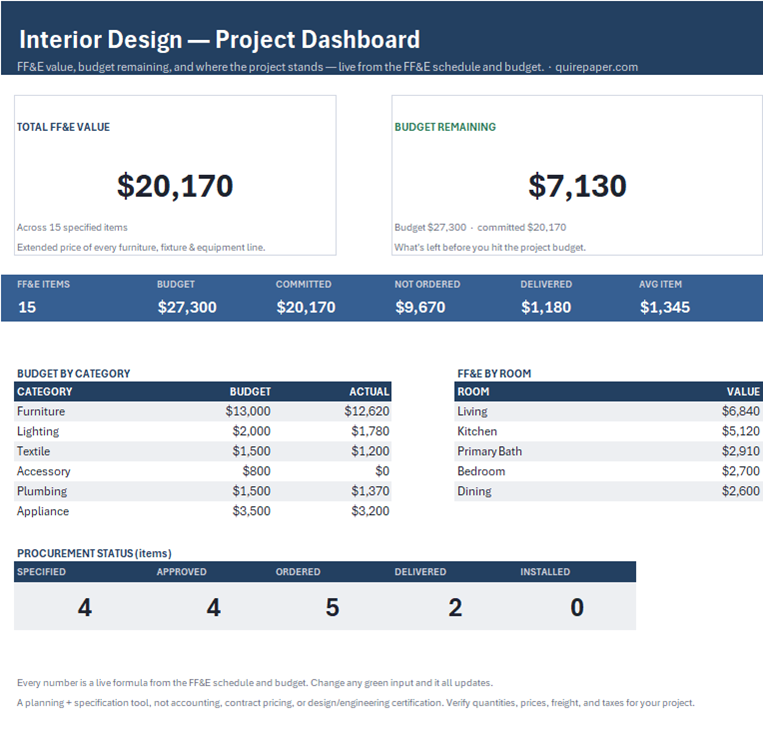
The design file with real numbers: an FF&E schedule that costs itself (qty × unit price = extended price, plus procurement status), a room-by-surface finish schedule, a budget that pulls its actuals from your FF&E selections, a client intake questionnaire, and a rollup dashboard. Six tabs, pure formulas, no macros.
Log what comes in and goes out, and the sheet works out stock on hand, what it is worth, what to reorder, and which items have stopped moving. It opens on a dashboard with charts, a reorder list by supplier, a category or supplier dropdown, and plain-English notes the formulas write for you.
Send a clean invoice and always know who still owes you. A fillable, printable invoice plus a tracker that shows what's outstanding, what's overdue, and what got paid this month, with an aging breakdown. No subscription, no per-invoice fee.
Every project's budget, committed costs, and actuals on one dark dashboard. You get cost to complete, projected cost at completion, and the margin you're on track to make, by cost division, with an OK / WATCH / OVER status on every line.
Log every application, interview, and contact, and see your response rate, which sources get answers, and which follow-ups are due. Compare up to four offers side by side on total comp, PTO, commute, and the weights you set. Opens on a dashboard with charts and notes the formulas write.

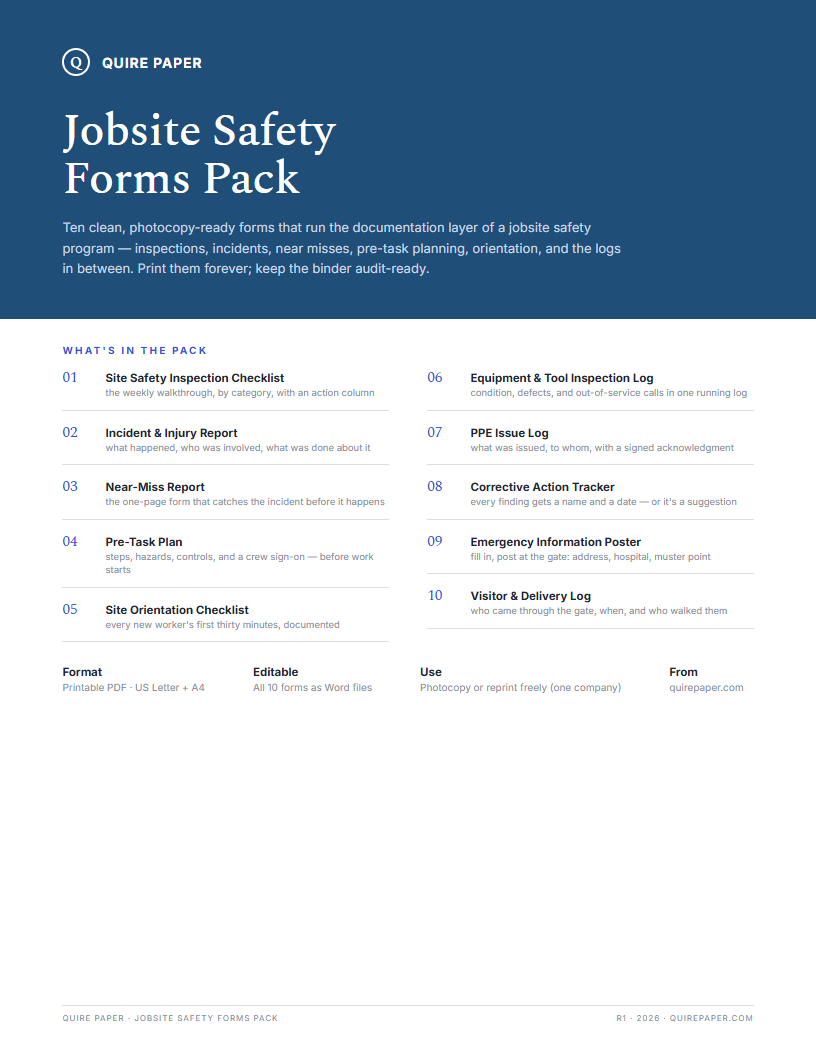
Ten photocopy-ready forms that run the documentation layer of a jobsite safety program: inspections, incidents, near misses, pre-task plans, orientation, and the logs in between. PDF plus editable Word versions of every form.
Your whole rental portfolio in one workbook: a rent roll (with a live lease-expiration engine), a rent ledger, and a maintenance log that roll up to occupancy, collections, expiring leases and open repairs on one dashboard. For small-portfolio, long-term-rental landlords.

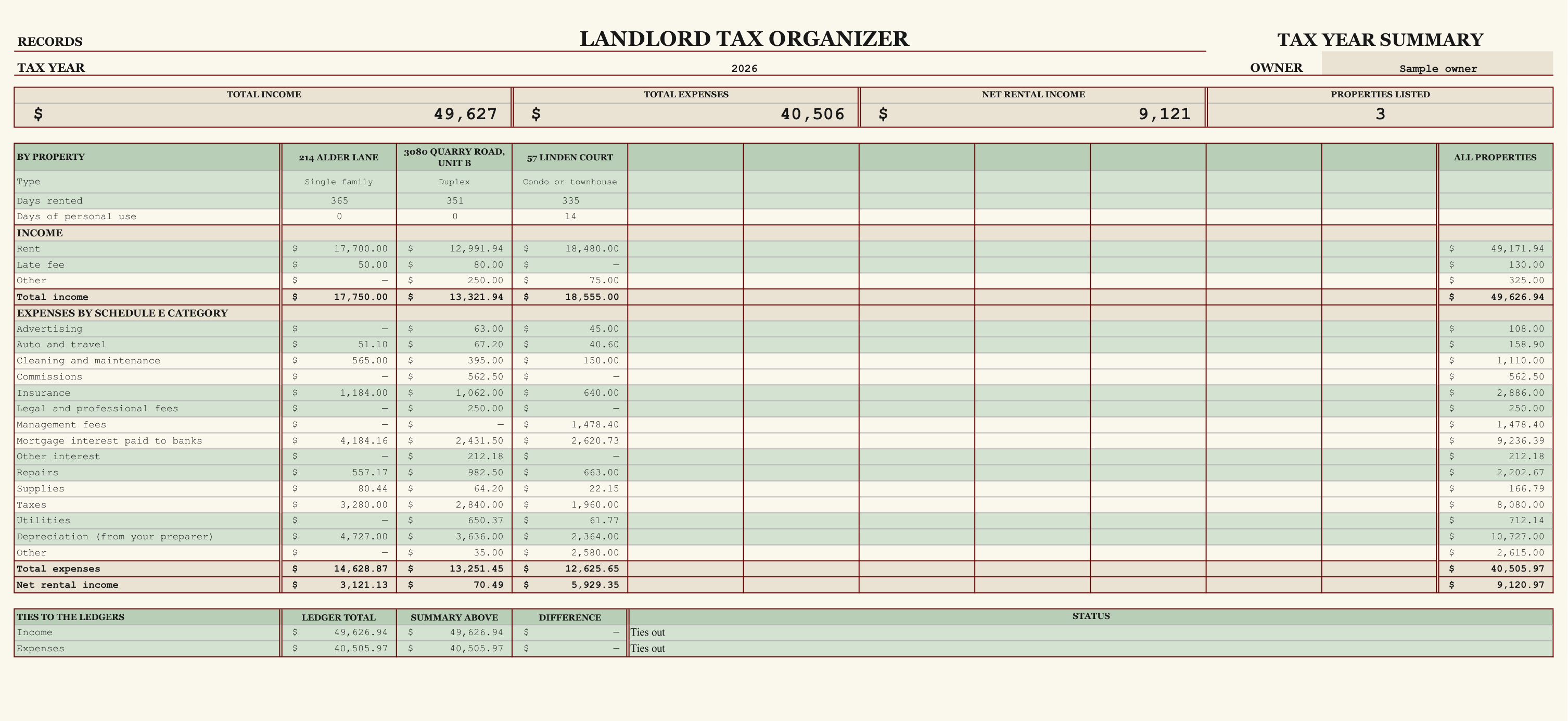
A year of rental income and expenses, kept by property and by Schedule E expense category. Type each rent payment and each expense once, and the summary adds up every property and the portfolio, ready to hand to your tax preparer. For landlords with 1 to 10 long-term rentals.

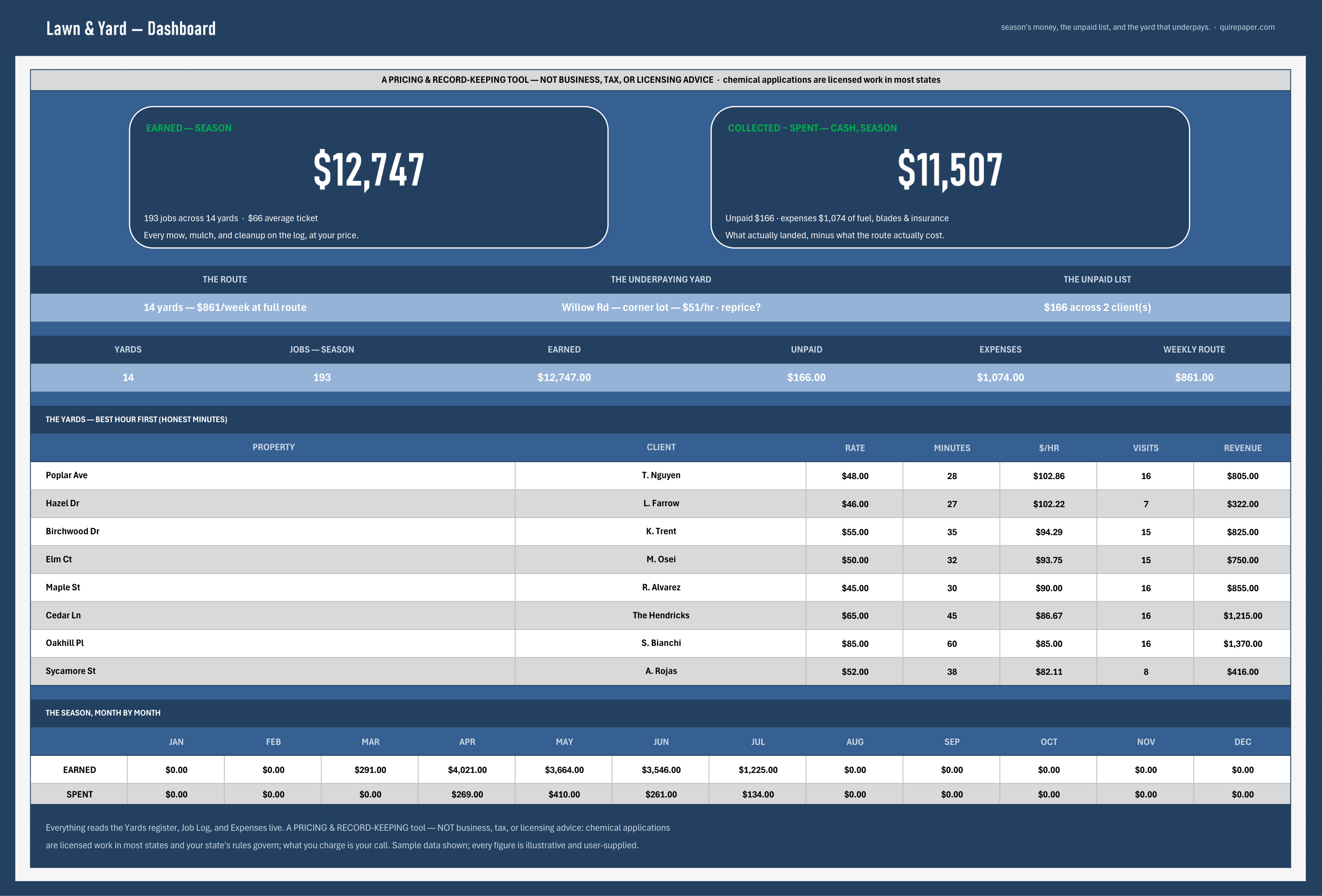
The route's whole paper trail. Every yard carries its mow rate and its real minutes (gate to gate, trimming included), so $/HR per yard is finally visible. The corner lot that takes 70 minutes at a 30-minute price gets named in red ("$51/hr · reprice?"). A ten-second job log keeps every mow, mulch, and cleanup with its paid/unpaid status. The quote builder prices extra work as materials + hours × your target, and reads the client's budget against it before you say a number out loud. A pricing & record-keeping tool. Chemical applications are licensed work in most states, and your rules and prices are your own.
Every lease's days-to-end and status (Active, Renewal window, Expiring soon, Expired, Month-to-month), plus your renewal offers, the tenants' responses, the auto % increase, and a notice-deadline timeline for every unit. The renewal season, run from one workbook.
Every professional license across all 50 states on one dashboard, with a US map that heat-shades by license count.

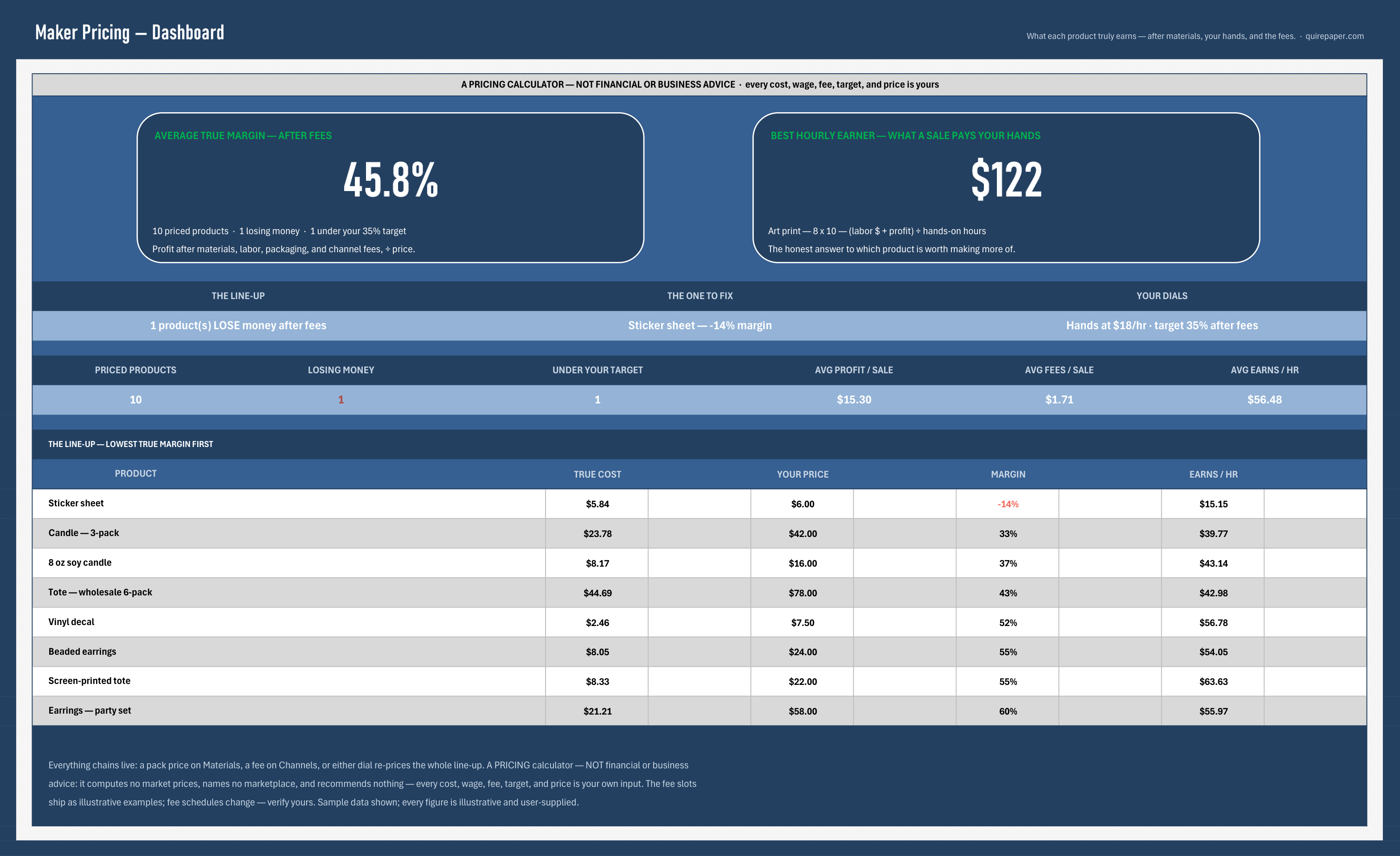
Price handmade work honestly. Material unit costs (buy the case, cost the unit) feed a true cost with YOUR labor and packaging. Then you see what's left after the sales channel's fees, per product, on the channel it really sells on, plus the fee-aware price your own target margin implies, and EARNS/HR: what a sale pays your hands. The sample's sticker sheet loses money after fees on purpose, and that red row is the pitch. Pairs with the Reseller Tracker (this prices before you sell; that tracks profit after).
The practice book for massage and bodywork. Log a session in ten seconds (date, client, modality) with the rate pulled from the roster, and override any row for comps, member rates and intro promos. Every package counts down in sessions, purchased vs received: amber when it's time for the renew talk, red once a client is past the package. In the sample, one client is 9 sessions past and owes $990, which is the drift this sheet is built to catch. Balances net billed against paid, and package credit shows as a negative. Works for solo LMTs, bodywork studios and spa suites. A record-keeping tool. Treatment, intake screening, consent and scope of practice are your professional territory.

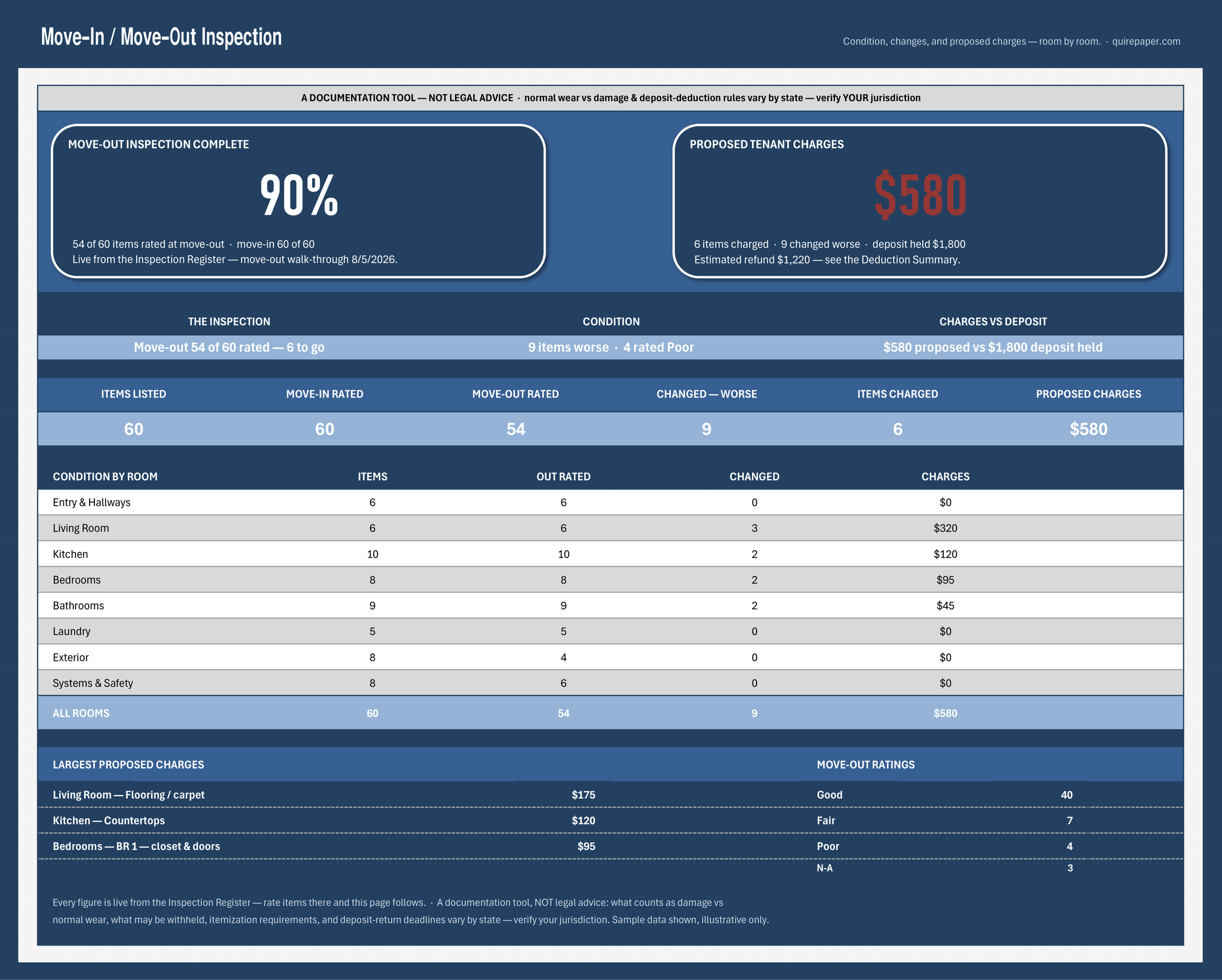
60 items, room by room, rated Good / Fair / Poor at move-in and again at move-out. CHANGED flags trip automatically when condition comes back worse, and the workbook adds your proposed tenant charges and a deduction summary against the deposit. The walk-through, documented properly.

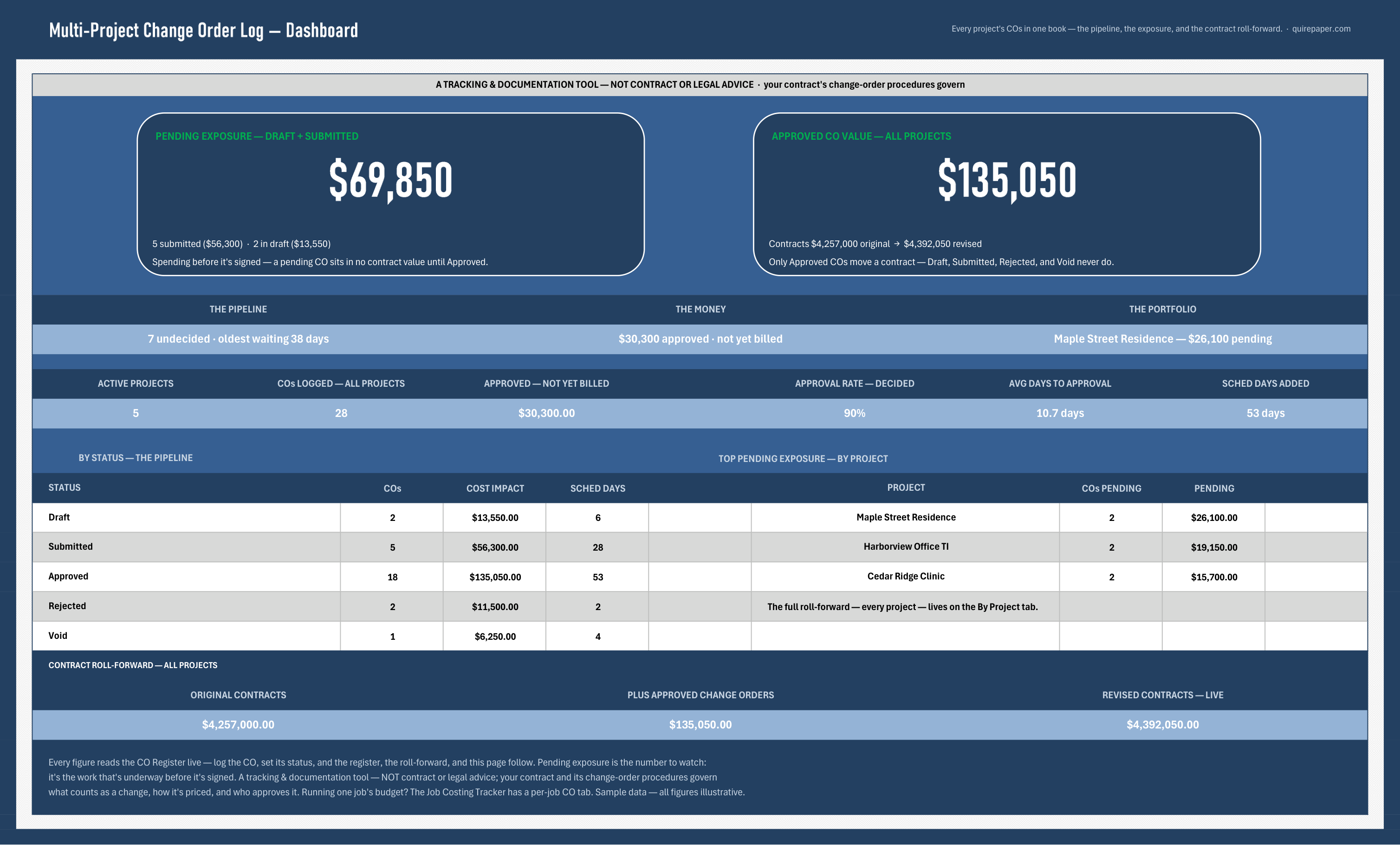
Every project's change orders in one book, not another single-job form. A 70-row register (project, CO #, cost and schedule impact, Draft/Submitted/Approved/Rejected/Void) feeds a per-project contract roll-forward (original + approved = revised), a PENDING EXPOSURE figure (the work you may be doing before it's signed), approved-but-unbilled flags, approval rate, and average days to approval. A tracking tool, not contract advice.
The music studio's book. Every lesson logged in ten seconds (date, student, instrument), with the rate pulled from the roster and an override on any row for make-ups, sibling rates, and recital comps. Every package counts down in lessons, purchased vs taught: amber when it's time for the renew talk, red once a student is past the package. In the sample, one student is 9 lessons past and owes $495, which is the drift this sheet is meant to stop. Balances net billed against paid, and package credit sits as a negative. Works for piano, violin, guitar, voice, drums, any studio. A record-keeping tool. Rates, studio policies, and teaching are your own.
List what you own and what you owe, type in your balances once a month, and see where you stand. It opens on a dashboard: net worth now, the change since last month and over the year, a debt-to-asset ratio, charts, and a focus-month dropdown. A menu on every tab gets you around.
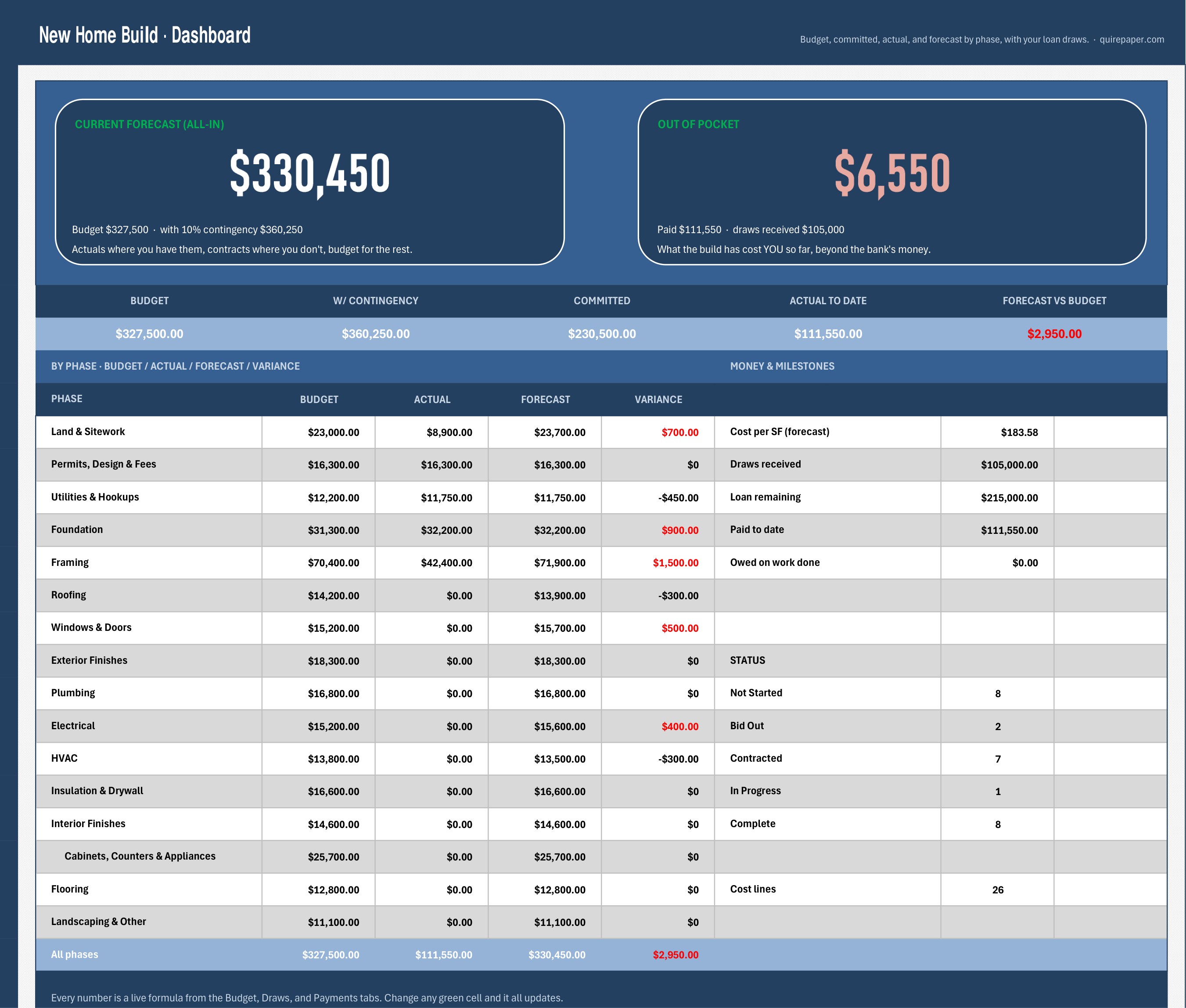
Cost control for building a house: sixteen phases from sitework to landscaping, budget, committed, actual, and forecast on every line, a construction-loan draw log, and the out-of-pocket number owner-builders feel but rarely see. Five tabs, pure formulas, no macros.
The small nonprofit's grant book. Every award carries its restriction, its SPENT and REMAINING from a receipt-level spending log, and its reporting deadline, amber inside your warning window and red past due, because a missed report is what costs renewals. The dashboard separates out RESTRICTED LEFT: money spendable only per its award letter, never quietly absorbed into operations. The pipeline tracks applications from research to decision with the win rate. A record-keeping tool. The award letter governs allowable costs, and filings belong with your tax professional.

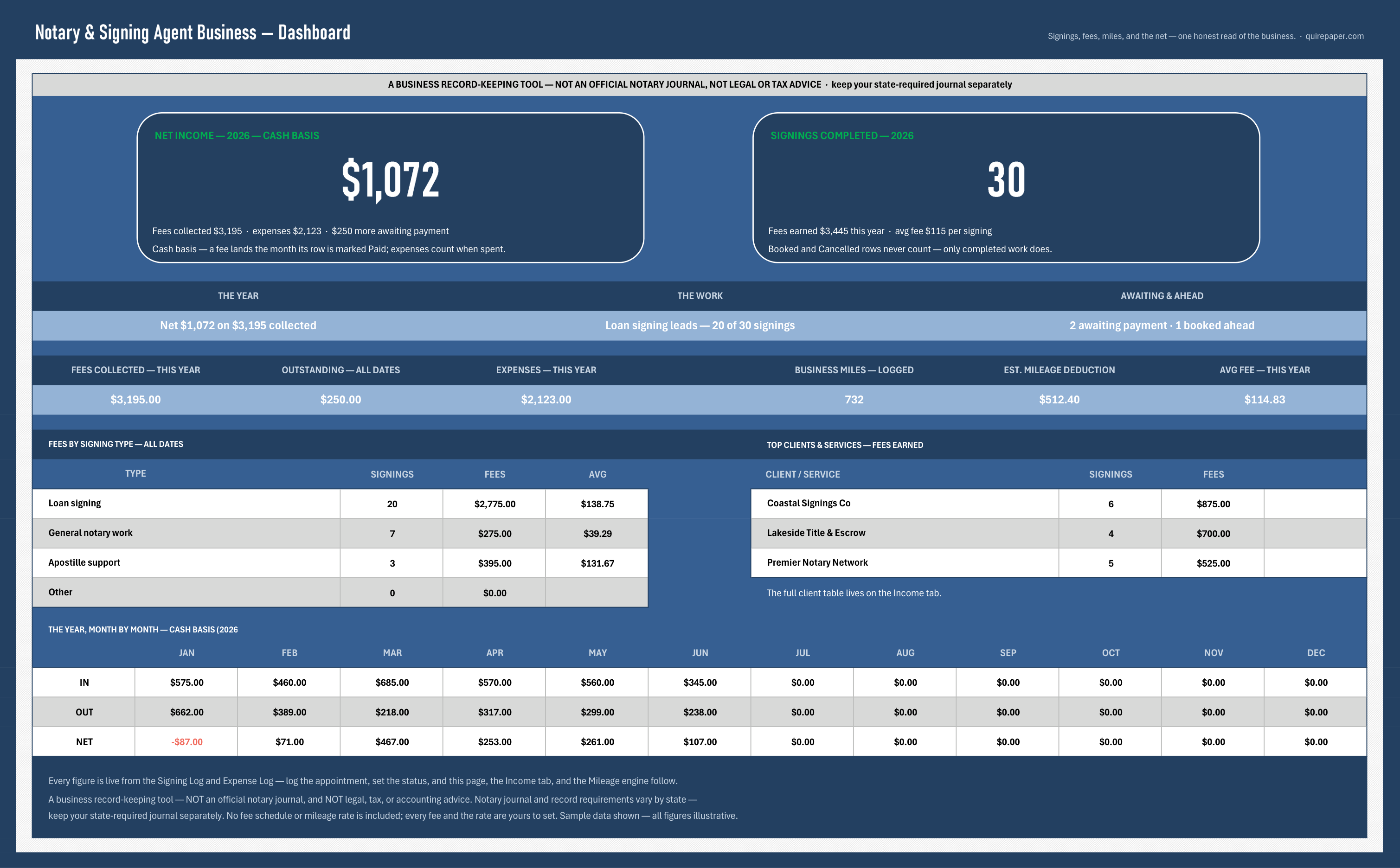
The business side of a mobile notary / signing agent practice, in one workbook. A Signing Log (fee, miles, travel time, payment status) feeds income by month, by signing type, and by client. An Expense Log has a live category rollup, and a mileage engine turns your driving into an estimated deduction at a rate you set. Not an official notary journal: keep your state-required journal separately.

A repeatable method for capturing a person's memories, voice, and wisdom before the window closes. It includes interview frameworks, a question bank for a year of Sundays, the archive system, and an honest guide to the AI layer you can build on top.

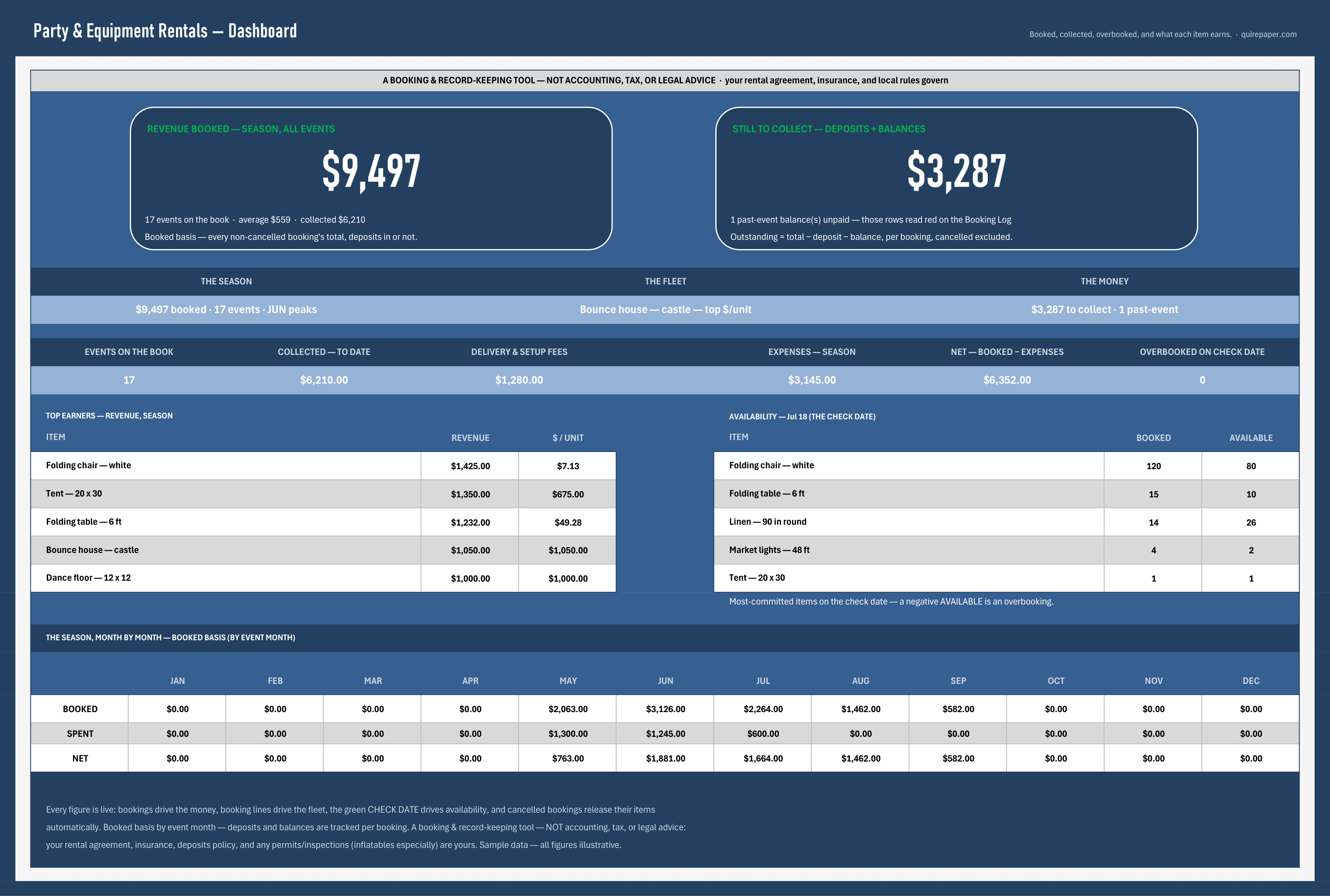
The booking book for a party or event-equipment rental business. A booking log with deposits, balances and a live OUTSTANDING per event (unpaid past events flag red). Per-line booking items drive per-item earnings and utilization. The inventory tab doubles as an availability checker: pick any date and see what's booked, what's free, and what's OVERBOOKED in red. There's also an expense log and a season dashboard that names your peak month and your best earner per unit owned.
The trainer's practice book. Every session logged in ten seconds (date, client, focus), with the rate pulled from the roster and an override on any row for comps and promos. Every pack counts down in sessions, purchased vs trained: amber when it's time for the renew talk, red once you're training past the pack. In the sample, one client is 8 sessions past and owes $520, which is the drift this sheet is meant to stop. Balances net billed against paid, and pack credit sits as a negative. Works for trainers, coaches, and small studios. A record-keeping tool. Programming, screening, and waivers are your professional territory.

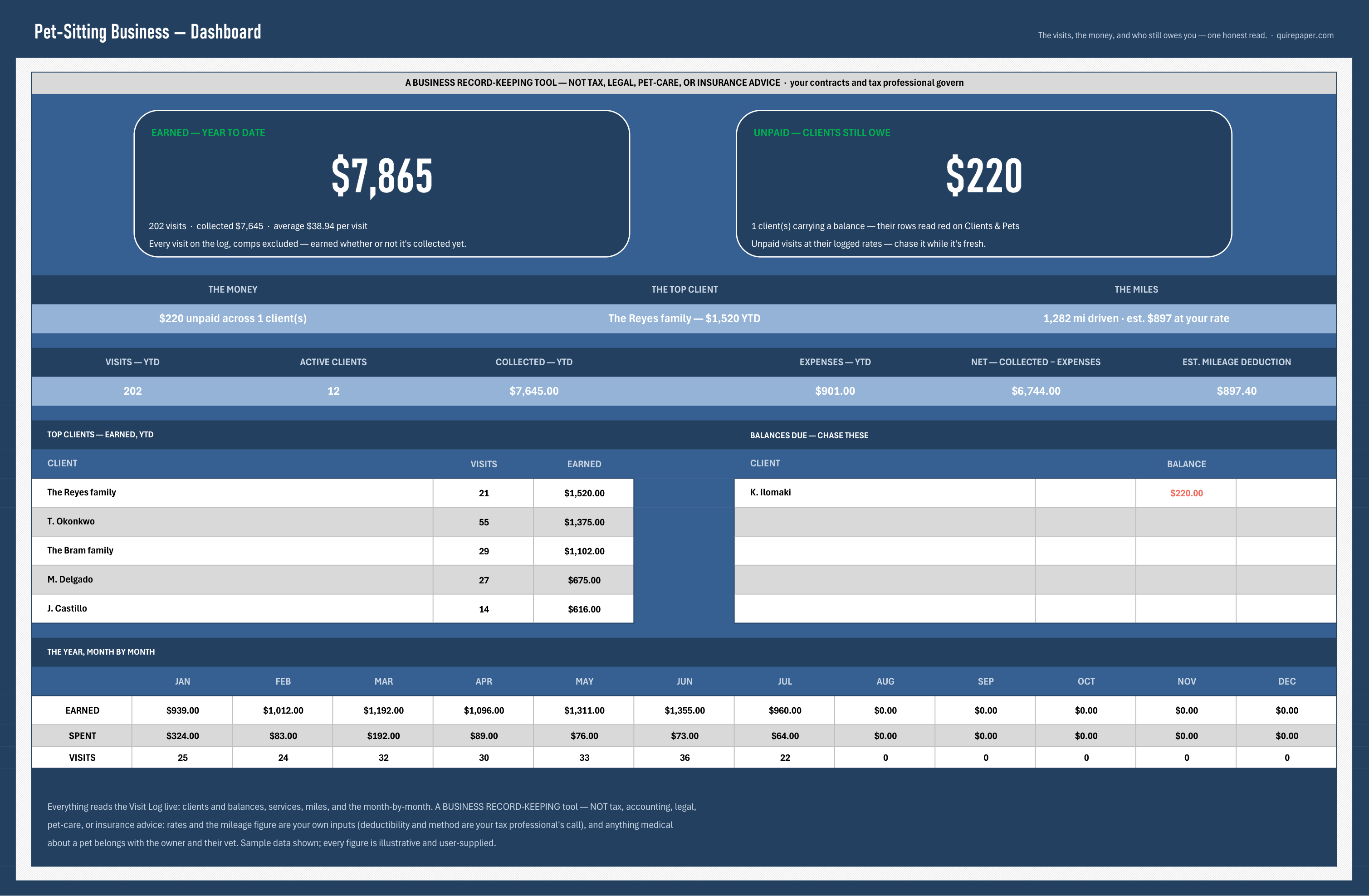
The books-and-bookings workbook for a pet-sitting or dog-walking business. One visit log drives everything: per-client BALANCES DUE that turn red as soon as someone owes you (the loop booking trackers never close), per-service earnings, a mileage total with an estimated deduction at your own rate, an expense log, and a season dashboard. Unpaid visits tint amber, and comp visits stay on the record at $0. It's deliberately not a scheduling app. It's the money book those apps don't keep.

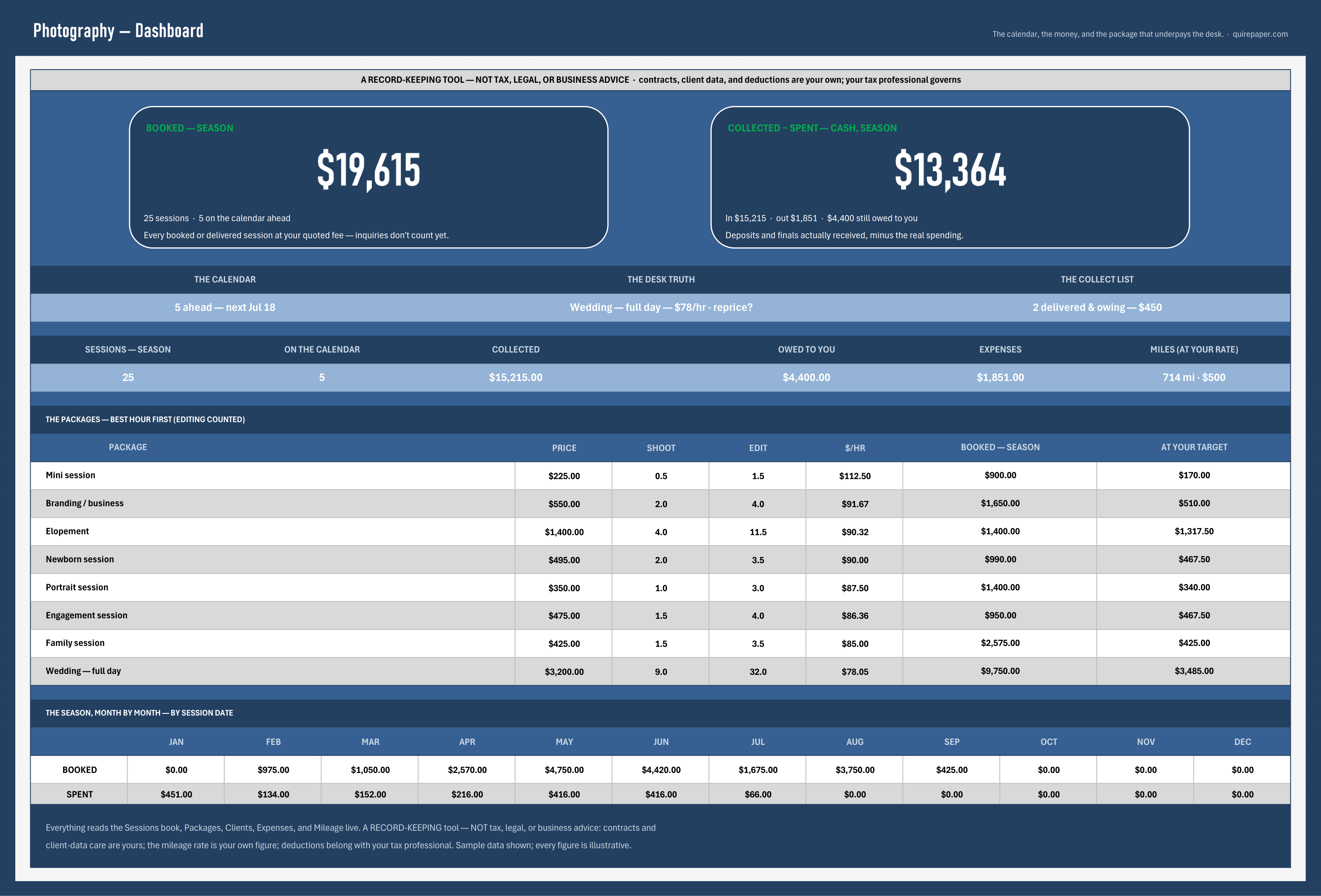
A photographer's whole back office in one file, covering what bookkeeping spreadsheets and client trackers each do half of. A booking book where every session carries its deposit, balance, and the flag that runs your week (COLLECT in red for delivered galleries still owed, EDIT & DELIVER in amber for the desk queue). Packages are priced on the real denominator, shoot hours PLUS editing hours. In the sample, the full-day wedding books the most money and pays the worst hour on the menu. Clients fill themselves in, and expenses and a mileage log at your own rate make April easier. Works as-is for videographers. A record-keeping tool, not tax advice.

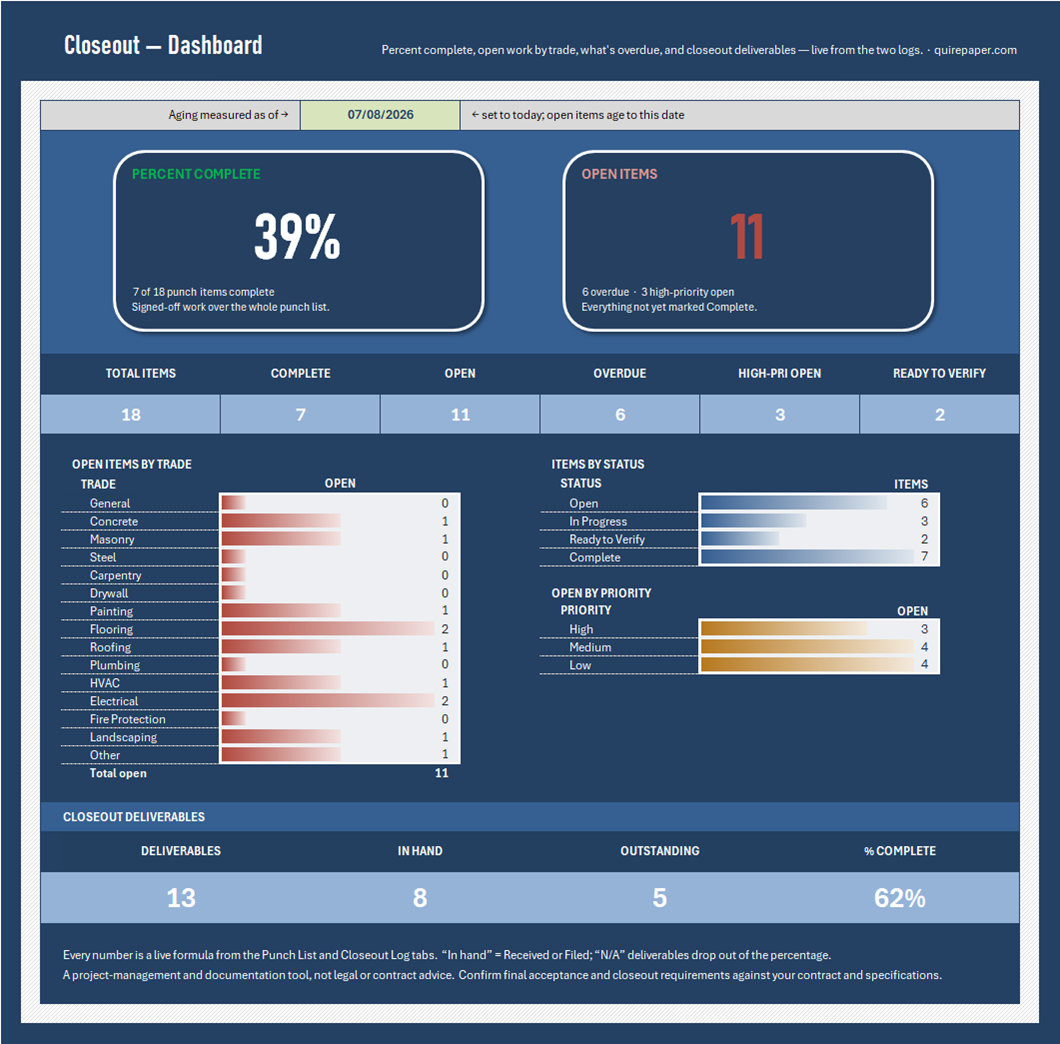
A construction punch list that rolls itself up. Log each item once and the dashboard shows percent complete, open work by trade, what's overdue, and where your closeout deliverables stand: warranties, O&M, as-builts, permits. Four tabs, pure formulas, no macros.

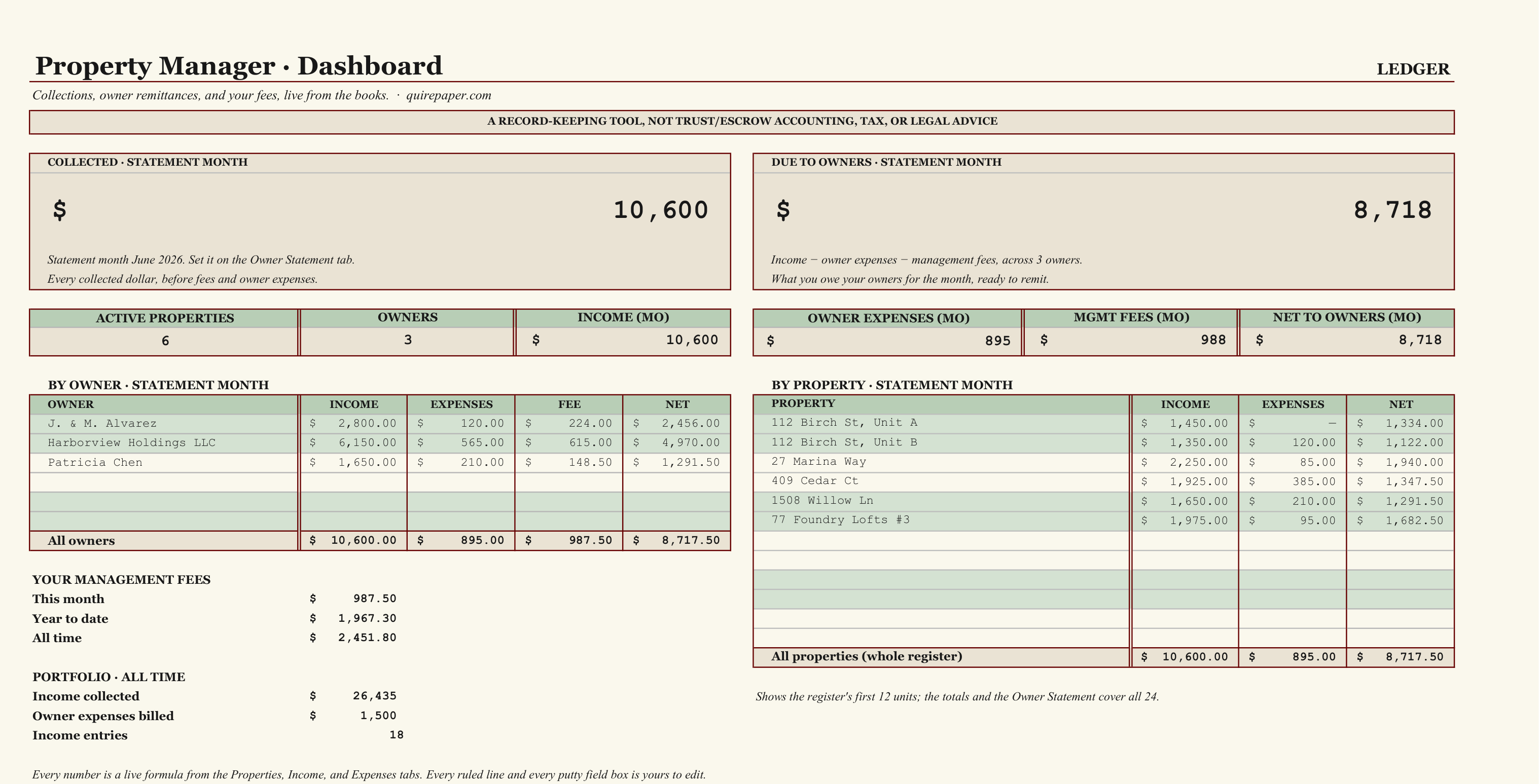
Books for managing other people's rentals: a property + owner register, income and expense logs with auto owner and fee lookups, and the piece generic spreadsheets don't have. Pick an owner and a month and the owner statement generates itself, down to NET DUE TO OWNER. Six tabs, pure formulas, no macros.

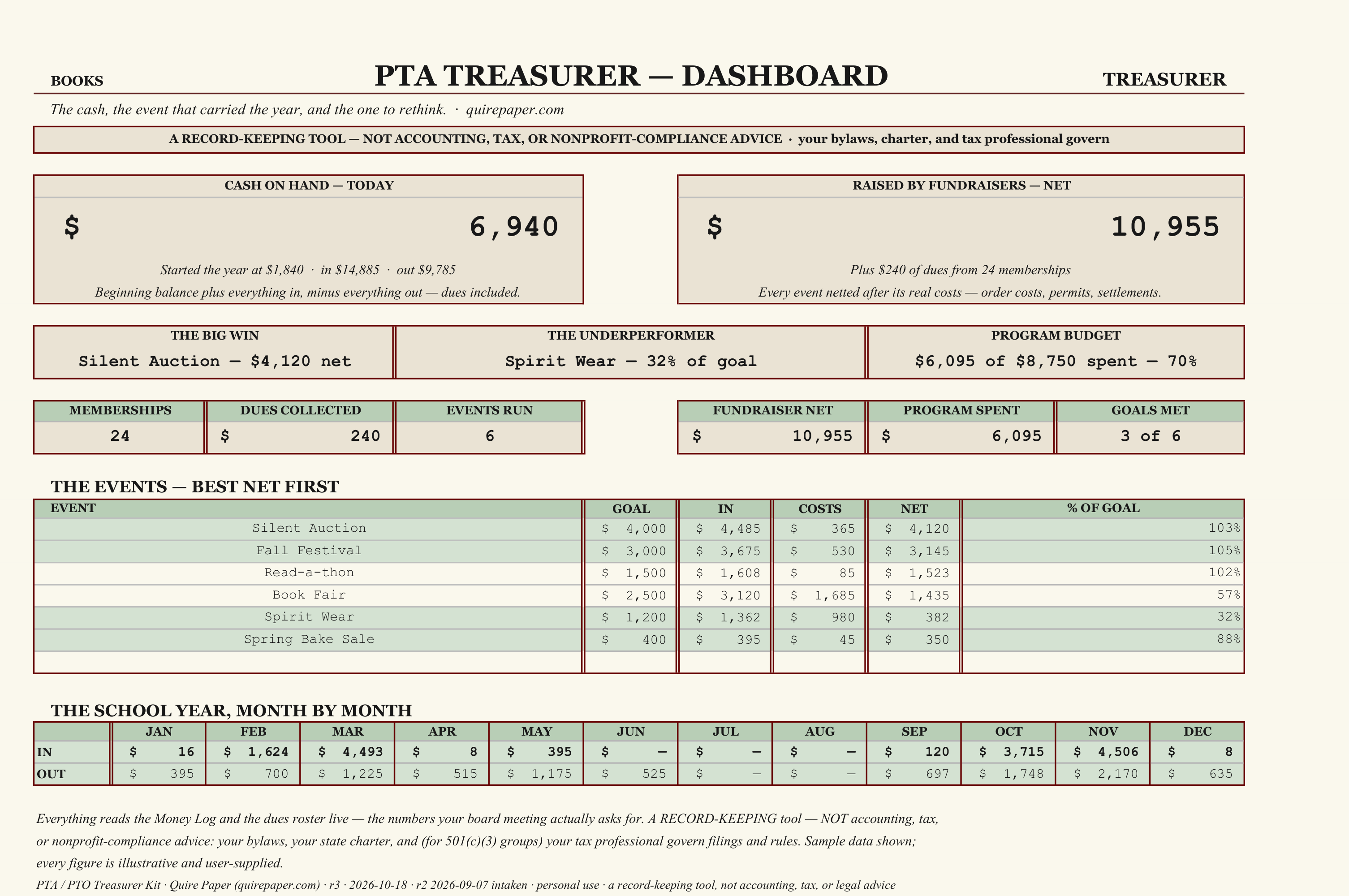
The treasurer's book for a parent-teacher group. One money log with a single habit: fundraiser money gets the EVENT tag and program spending gets the COMMITTEE tag. Everything else fills itself. You get a P&L for every fundraiser against the goal the board voted (the Book Fair's vendor settlement shows why gross isn't net), budget vs actual by committee with amber-watch and over-budget-red, the dues roster, and a dashboard that answers what every board meeting asks: how much cash, which event carried us, which one underperformed. A record-keeping tool, not accounting or nonprofit-compliance advice.

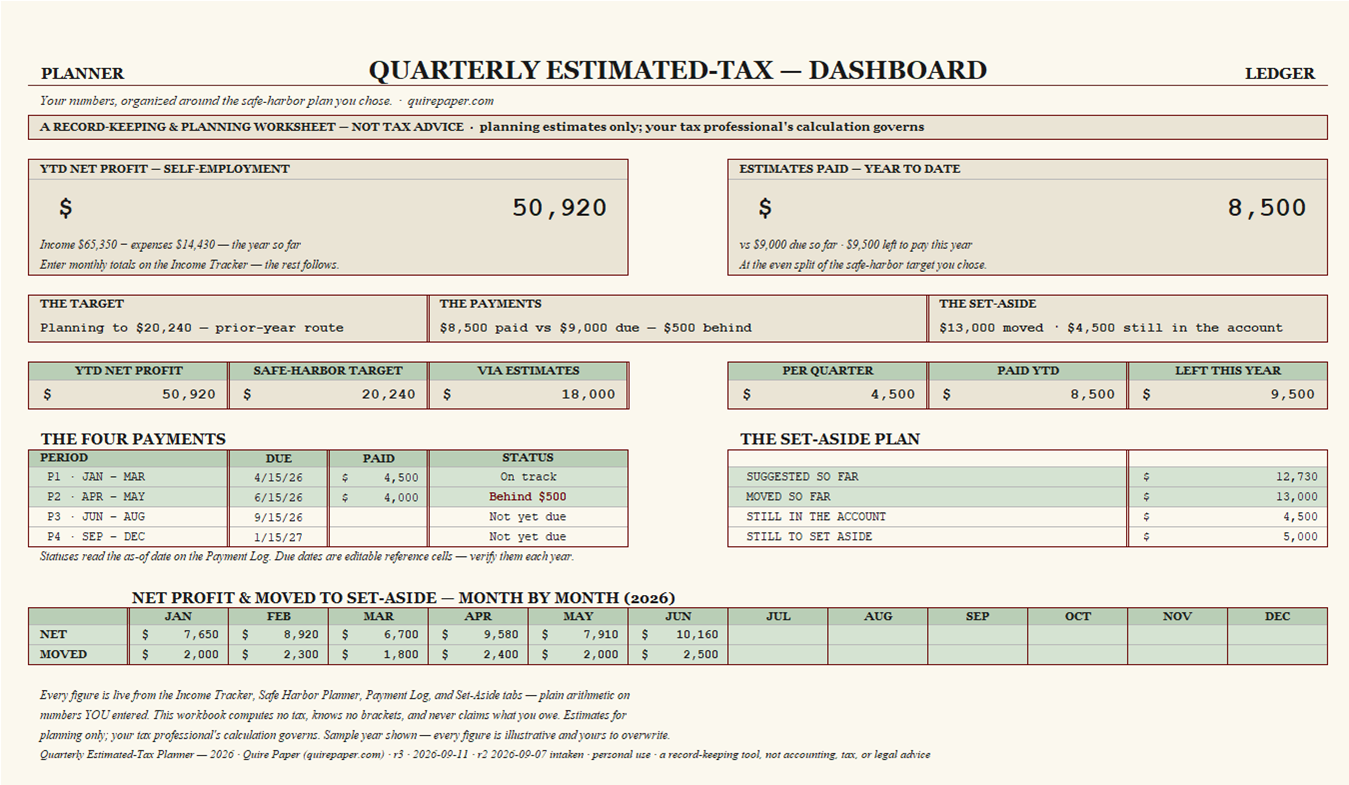
Quarterly estimated taxes, organized. An Income Tracker for your self-employment year, a Safe Harbor Planner that runs the two standard pay-in routes as plain arithmetic on numbers YOU enter (no brackets, no rates hardcoded; every percentage is an editable reference cell), a Payment Log with the four 2026 due dates and an on-track flag, and a set-aside calculator at a rate you choose. A record-keeping and planning worksheet, not tax advice. Your tax professional's calculation governs.

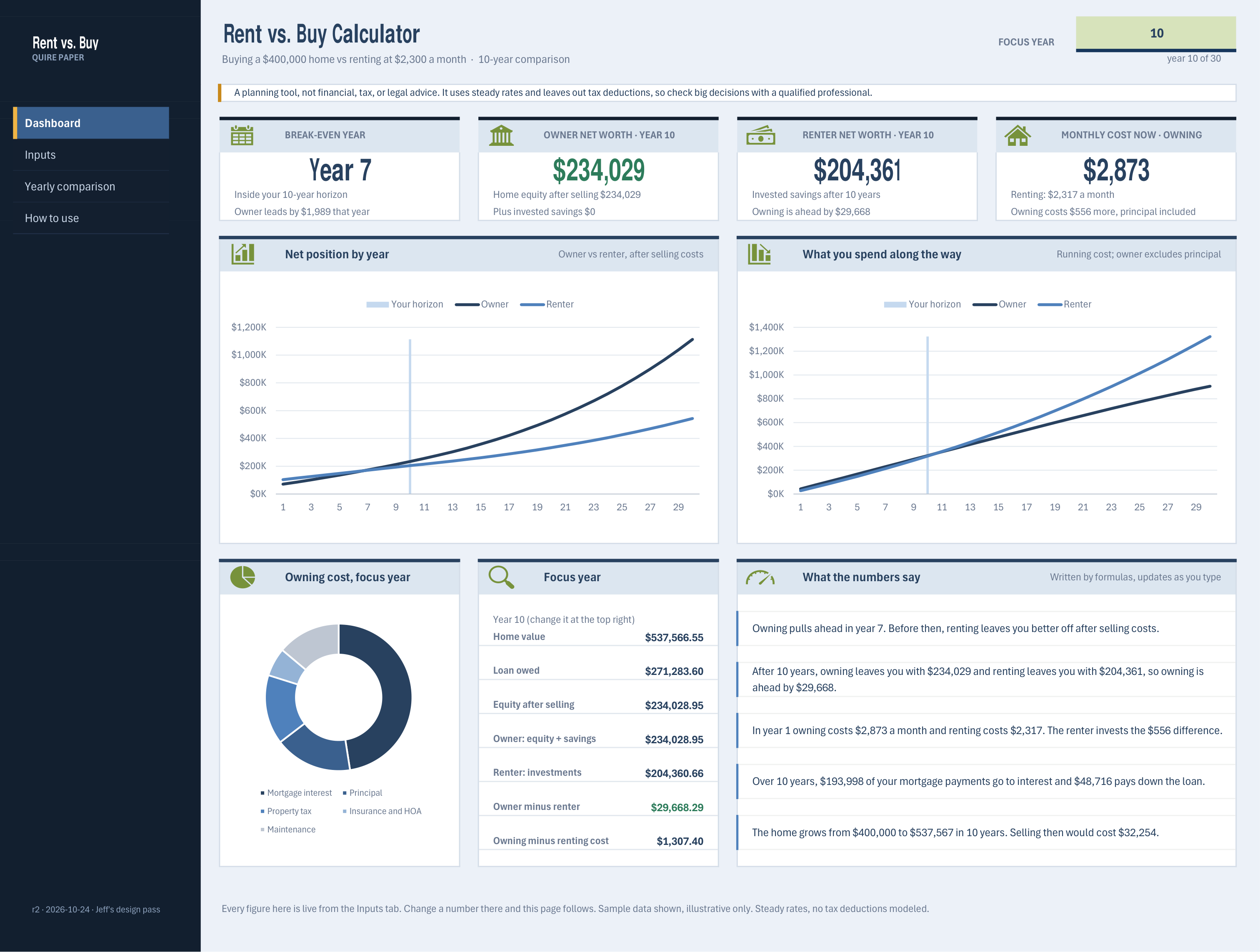
Put buying and renting side by side for up to 30 years. It finds the year owning pulls ahead, shows what each path is worth at the horizon you pick, and gives the monthly cost of each today. It opens on a real dashboard with charts, KPI cards, a focus-year dropdown, and plain-English notes the formulas write for you.

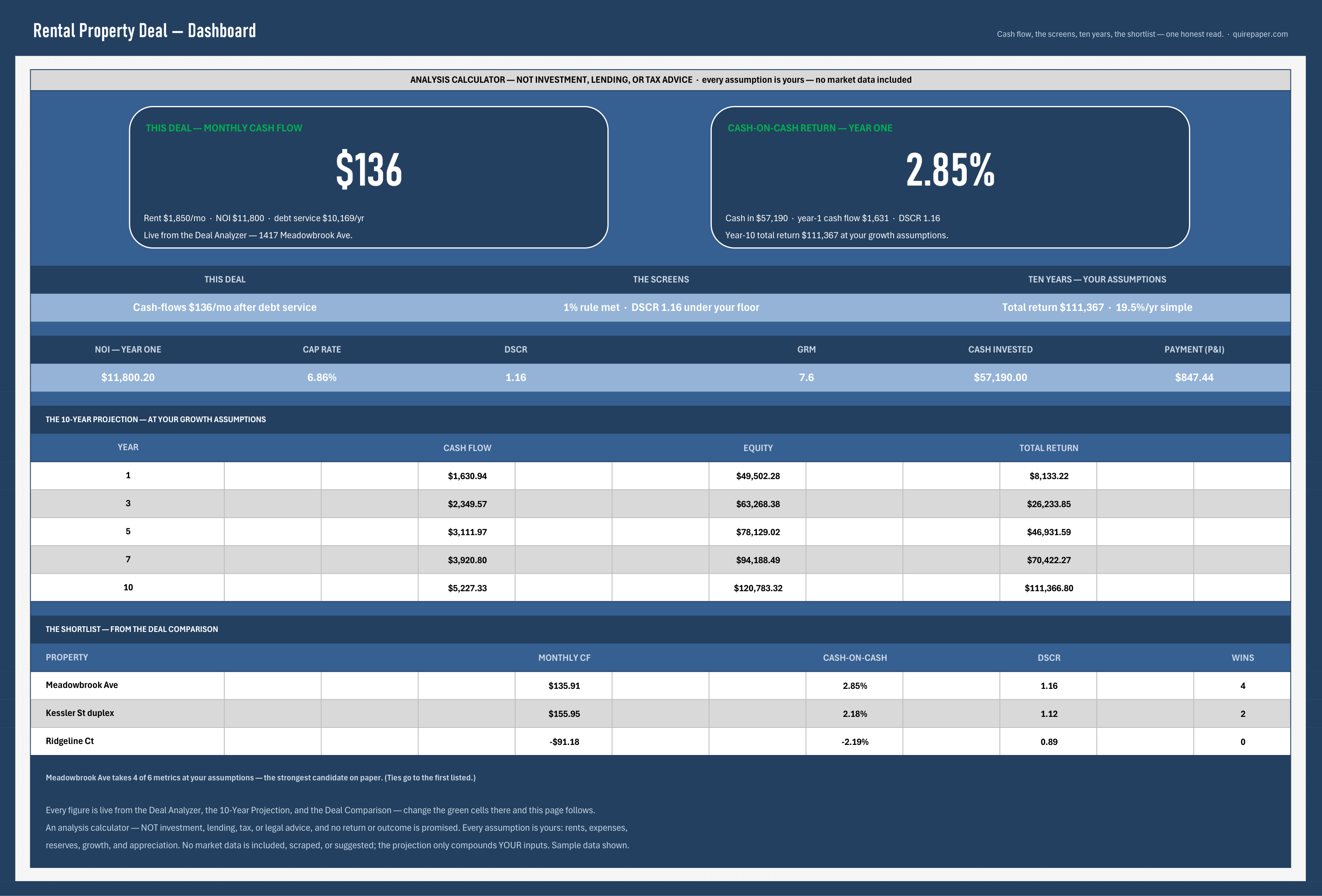
The buy-and-hold analyzer with honest inputs. A contractor-style make-ready estimate feeds your cash invested, and operating expenses run both ways (fixed line items plus %-rule reserves for vacancy, maintenance, capex, management). From there you get NOI, cap rate, cash flow, cash-on-cash, DSCR, GRM, and the 1% rule, each with a plain verdict. A 10-year projection compounds YOUR growth assumptions into cash flow, equity, and total return, and a 3-property comparison names the strongest candidate. A calculator, not investment advice. Every number is yours.
Your whole reselling year on one dashboard: true net profit after fees and shipping, inventory on the shelf, sell-through, days to sell, and which platform earns the most. eBay, Poshmark, Mercari, Depop, Etsy.

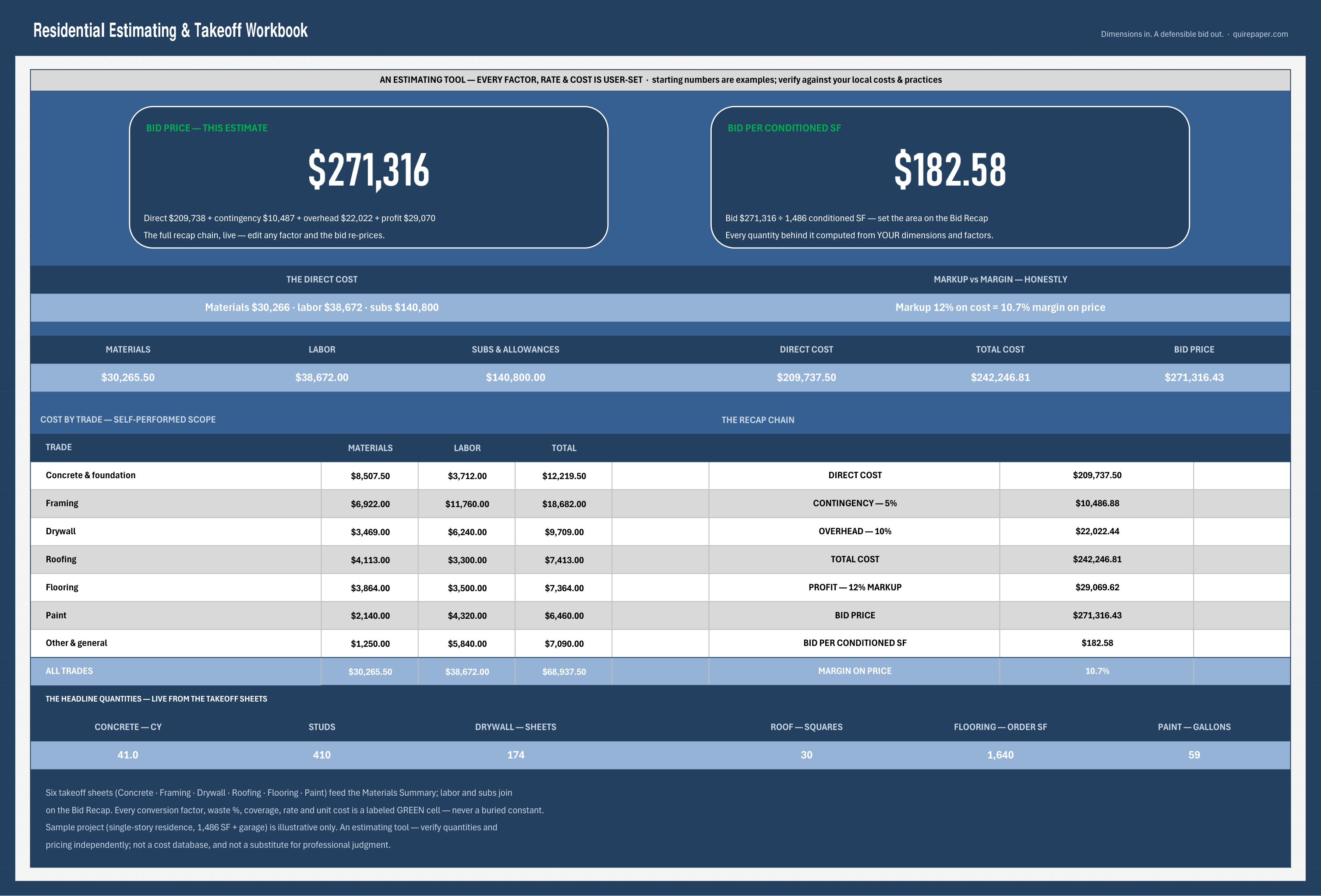
A quantities-first residential estimate, built the way estimators work. Six takeoff sheets (concrete, framing, drywall, roofing, flooring, paint) turn your dimensions into material quantities through transparent formulas: stud counts at YOUR spacing, CY with YOUR waste factor, gallons at YOUR coverage. A Materials Summary prices every quantity at YOUR unit costs, labor runs at YOUR crew rates, and a bid recap gives you contingency, overhead, profit markup, bid price, and $/SF. No cost data claimed anywhere. Every factor is a labeled, editable reference cell.

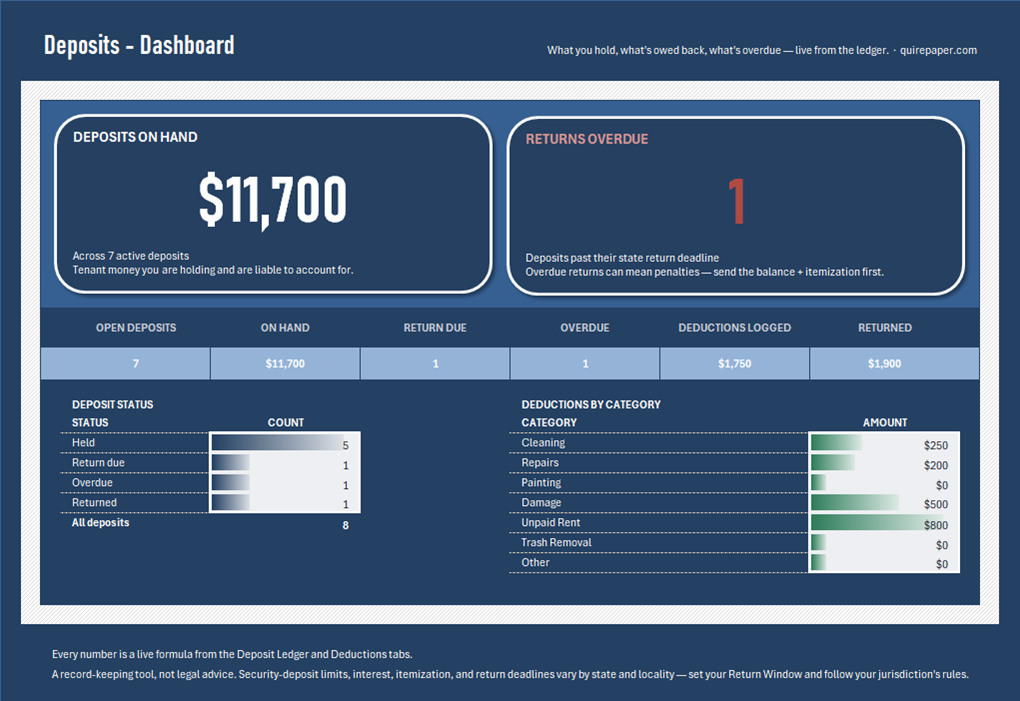
Track every tenant security deposit from start to finish: what's held, where it's held, itemized move-out deductions, and the state return deadline, so a missed return window doesn't turn into a penalty. Pairs with the Landlord / Rental Property Tracker.
For 1099 contractors, freelancers, and gig workers: log expenses by IRS Schedule C category and business miles by trip, and the workbook totals your deductions, maps them to Schedule C, and estimates the tax they save. A record-keeping tool, not tax advice.
The small facility's ledger. Every unit's rate, tenant, and move-in date go in, and CHARGED accrues itself (months on the books × the rate), so each balance stays accurate without writing an invoice. Red when a tenant owes, negative when they've paid ahead. The dashboard answers the three storage questions: OCCUPANCY (by size, too, so you see which doors sell out), THE DELINQUENT, and THE VACANCY BLEED, the rent your empty doors would earn each month. What happens after a red balance (late fee, lock-out, lien) is your state statute and your lease, not this workbook. A record-keeping tool.
Save for car repairs, gifts, insurance, and the trip in separate buckets. Each fund shows what it needs a month, whether you are on track, and how far along it is. It opens on a dashboard with progress bars, charts, a focus-fund dropdown, and plain-English notes the formulas write.

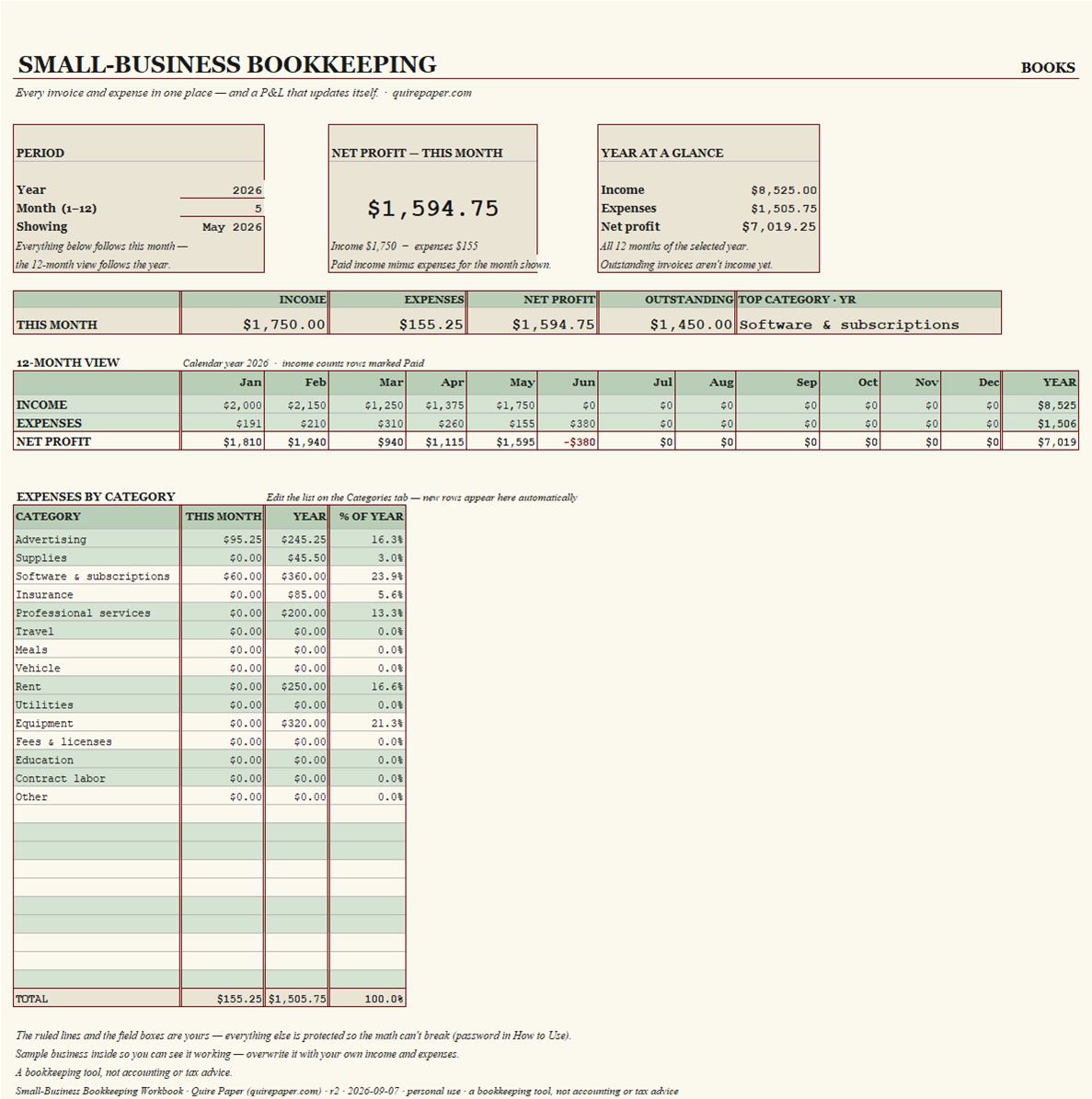
Every invoice and expense in one place, with a P&L that updates itself. An income ledger with invoice status, an expense ledger with category dropdowns, and a month-by-month dashboard that shows the whole year.

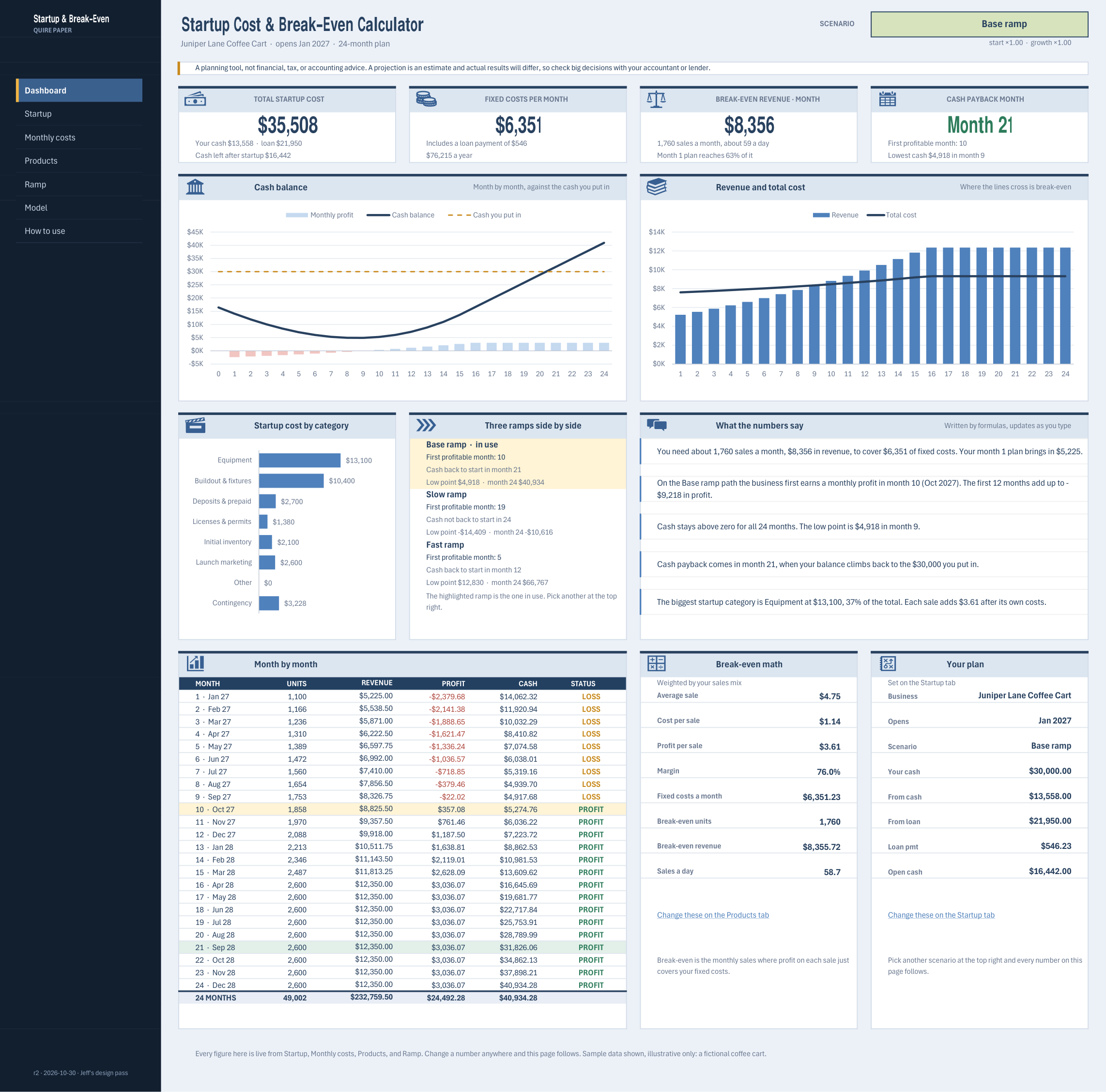
Add up what it costs to open, what it costs to run each month, and how much you have to sell to cover both. It opens on a dashboard with a 24 month cash curve, a break-even point, and a Base, Slow, or Fast ramp dropdown that moves every number.

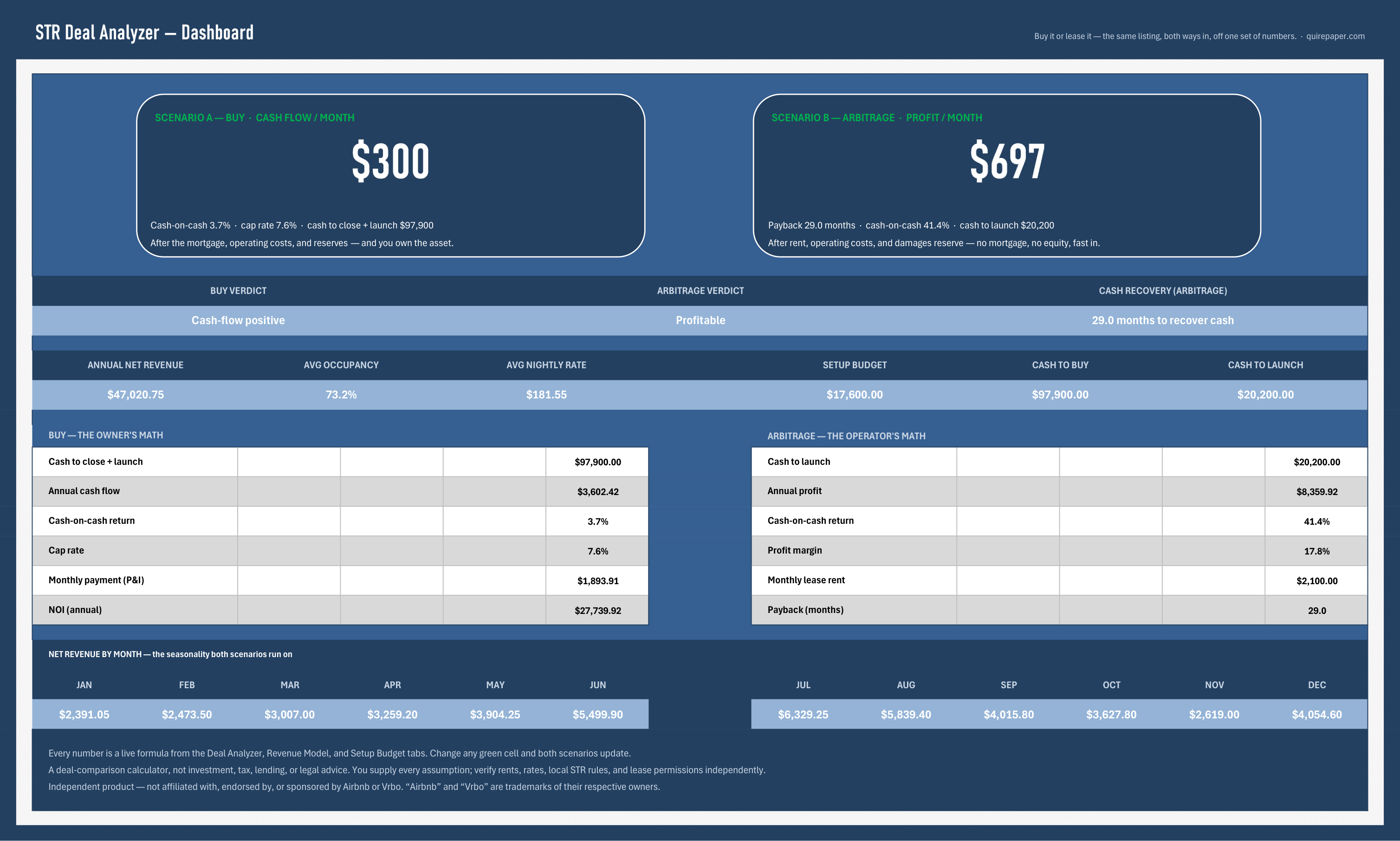
Buy the property, or lease it and host it? One set of numbers runs both. A 12-month seasonal revenue model (your occupancy, your rates) and a furnish-to-launch budget feed a BUY analysis (PMT payment, cash flow, cash-on-cash, cap rate) and a RENTAL-ARBITRAGE analysis (margin, payback months) side by side. Five tabs, pure formulas, no macros.

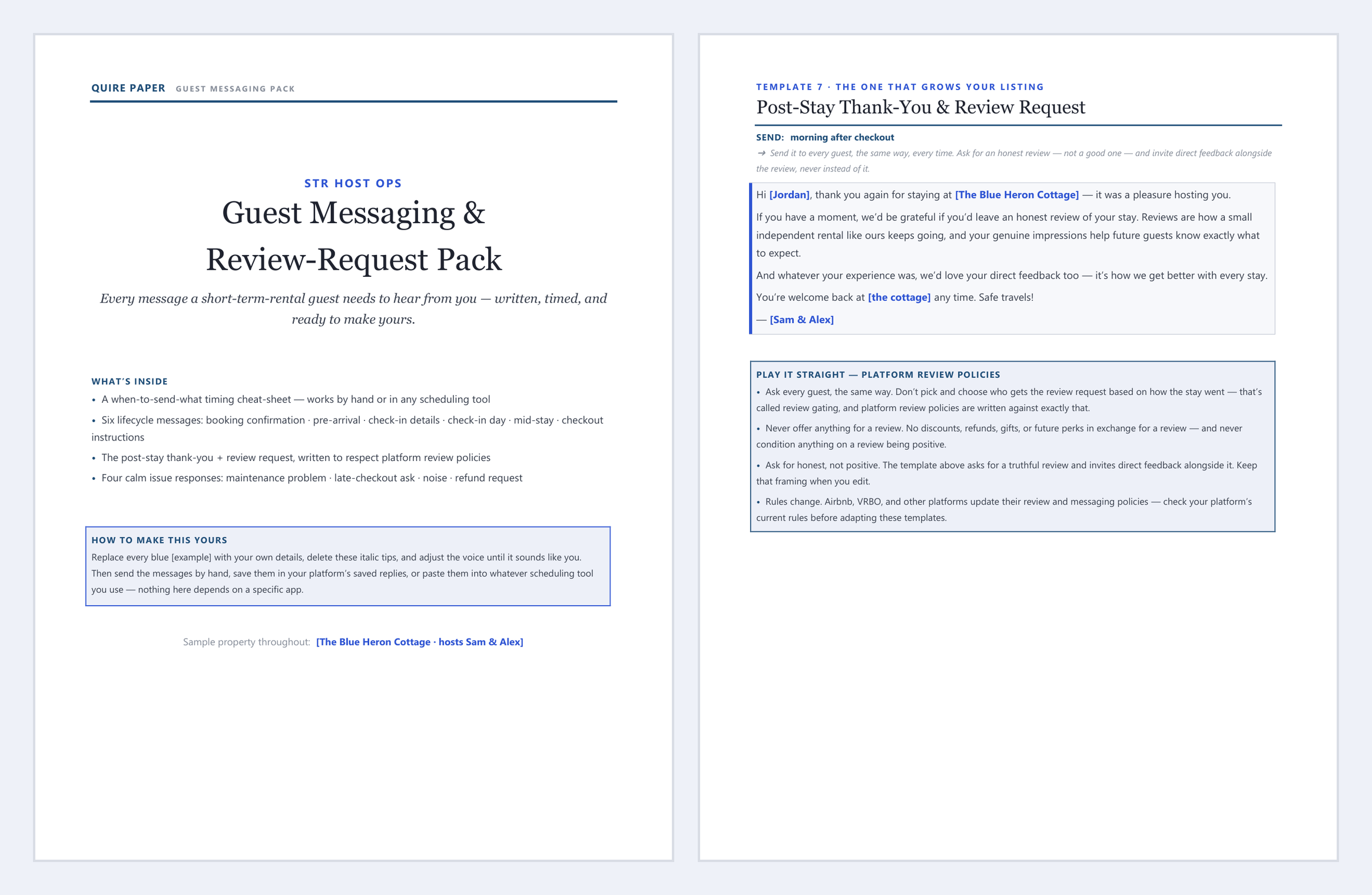
Eleven pre-written guest messages for the whole stay: booking confirmation, pre-arrival, check-in details, mid-stay, checkout, the post-stay review request, and four calm issue responses. Plus a when-to-send-what timing cheat-sheet. Replace the blue example text with your details. Works by hand, in saved replies, or pasted into any scheduling tool.

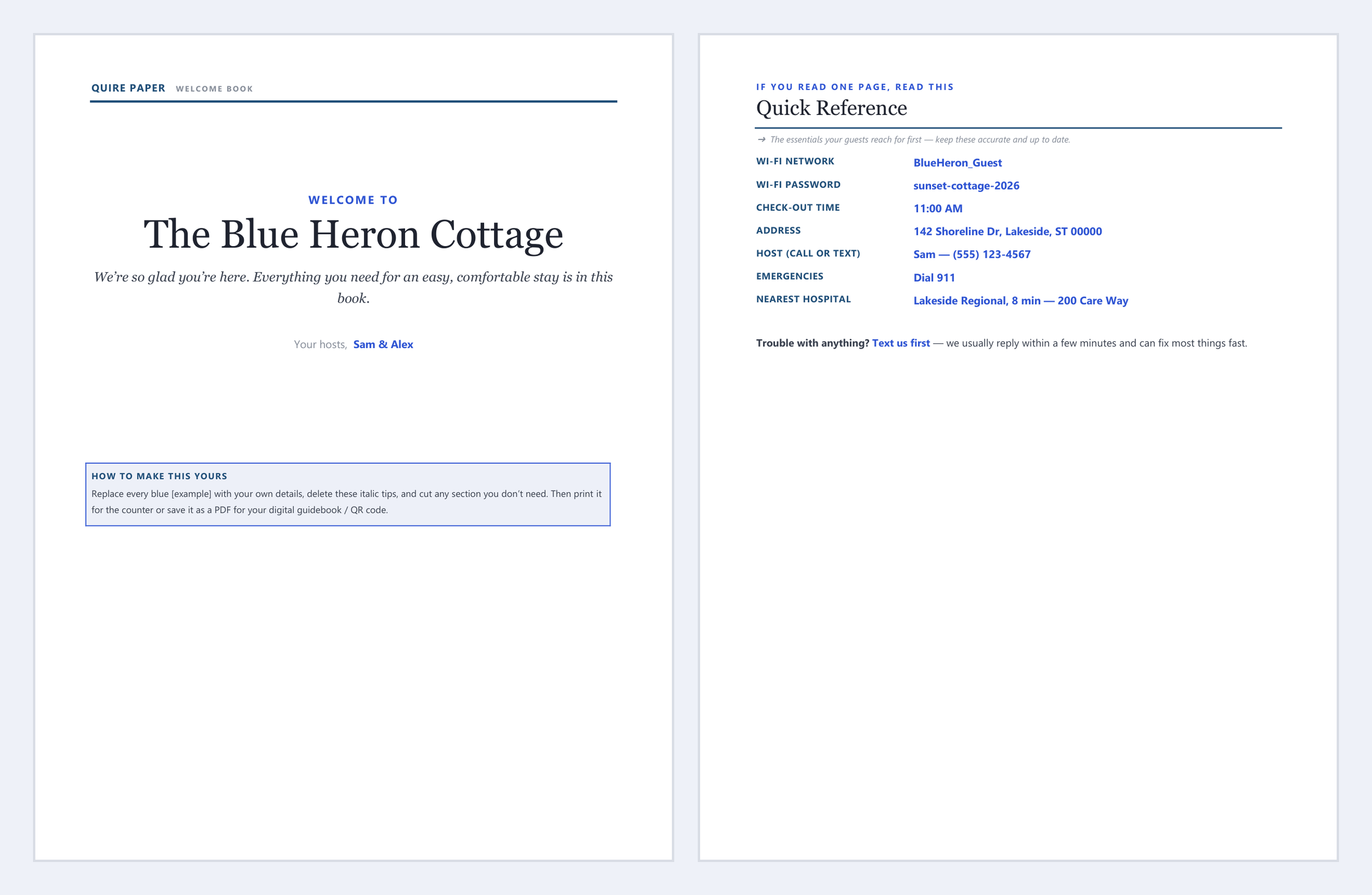
A fully editable house manual for your short-term rental: Wi-Fi, check-out, how everything works, house rules, your local favorites and safety, all in one guidebook. Replace the blue example text with your details, delete the tips, and print it or save a PDF for a QR-code digital guide. Editable Word template + a filled sample PDF.

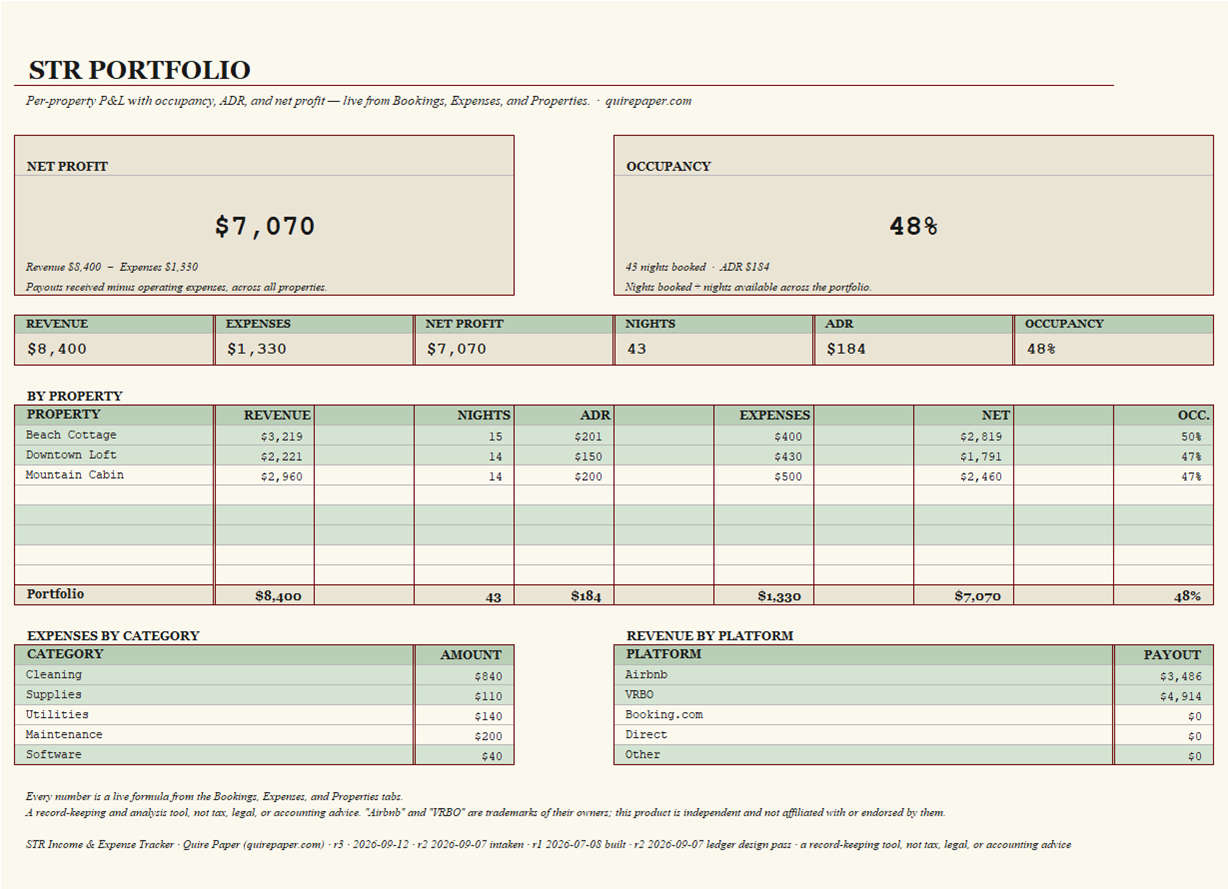
Every booking and expense across your Airbnb & VRBO listings in one workbook, with per-property P&L, occupancy, ADR, cleaning and platform fees, and net profit figured for you. Multi-property, formula-driven, no macros.
Don't run short mid-turnover. Set a par level for every supply in every property and log what's on hand. The sheet calculates the reorder quantity, the restock cost, and an OK / Reorder / Out status, and a dashboard totals your shopping run by category and by property. Two tabs, pure formulas, no macros.

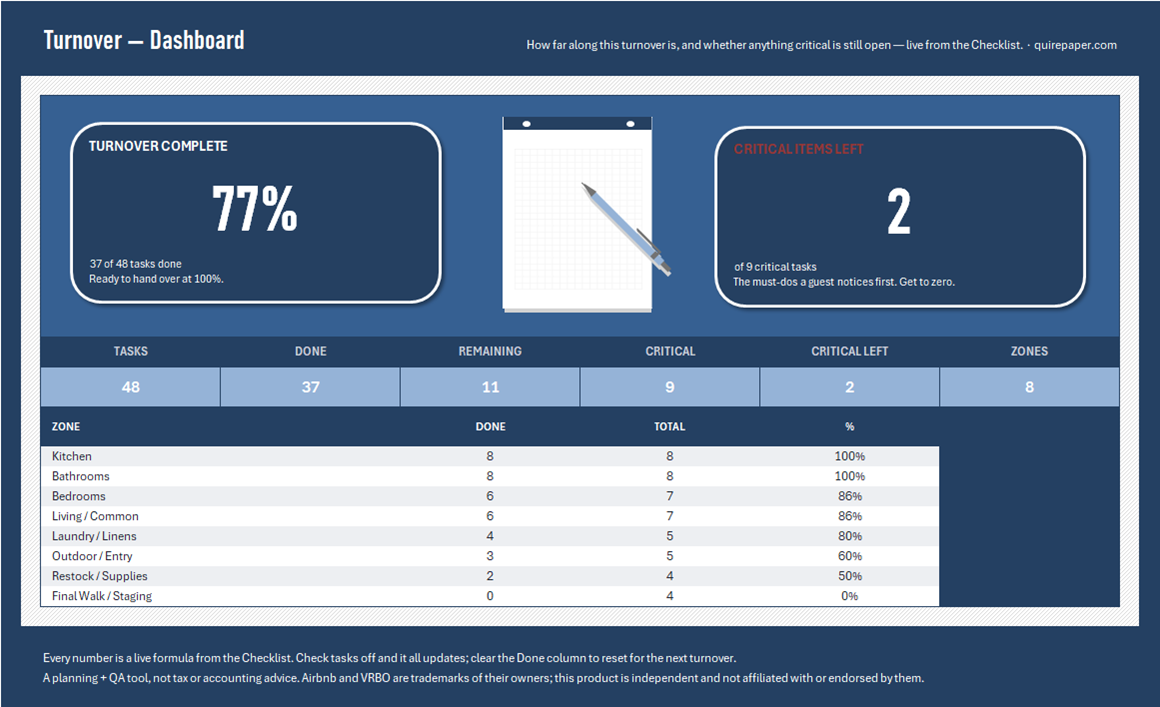
More than a static printout: a trackable turnover QA system. ~48 tasks across 8 zones, each with a critical flag and a done check, plus a live engine that shows your completion %, tasks remaining, and the critical items still open before you hand the property over. Two tabs, pure formulas, no macros.
Every subcontractor's certificate of insurance in one register that watches the expiration dates for you. It flags who has lapsed, who's about to, and who's missing a required policy before they set foot on your site. Type the dates and the workbook tracks the rest.

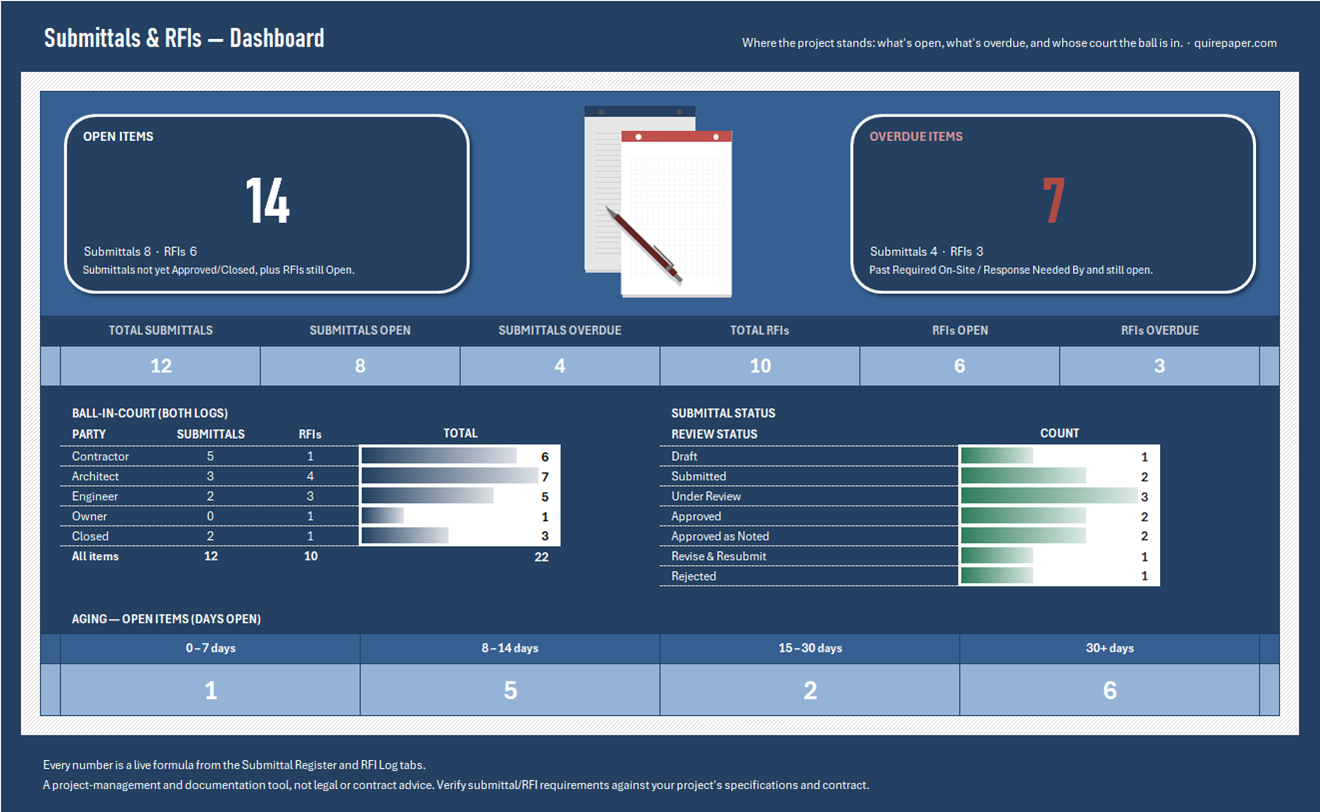
Two logs every project lives by: a submittal register and an RFI log on one dashboard that shows what's open, what's overdue, and whose court the ball is in. Type your entries and the workbook counts the rest.

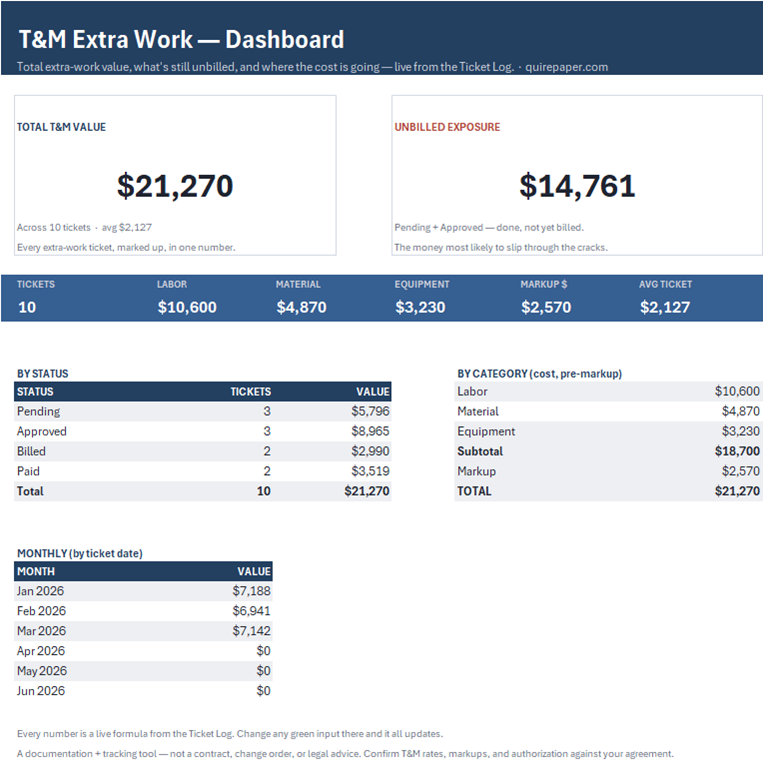
Document every time & material extra with a signable field ticket for labor, material, and equipment (each with its own markup), plus a running log of every ticket and a dashboard that shows your UNBILLED EXPOSURE: the approved work that hasn't hit an invoice yet. Four tabs, pure formulas, no macros.

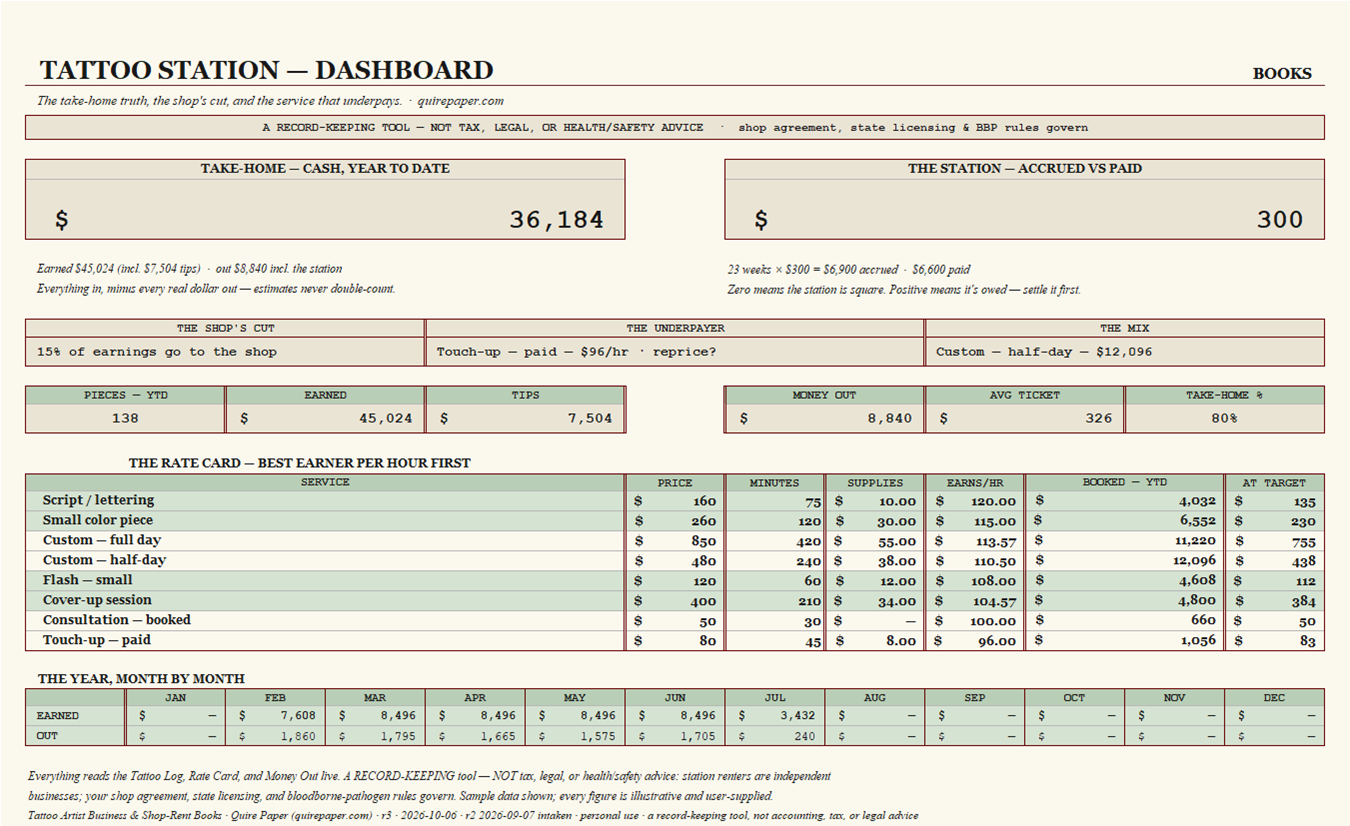
The station renter's books. THE STATION ENGINE: weekly shop rent accrues from your start date (weeks × rate, netted against every rent payment you log), so 'am I behind on the station?' always has an answer. The sample sits one week, $300, behind. A rate card works out what each piece EARNS PER HOUR after supplies (needles, ink, barrier, aftercare) against your target. In the sample, the paid touch-up runs $96/hr against a $100 target and reads red, with the price that fixes it already figured. There's also a tattoo log with tips, a money-out log for inks and the license, and TAKE-HOME, cash in minus cash out. Works for percentage-split shops too. A record-keeping tool. Your shop agreement, state licensing, and bloodborne-pathogen rules govern.
Compare rental applicants side by side on the same lawful criteria (income ratio, credit, rental history, references, background), with a built-in fair-housing & FCRA checklist. It does the income math and keeps the record. You make the decision.

A guided capture kit for loud minds: prompted brain-dump page, a calm four-pile sort, tiny first steps, a bedside night page, and pocket cards. From our Daily Reset line.

A calm one-page daily planner for busy minds: brain-dump, pick just three, break down the scary task, end the day with proof. From our Daily Reset line.

A month-ahead ritual: dump it all out, pick just three things, keep one small habit, and close the month with proof. From our Daily Reset line.

The complete Daily Reset collection: Daily, Weekly, and Monthly Resets, Gentle Goals, and the Brain Dump, with a Start Here guide. $56 separately, $39 together.

A ten-minute Sunday ritual: dump the week, pick three, match heavy work to your good hours, close kindly on Friday. From our Daily Reset line.
Where every tool is, who has it, when it is due back, and when it needs service. A register, a check-out log, and a service log feed a dashboard with a where-is-everything chart, a service due list, overdue returns, warranty dates, a job-or-crew focus filter, and notes the formulas write for you.

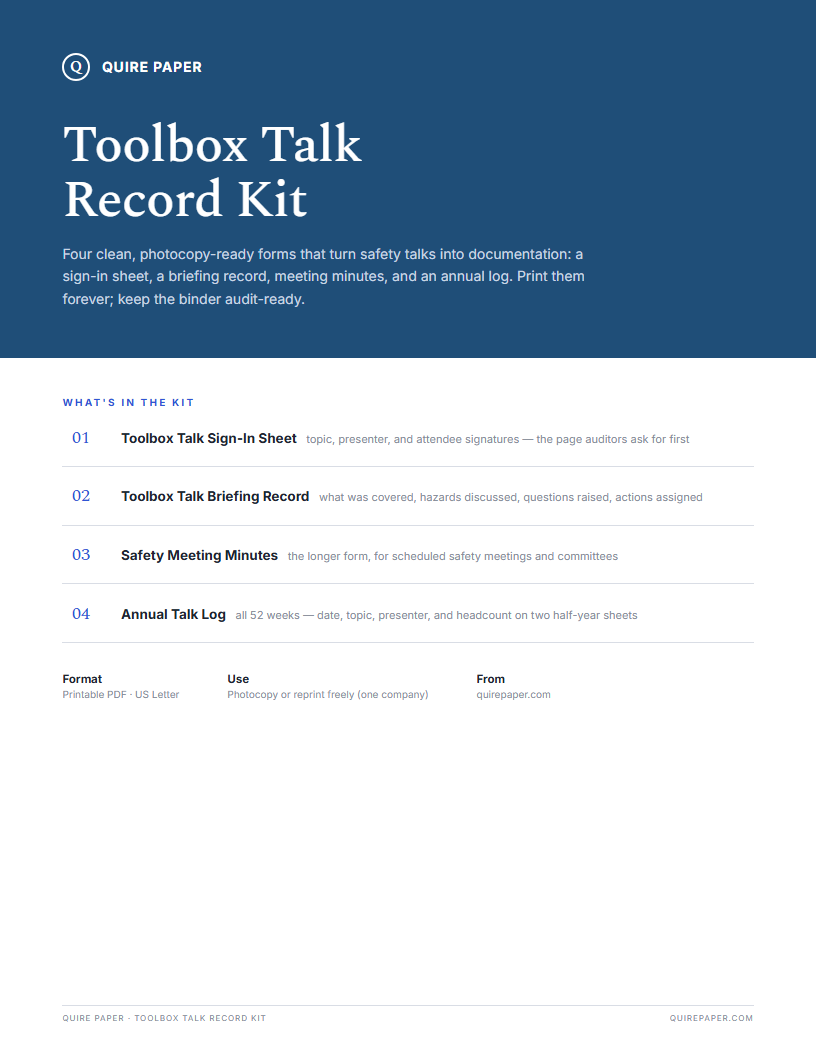
Four photocopy-ready forms that put your safety talks on paper: sign-in sheet, briefing record, meeting minutes, and a 52-week annual log. Keeps the binder ready for an audit.

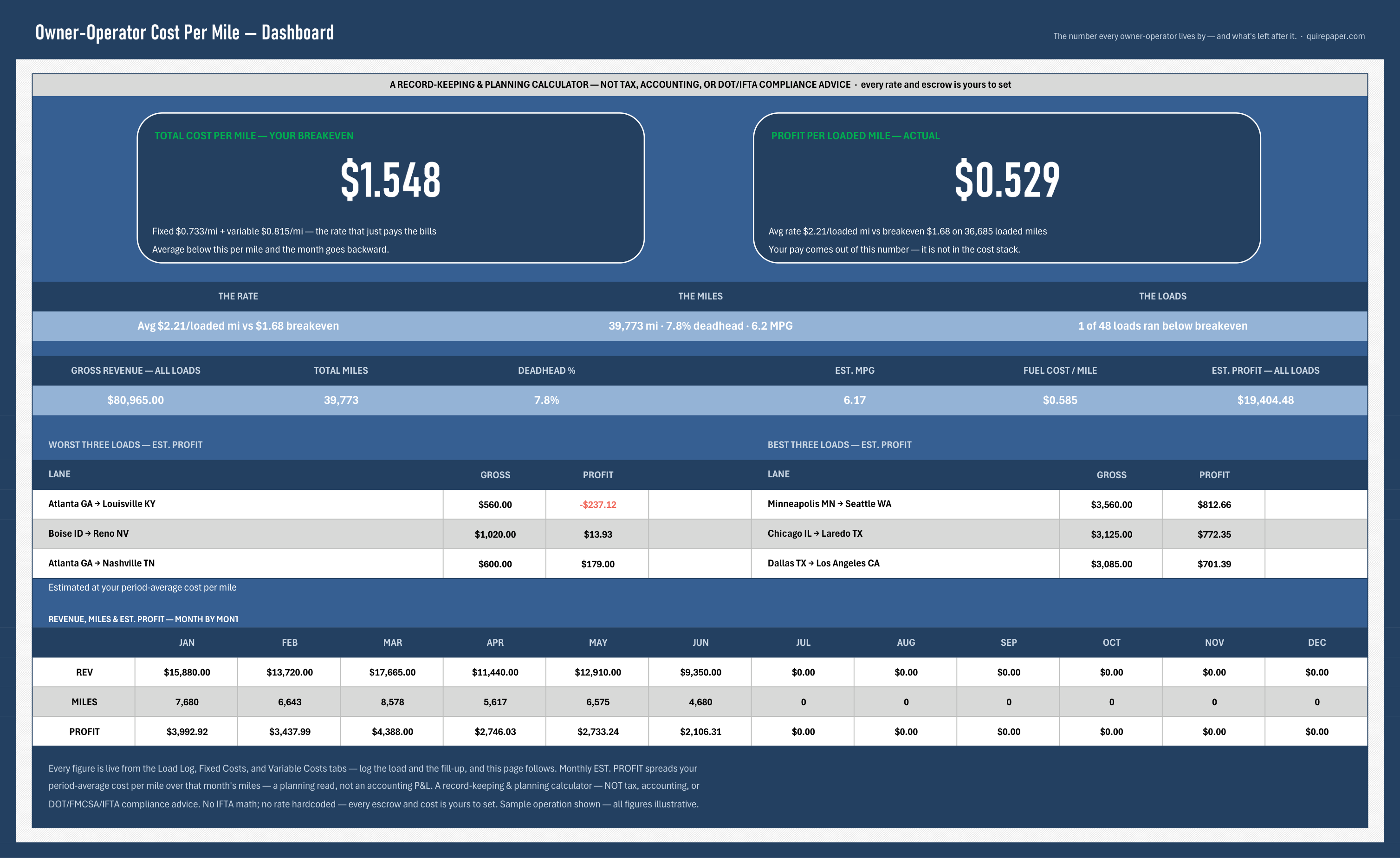
The number every owner-operator lives by, computed instead of guessed. A Load Log (loaded and deadhead miles, gross pay, rate per mile, estimated profit per load), Fixed Costs at YOUR expected monthly miles, a fuel log that turns fill-ups into MPG and fuel cost per mile, and the engine that adds it up: total cost per mile, breakeven per loaded mile, profit per loaded mile. No IFTA math, no compliance claims. Every rate and escrow is yours to set.

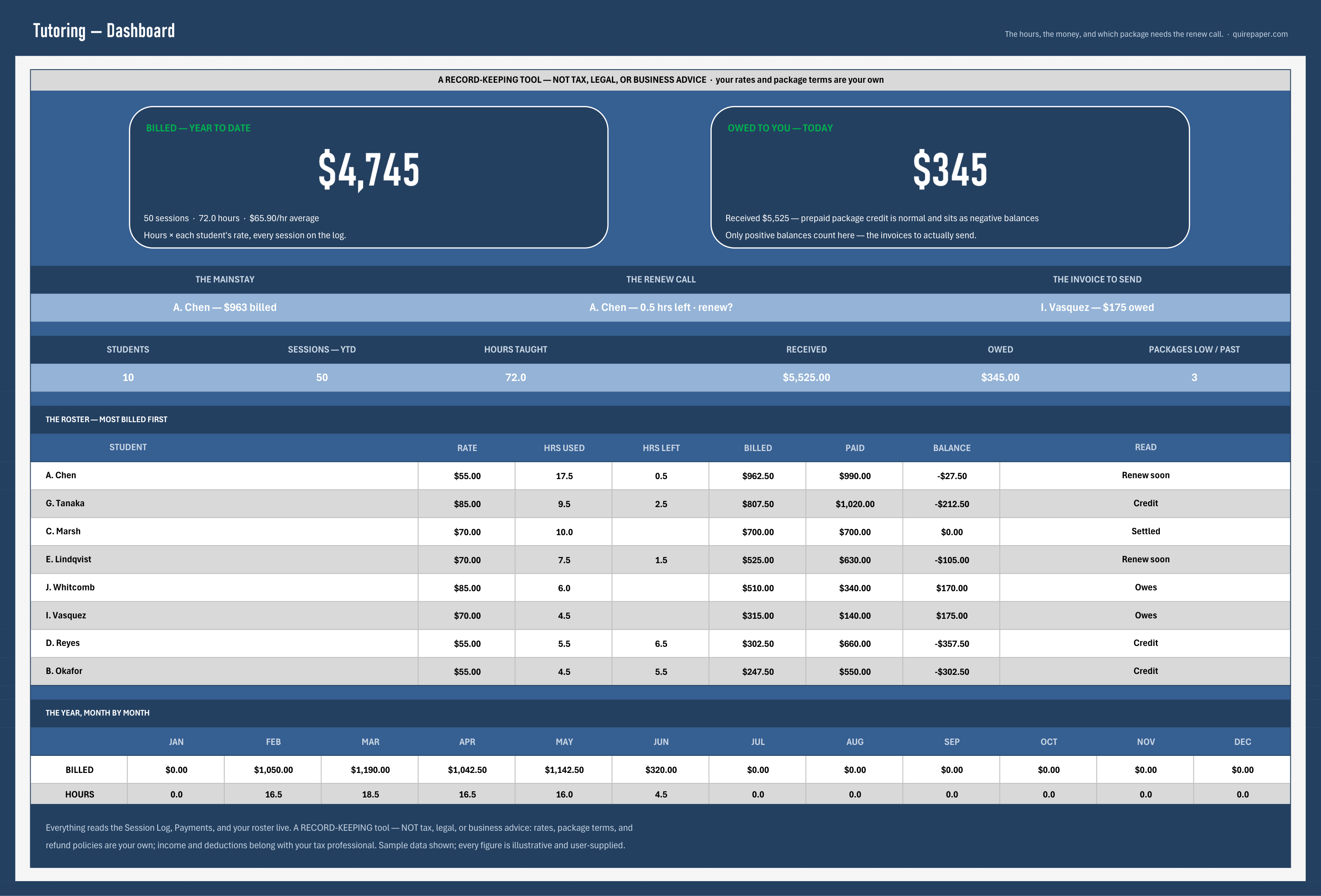
The tutor's practice book. Every session logged once (hours × the student's rate, with per-session overrides when you need them), and everything else fills itself. That includes each family's balance (billed − paid, red when they owe) and the thing bare session logs never track: PREPAID PACKAGES counted down to the hour, amber when it's time for the renew call, red when you've slipped into teaching unpaid hours. The dashboard names the mainstay, the renew call, and the invoice to send. A record-keeping tool, not tax or business advice.

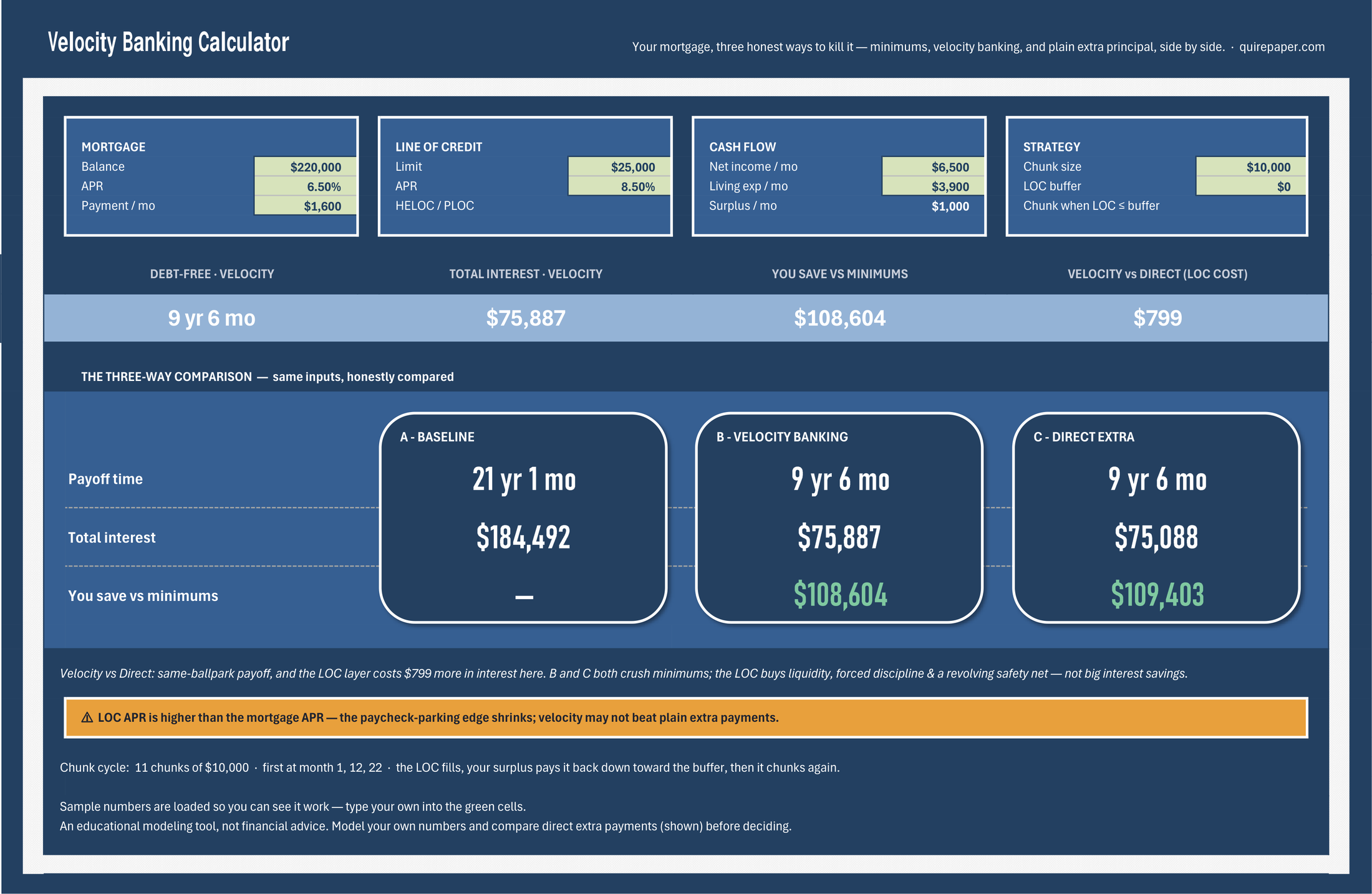
Model the velocity-banking mortgage-payoff strategy with your own numbers: chunk from a line of credit, funnel your cash flow, and watch the payoff. It's compared side by side against minimum payments and plain extra principal.
The route owner's money book. A stop-by-stop route log where NET is worked out after the location's commission: collected × (1 − commission) − product loaded − repairs. A machines register adds per-machine earnings and the number route owners chase, PAID BACK %, which is each machine's net-to-date against what it cost you, green at the 100% goal line. The dashboard names the earner and the laggard ('M-6: $38 net · move it?'). A record-keeping tool, not tax or legal advice.

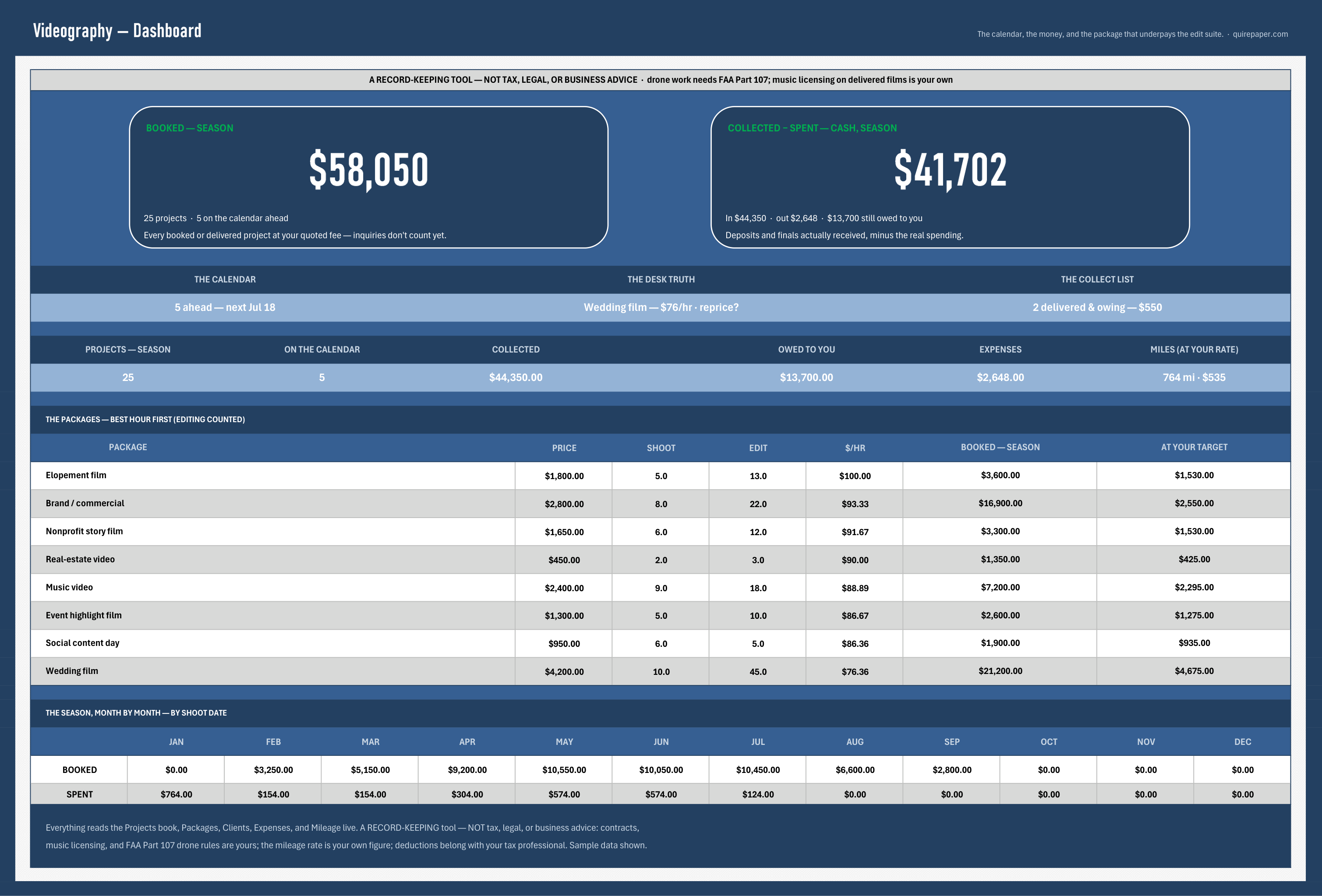
The working videographer's back office in one file. A booking book where every project carries its deposit, balance, and the flag that runs your week (COLLECT in red for delivered films still owed, EDIT & DELIVER in amber for the edit queue). Packages are priced on video's honest denominator, shoot hours PLUS edit-suite hours. In the sample, the wedding film (10 in the field, 45 at the desk) books the most money and pays the worst hour. Clients fill themselves, and expenses and mileage keep April painless. Two video-specific notes, stated plainly: commercial drone work requires FAA Part 107, and music licensing on delivered films is yours. A record-keeping tool, not tax advice.

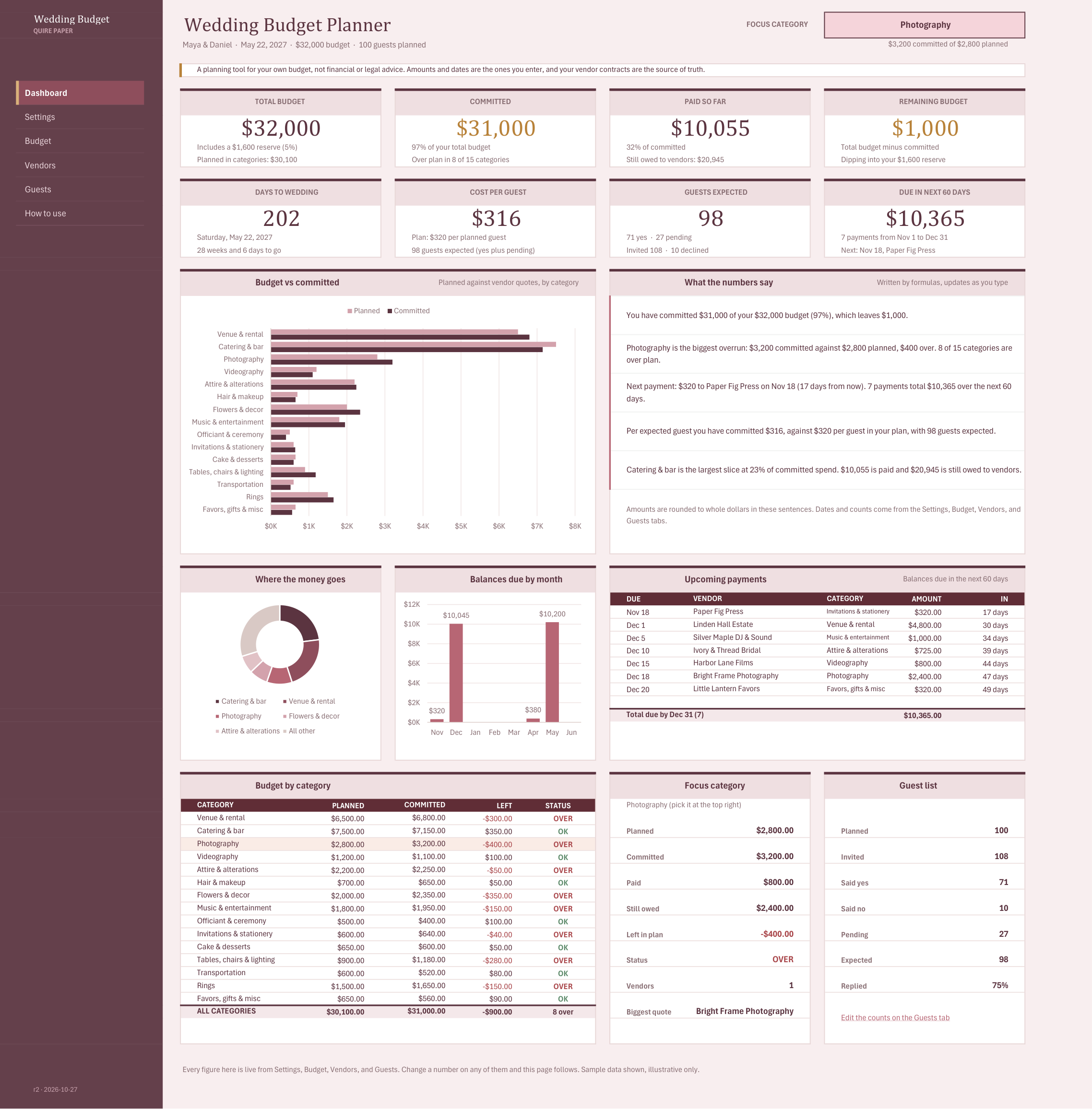
Every category, vendor quote, deposit, and due date in one workbook. The dashboard shows what you have committed, what is paid, what is left, and which payments land in the next 60 days, with a category dropdown and plain sentences the formulas write for you.

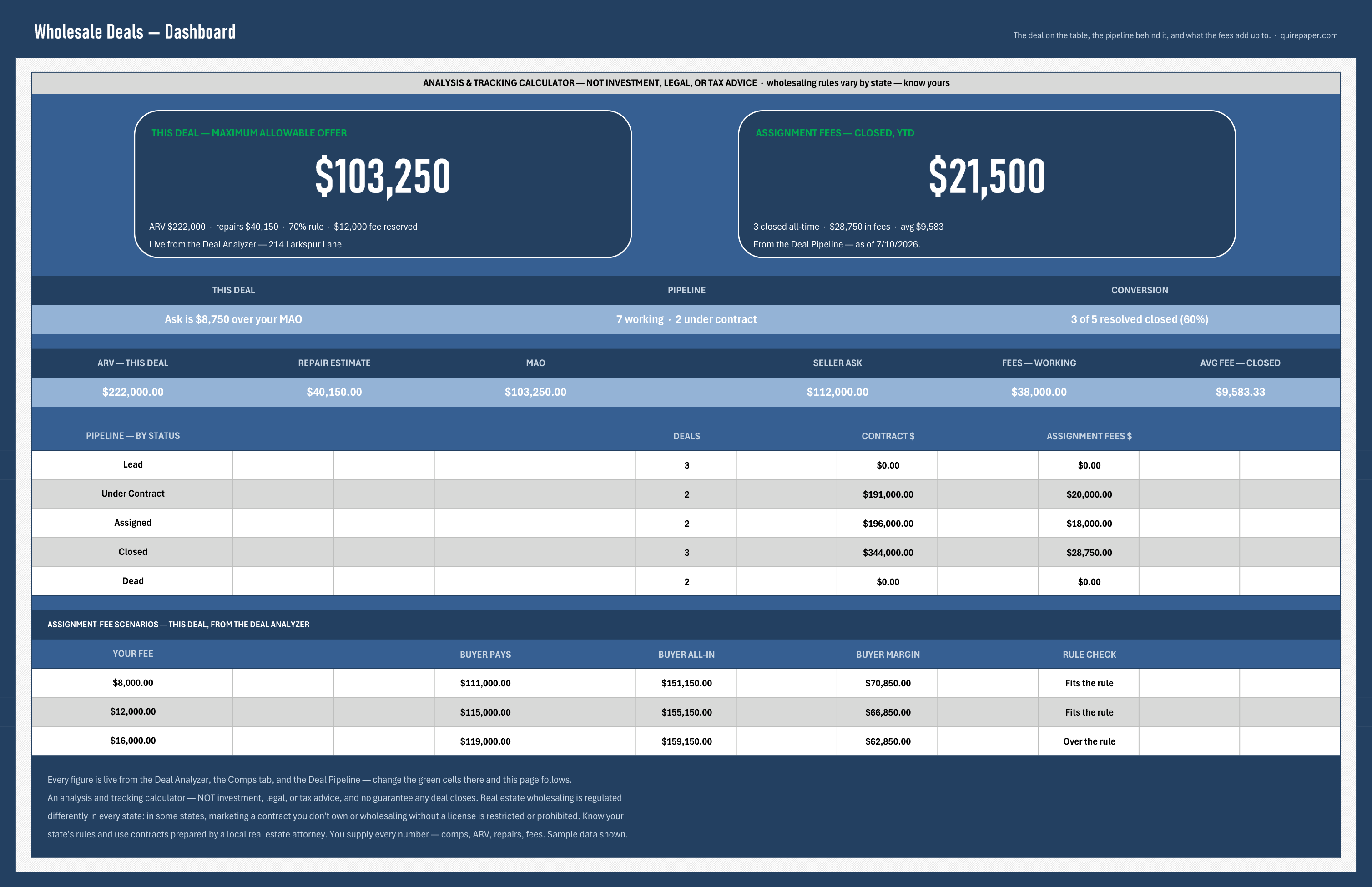
MAO figured properly. Your own comps normalized to $/sqft suggest the ARV, a contractor-style repair quick-estimate feeds the chain, and ARV × your %-rule − repairs − your fee gives the most you can offer. Then the deal side: assignment-fee scenarios at three tiers (what the end buyer pays, their margin, whether the rule still holds), a double-close cost check, and a 24-row pipeline from lead to close. A calculator, not legal or investment advice. Wholesaling rules vary by state.

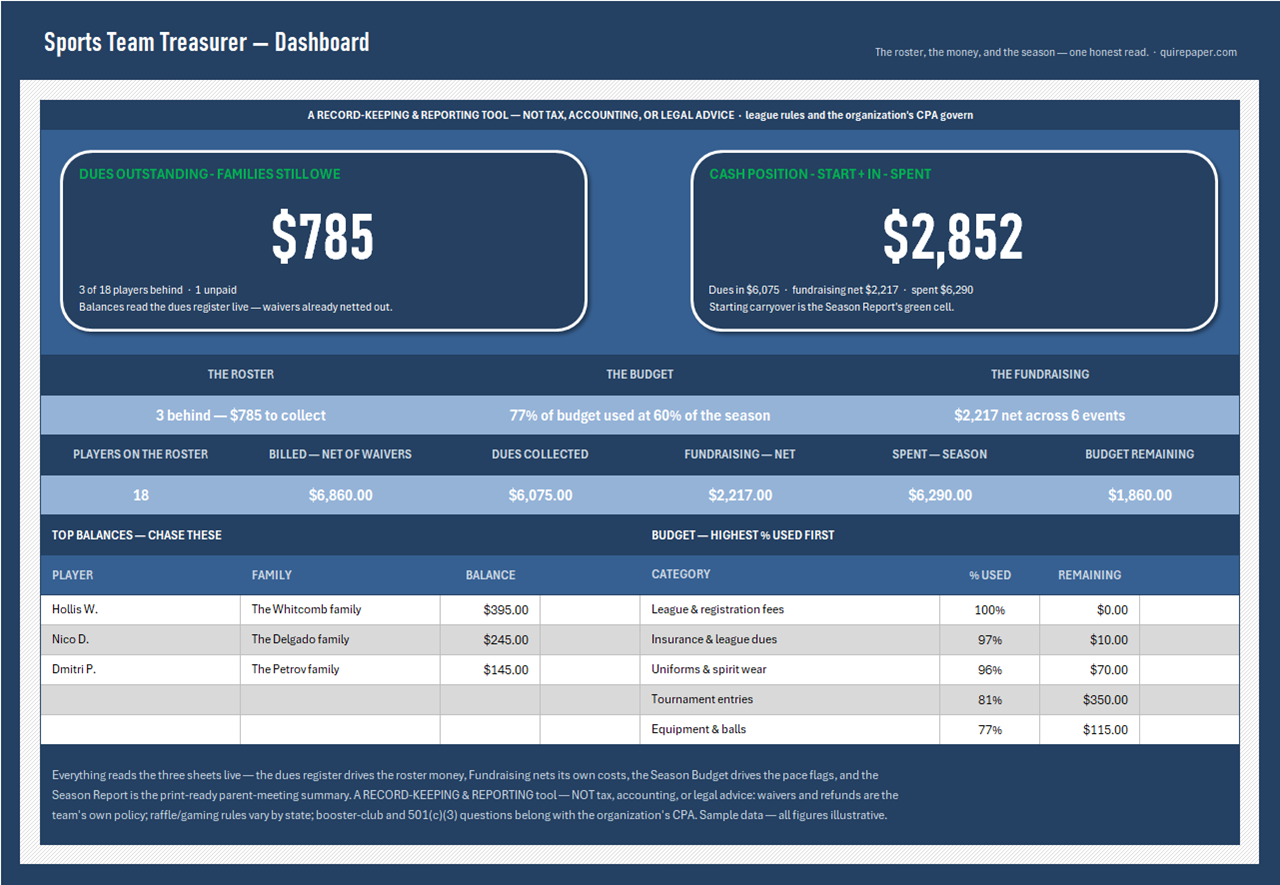
The volunteer team treasurer's workbook. A per-player dues register with a fee stack (registration, uniform, extras), a WAIVER column, three payment slots, and live Paid/Partial/Unpaid statuses. A fundraising tracker nets out event costs (a $812 candy-bar gross that cost $390 is a $422 fundraiser, and the sheet says so). A season budget with pace flags. And a print-ready SEASON REPORT for the parent meeting: money in, money out, cash position, and who still owes. A record-keeping tool, not tax or legal advice.